Key takeaways Attackers copied data on around 27,000 orders from Trezor's shipping partner Skladon on November 7, 2026. The exposed fields are name, phone number, delivery address, email addr
Key takeaways
- Attackers copied data on around 27,000 orders from Trezor's shipping partner Skladon on November 7, 2026.
- The exposed fields are name, phone number, delivery address, email address, plus product and price for all orders placed from August 9 to November 7, 2026.
- Neither Trezor nor Skladon ever held recovery seeds, PINs or passphrases; according to Trezor, customers are already reporting scam calls.
If you ordered a hardware wallet from Trezor between August 9 and November 7, 2026, you should assume that scammers may know your name, your address and what you bought. The manufacturer disclosed the incident on November 16 in its blog. Devices and coins are not affected, the company says. The danger lies elsewhere: in convincing calls, emails and letters that refer to a real order.
Skladon data breach: what happened on November 7
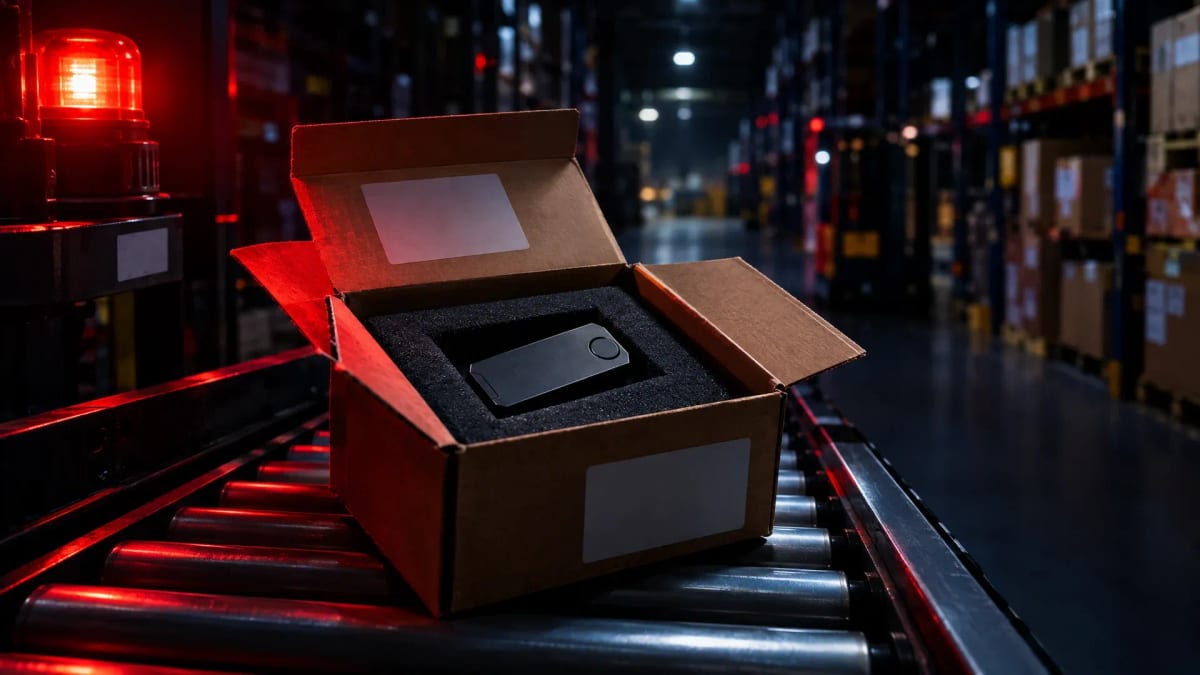
Skladon is one of the logistics partners Trezor uses to ship its orders. On November 15, 2026, the provider reported unauthorised access to systems holding shipping data of Trezor customers. According to Trezor, the intrusion itself took place on November 7. The company assumes the attacker exported the data for around 27,000 orders.
By Trezor's account, the leaked data comprises full name, phone number, delivery address and email address, along with order date, product name and purchase price. Trezor's own systems were not compromised, the manufacturer says. A recovery seed (also called seed phrase or wallet backup) is the sequence of 12 to 24 words from which a wallet and its funds can be fully restored. Neither Trezor nor Skladon ever stores this seed, the PIN or any passphrase, so none of them could have leaked.
"Treat unexpected contact about your order as suspicious. Trezor will never call you or ask for your wallet backup."
Trezor team, blog, November 16, 2026 (source)
The Block and Cointelegraph also reported on the case. According to Trezor, customers have already come forward after receiving calls from people posing as support staff.
Which Trezor customers are affected by the data breach
Trezor draws the line by order date. Anyone who ordered between August 9 and November 7, 2026 and received an email from the manufacturer about the incident is among those affected. Anyone who received the email but ordered only after November 7 is not affected. Orders from August 9 to 14 are a special case: a small share of these customers may also be affected, but Trezor can no longer contact them. Under its 90-day rule, their data had already been anonymised in Trezor's own systems, but apparently not yet at the shipping partner. The manufacturer informs this group only via its blog and a post on X.
The leak is not limited to particular countries. Skladon delivers Trezor orders to many countries, according to the manufacturer, which does not publish a list. If you ordered from the Trezor shop during that period, search your inbox for the notice, including the spam folder. Trezor says it has informed the competent data protection authority.
What makes the case sensitive is the combination of data fields. A delivery address together with the information that someone there bought a hardware wallet reveals not only an identity but also that the household probably holds cryptocurrency. Trezor explicitly asks those affected to pay attention to their physical safety as well and advises contacting the local police first in case of threats.
Third incident at a Trezor partner this year
This is not the first leak at a Trezor service provider. In August it emerged that customer data had leaked at the shipping provider ShipMonk; after an initial 13,689 affected customers, around 67,000 further records of US customers were added later, as our report on the ShipMonk data breach describes. In September, according to Cointelegraph, the email service Brevo, which Trezor uses to send its newsletter, was hit: 347,149 email addresses were exposed. Skladon is thus the third partner in roughly four months.
Trezor acknowledges this in its own statement. The company says it knows this is not the first time and apologises in particular to customers affected again. The manufacturer says it is reviewing its relationships with third-party providers and the security requirements it sets for them. Similar cases at other manufacturers, and the question of how to order a wallet without giving your home address, are covered in our article hardware wallets after a data breach.
How to protect yourself from phishing that uses real order data
What happened: On November 7, 2026, unknown parties accessed systems of Trezor's shipping partner Skladon and, according to the manufacturer, exported name, phone number, address, email address and order details for around 27,000 orders. Trezor disclosed the incident on November 16; as of November 17, the investigation is ongoing.
Are you affected? Yes, if you ordered from Trezor between August 9 and November 7, 2026 and received an email about the incident. For orders placed from August 9 to 14, it is possible even without an email. If you ordered later or meet neither condition, you are not affected as far as Trezor knows. Scammers can quote real order details such as product and price to appear credible.
- No callbacks to unknown numbers: If someone calls you on behalf of Trezor, hang up; Trezor says it never makes unsolicited calls, and you reach support only via trezor.io/support.
- Your recovery seed stays on paper or metal: You enter the words only on your Trezor device, never on the phone, in a form, in an app or after scanning a QR code from a letter or email.
- Ignore letters with a replacement device: If a supposed replacement or security device arrives by post with instructions or an enclosed note, do not use it and report it to Trezor support.
- Two-factor protection via an app: For the inbox registered with Trezor, switch the login to an authenticator app and change the password, because the address is now in other hands.
- Leave fewer traces next time you order: For future purchases, use anonymous pickup at a parcel locker or pickup point if it is offered in your country, and do not tell people around you that you hold crypto.
The basics of safe storage are explained in our guide how to store crypto safely, and the right devices are compared in our hardware wallet comparison.
Anonymous pickup: how Trezor is changing its order process
Alongside the notice, Trezor has launched anonymous pickup. Since November 16, customers in 18 European countries can collect their order at a parcel locker or pickup point, so that, according to the manufacturer, name and home address never reach Trezor in the first place. The notice does not say which 18 countries these are; whether yours is included is shown in the shop's checkout. For the US, Trezor is working on an introduction "as soon as possible".
The manufacturer is also cutting the retention of order data from 90 to 45 days and intends to lower this period further. If you use an exchange instead of a hardware wallet, you will provide your name and address there anyway for identity verification; which providers hold a licence under the European MiCA regulation is shown in our comparison of regulated crypto exchanges.
Trezor data breach: order data will be kept for only 45 days
For Trezor customers, the leak does not change the security of the coins on the device as long as the recovery seed stays secret. Any message about your own order, however, deserves suspicion for months to come. Whether those affected are entitled to compensation depends on the individual case; how this works under the GDPR for data breaches at crypto services is explained in our article crypto data breach: claiming compensation under the GDPR. Trezor says it will update its notice as soon as the investigation yields new findings.
(As of November 17, 2026. This article is not investment advice. Prices and fee structures change; check the terms with the provider before you buy.)