Key Takeaways SpaceX (SPCX) shares climbed 7% Friday following an intense week of successful missions. Three separate launches occurred within a 13-hour window, including an ISS astronaut mis
Key Takeaways
- SpaceX (SPCX) shares climbed 7% Friday following an intense week of successful missions.
- Three separate launches occurred within a 13-hour window, including an ISS astronaut mission, a Google satellite deployment, and a classified government payload.
- The company’s Starship vehicle successfully achieved Earth orbit for the first time, releasing 26 Starlink V3 satellites.
- Starlink operations generated $4.3 billion in quarterly revenue with $1.7 billion in operating profit.
- The AI computing division recorded a $1.3 billion loss, though new contracts could generate up to $3.4 billion monthly.
Shares of SpaceX (SPCX) gained 7% Friday as investors responded to an extraordinary week of operational achievements. The rally followed three successful missions completed within a single 13-hour period.
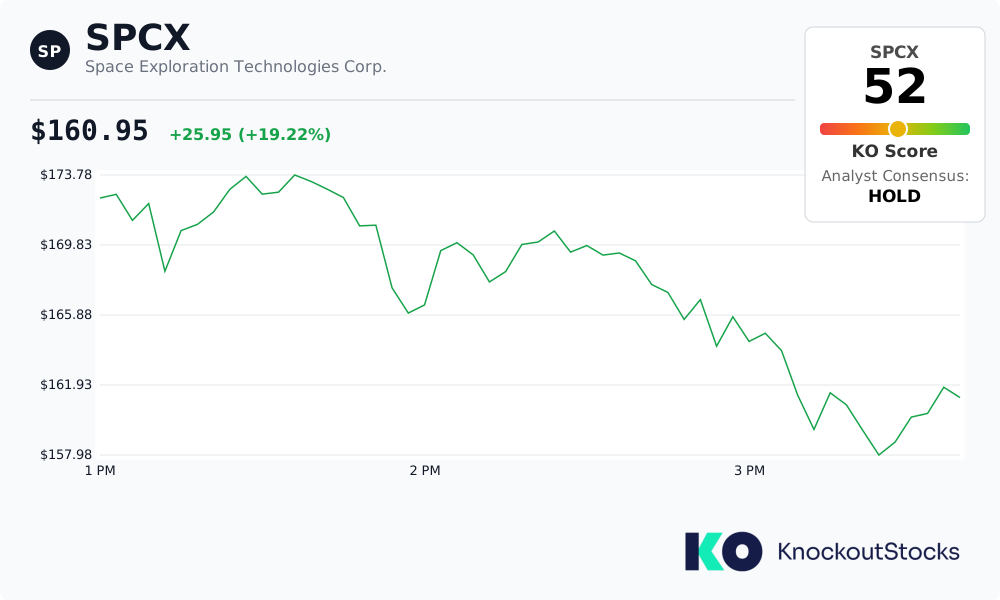 Space Exploration Technologies Corp., SPCX
The rapid-fire sequence began Thursday evening when a Falcon 9 lifted off from Cape Canaveral carrying NASA’s Crew-13 mission. Four astronauts headed toward the International Space Station in a Dragon capsule.
The capsule docked with the orbiting laboratory in fewer than eight hours, setting a speed record for American crew vehicles traveling to the ISS.
According to Julianna Scheiman, a director at SpaceX, favorable orbital mechanics allowed the accelerated rendezvous. The station’s position enabled an unusually direct flight path.
The astronauts are scheduled for a six-month stay aboard the station. Meanwhile, the first-stage booster executed a successful landing and is slated for reuse.
Record-Breaking Day of Operations
Launch number two featured Transporter-18, a rideshare flight carrying 130 separate commercial payloads. Among them was Google’s experimental Project Suncatcher, designed to evaluate AI processing capabilities in the space environment.
Google’s experiment will assess how its Tensor Processing Unit chips perform under space conditions, including exposure to cosmic radiation and dramatic thermal fluctuations.
The mission utilized a booster on its 25th flight, demonstrating SpaceX’s ongoing commitment to maximizing rocket reusability.
The final launch in the sequence deployed a Falcon Heavy rocket carrying a secret payload for the National Reconnaissance Office. This represented the first time the heavy-lift vehicle has flown for that intelligence agency.
Both side-mounted boosters returned to Florida landing zones. Combined with the earlier missions, SpaceX successfully recovered four separate boosters during the launch spree.
Earlier that week, the company achieved another milestone when Starship completed its first full orbit of Earth. The massive vehicle successfully deployed all 26 Starlink V3 satellites despite losing one engine during the climb to space.
Starship represents a cornerstone of SpaceX’s strategy to dramatically expand Starlink satellite constellation capacity. A fully operational Starship system is expected to significantly reduce orbital delivery costs.
Jon Edwards, a SpaceX executive, characterized the week as exceptional on social media platform X. He highlighted the diversity of hardware flown: Starship, Dragon crew capsule, Falcon 9, and Falcon Heavy.
The Connectivity division, dominated by Starlink operations, continues as SpaceX’s financial powerhouse. Last quarter, the segment delivered $4.3 billion in revenue alongside $1.7 billion in operating profit.
The Space division, handling launch services, showed contrasting results with a $542 million operating loss against $962 million in revenue.
This apparent deficit stems largely from internal accounting practices. When SpaceX launches its proprietary Starlink satellites, the Space division doesn’t book revenue for those flights.
The Connectivity division instead carries these launch expenses, distributing them over time through depreciation schedules. This accounting method inflates Starlink’s apparent profitability while making the launch business appear less viable than operational reality suggests.
SpaceX’s AI computing division represents the company’s newest venture. The unit reported a $1.3 billion quarterly loss on $2.6 billion in revenue.
However, the outlook is shifting rapidly. Recent agreements with Anthropic, Alphabet, and additional clients to lease computational capacity could generate monthly revenue approaching $3.4 billion once contracts reach full deployment.
Scaling this business requires substantial investment. The AI division’s capital expenditures alone totaled $15.8 billion during the most recent quarter.
The post Triple Rocket Launch Spree Drives SpaceX (SPCX) Stock Up 7% on Friday appeared first on Blockonomi.