Trump Capital Gains Tax Cut: What It Could Mean for Investors President Trump is weighing a capital gains tax cut and a larger exemption for home sales as he looks for policy pledges to offer
Trump Capital Gains Tax Cut: What It Could Mean for Investors
President Trump is weighing a capital gains tax cut and a larger exemption for home sales as he looks for policy pledges to offer voters ahead of the November midterms, according to the The Kobeissi Letter, citing a top economic aide and a former administration official. If enacted, it would mark the first major cut to US capital gains tax rates since 2003.
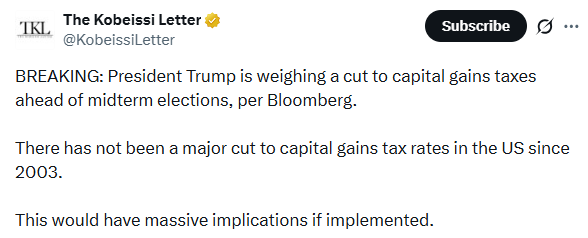
What Trump Is Actually Considering
National Economic Council Director Kevin Hassett confirmed the discussions in an August 11 Fox Business interview with host Larry Kudlow, who led the same council during Trump's first term. Two specific ideas are on the table:
Indexing capital gains to inflation — taxing only the "real" gain on an investment, after adjusting the original purchase price for inflation, rather than the full nominal gain
A larger home-sale exemption — potentially excluding home sales worth $2 million or less from capital gains taxes entirely, up from the current $500,000 exemption for married couples filing jointly
Kudlow said he discussed both ideas directly with Trump: "I spoke to him, he liked the idea of the indexing, he liked the idea of a bigger exemption." Hassett framed the broader push as part of a pre-midterm policy rollout, saying, "You can expect a lot more policy between now and the midterms."
How "Indexing" Capital Gains Would Work
The mechanic behind capital gains indexing is straightforward once broken down with numbers. Under the current system, an investor pays tax on the full nominal gain between purchase and sale price, regardless of inflation. Under an indexed system:
Scenario
Purchase Price
Sale Price (5 yrs later)
Nominal Gain
Inflation-Adjusted Cost Basis
Taxable Gain
Current system
$100,000
$200,000
$100,000
Not adjusted
$100,000
Indexed system (20% cumulative inflation)
$100,000
$200,000
$100,000
$120,000
$80,000
In this example, indexing would cut the taxable gain by 20%, and the tax bill along with it. The longer an asset is held during a high-inflation period, the bigger the effective tax cut becomes.
Why This Would Be a Big Deal — and Why It Might Not Happen
There hasn't been a major cut to US capital gains tax rates since 2003, which is part of why this proposal is drawing significant attention. But several factors make near-term passage unlikely:
Most tax changes require Congress. A standalone indexing bill would need legislative approval, and Republican Senators Ted Cruz and Tim Scott have already floated a version of this proposal that's estimated to reduce federal revenue by roughly $200 billion.
A unilateral option carries legal risk. Past administrations, including Trump's first, examined indexing capital gains via Treasury regulation without Congress. Legal experts say that route would likely face court challenges.
The deficit backdrop complicates the politics. The Congressional Budget Office estimated the fiscal deficit at $1.8 trillion for the first ten months of 2026, giving deficit-conscious lawmakers reason for caution even within the GOP.
The benefits skew toward wealthier households. Critics note that both proposals would disproportionately help higher-income taxpayers, a point Republicans are aware could be used against them politically even as they campaign on the idea.
White House spokesman Kush Desai declined to confirm specifics, saying only that Trump is "always exploring new ideas to Make America Wealthy Again," while noting formal policy announcements would come from the administration directly.
Meanwhile, Government Hiring Is Surging
Separately, newly released Bureau of Labor Statistics JOLTS data for June shows a notable divergence: total US job openings actually declined for the month, but government hiring is moving sharply in the opposite direction.
Government job openings rose by 10,000 in June to 823,000, the highest level since June 2025
This marks the fourth consecutive monthly increase, adding 98,000 government openings over that span
Since November 2025, total government vacancies have surged by 165,000
Federal government openings specifically rose by 39,000 to 139,000 — the highest since October 2024, and the largest single-month increase since May 2024
This runs counter to the broader June JOLTS picture, where losses in health care, leisure and hospitality, and professional services pulled total US job openings lower. Government hiring, particularly at the federal level, stood out as one of the few sectors moving decisively upward.
Conclusion
Two distinct economic signals are converging ahead of the midterms: a possible capital gains tax cut aimed squarely at courting voters, and a government hiring surge that's outpacing much of the private sector. Neither is a done deal — the tax proposal faces a steep legislative and legal path, and hiring data can shift month to month — but both are likely to feature prominently in the economic debate heading into November.
Disclaimer
This article is for informational purposes only and does not constitute financial, investment, or tax advice. Figures are drawn from original reporting from The Kobeissi Letter, Bureau of Labor Statistics JOLTS data, and public statements from named officials, current as of August 12, 2026. Policy proposals described here are under consideration and have not been enacted. Always consult official government sources or a qualified professional for guidance specific to your situation.