Markets will ultimately not get the hoped-for respite. As the temporary tariffs imposed 150 days ago expired, Donald Trump chose to revive the trade war by announcing, this Friday, a new wave
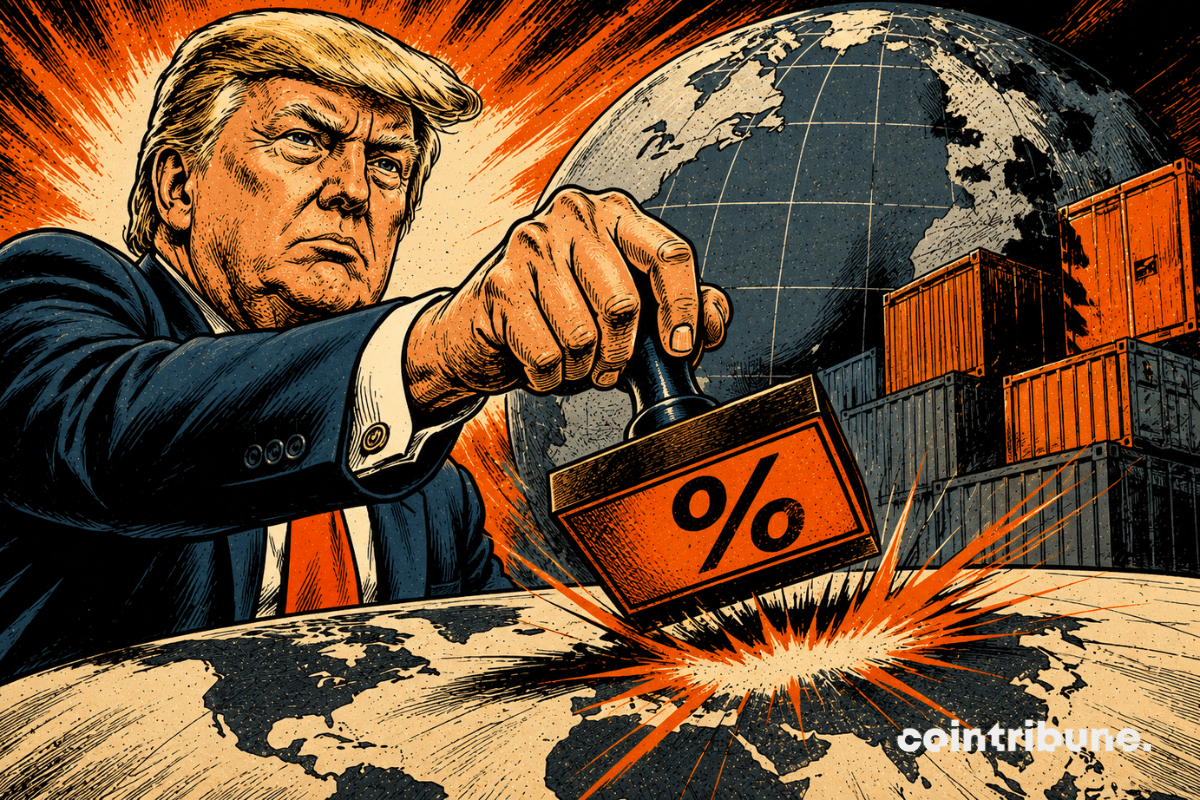
Markets will ultimately not get the hoped-for respite. As the temporary tariffs imposed 150 days ago expired, Donald Trump chose to revive the trade war by announcing, this Friday, a new wave of taxes targeting about sixty economies. Presented as a response to forced labor in certain supply chains, this offensive goes far beyond the realm of trade. It reignites tensions between the United States, China and the European Union, while fueling a new phase of volatility in financial markets and alternative assets.
In brief
- Donald Trump imposes from this Friday surcharges of 10% to 12.5% targeting about sixty economies upon the expiration of the temporary measures of February.
- The U.S. administration relies on an investigation aimed at eliminating products made with forced labor from global supply chains.
- Beijing denounces a unilateral measure harmful to global trade, supported by strong criticism from Australia, New Zealand and Japan.
- Brussels welcomes the maintenance of surcharges below 15%, in accordance with the Turnberry agreement signed last year.
A targeted tariff offensive under the guise of social standards
This new system immediately took over this Friday from the temporary 10% taxes introduced last February for 150 days, which expired at the same time. A grace period was provided for products en route, which will escape this taxation if they arrive at their destination before July 28. Thus, we observe a differentiation of rates :
- The 10% surcharge : it applies to partners with legislation deemed incomplete by Washington, notably the European Union, the United Kingdom, Mexico, or Canada ;
- A 12.5% surcharge : it affects about forty other nations, including China, Japan, Switzerland, or South Korea ;
- Only energy and raw materials not produced on American soil escape this new tax regime.
The U.S. administration relies on an investigation conducted since mid-March by the White House trade representative (USTR), Jamieson Greer, concerning the elimination of products made from forced labor. On CNN, Jamieson Greer firmly justified the administrative approach: “we seek to end the trade of such products. If you allow the import of goods made with forced labor, it creates unfair competition against your own products. We want all countries to have the same kind of protections.” This approach fits into a logic of continuous pressure on U.S. trading partners.
Greta Peisch, an international trade lawyer, points out that the goal is “to keep control and maintain pressure so that countries continue to implement the trade agreements that have been signed, and perhaps negotiate others in the future. There is this common thread, even if tariffs vary widely and change in justification in the meantime.”
Start your crypto adventure safely with OKXThis link uses an affiliate program.Between Chinese retaliation and European relief
Global diplomatic reactions immediately illustrated the rift caused by this announcement. In Asia, Australia called these new barriers “unjustified”, Wellington judged them “extremely disappointing”, and Tokyo indicated regret. China, an influential member of the BRICS bloc, hit by the 12.5% tariff, expressed strong opposition during a press conference held by Lin Jian, spokesperson for the Chinese Ministry of Foreign Affairs: “we oppose any form of unilateral tariff measures. A tariff war or trade war serves the interests of no party.” This intense tension comes despite the truce concluded last October between Washington and Beijing, amid persistent disputes over U.S. restrictions on technology exports.
Conversely, the European Union welcomed the news with apparent relief. Olof Gill, spokesperson for the European Commission, declared that “the EU welcomes that this result complies with the US commitments on tariffs,” the 10% rate applied respecting the 15% ceiling negotiated a year earlier at Turnberry, Scotland, and dispelling fears of escalation linked to the recent fine imposed on the giant Google.
Bilateral escalation and the overall macroeconomic impact
Alongside this global offensive, the White House pursues a strategy of sanctions targeting specific partners while preparing new legal measures. Brazil has thus been concerned since Wednesday by 25% tariffs applying to nearly half of its exports to the world’s largest economy, while Canada faces an additional 50% surcharge set to take effect in a month.
The U.S. government now favors selective targeting of goods rather than blind taxation of all imports. Furthermore, the office of the trade representative is conducting other investigations based on the same legal basis reviewed by the Supreme Court, notably regarding potential foreign industrial overcapacity, a procedure that again threatens the European Union.
On the macroeconomic and financial level, the establishment of these permanent customs barriers weakens traditional supply chains and revives the risk of a global inflationary surge. By restricting the fluidity of global exchanges and reinforcing protectionism, this policy forces economic actors to reassess their capital allocations. Faced with the fragility of sovereign currencies subjected to state arbitrations and the arbitrariness of tariff policies, financial markets could accelerate their migration towards DeFi assets insensitive to customs borders, strengthening the relevance of digital alternatives within international portfolios.