
Policy4 min read
ONS: UK GDP Grows 0.4% in Q2 2026
UK real gross domestic product increased by 0.4% in Quarter 2 (Apr to June) 2026, according to the ONS first quarterly estimate published on 13 August 2026. That follows 0.6% in Quarter 1 (Ja
Donald Trump opens the door to a new form of response against foreign criminal networks. In a memo signed on August 12, 2026, the American president authorizes certain licensed private compan
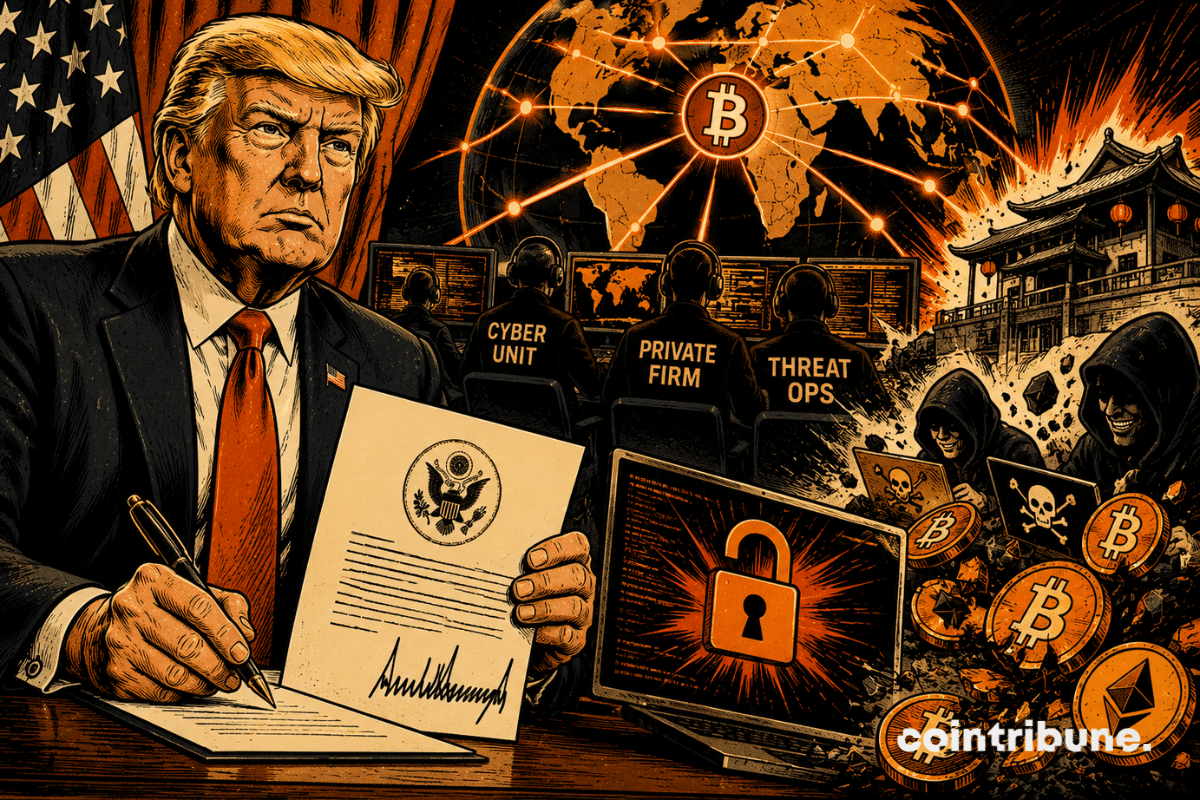
Donald Trump opens the door to a new form of response against foreign criminal networks. In a memo signed on August 12, 2026, the American president authorizes certain licensed private companies to participate in cyber operations under federal supervision. Crypto scam networks are among the targets, but the precise rules of these interventions are still to be written.
American authorities already have several tools to pursue crypto scam networks. They can seize domains, block assets, or trace laundering circuits. The freezing of over 700 million dollars linked to a Chinese network is a recent illustration.
Your 1st cryptos with BitpandaThis link uses an affiliate program.The memo signed by Donald Trump goes further. It now allows selected American companies chosen by the State to take part in certain operations conducted directly against the infrastructures used by these criminal networks. So it is no longer just about following the money or seizing funds afterward.
In its August 12 text, the White House entrusts the National Coordination Center (NCC) with implementing the program aimed at “Participating Companies.”
To enter, a company must sign a contract with the Department of Justice or the Department of Homeland Security, go through a vetting process, and obtain written authorization before each mission. Two executive directors will oversee the system, one designated by Justice and the other by Homeland Security.
Participating companies are American private firms admitted to the program and authorized to carry out cyber operations under the direction of the United States government.
At first reading, the term “hack” thus simplifies the scope of the text. Cyber-surveillance aims at clandestine information gathering and may involve unauthorized access to a system.
Cyber effects operations can manipulate, disrupt, degrade or destroy systems or the data they contain. Operations likely to cause death or serious injury, or involving the use of force under international law, are beyond the delegated approval authority of the program directors.
Why does Washington want to expand its arsenal? FBI figures provide part of the answer.
In 2025, the Internet Crime Complaint Center (IC3) recorded 181,565 complaints involving cryptocurrencies. That is 21% more than the previous year. Declared losses reached 11.366 billion dollars, a 22% annual increase.
These data obviously do not represent all victims. They only correspond to cases reported to the FBI. Actual damage may therefore be greater.
The crypto scam report in the United States already showed the extent of the phenomenon. However, the FBI’s 2025 IC3 report gives an important clarification: not all crypto-related complaints necessarily involve investment fraud.
This category alone represents 61,559 complaints and 7.228 billion dollars in losses. Over one year, reports increased by 48%, while losses grew by 25%.
Behind these figures are sometimes organizations much more structured than a simple fake investment site.
This distinction changes the reading of the memo. The targeted networks are not just sites that collect deposits: “pig butchering” schemes, which gain a victim’s trust before pushing them to a fictitious platform, combine social engineering, cross-border laundering, and in some cases, exploit workers in clandestine complexes.
Intervention in the infrastructures could accelerate the identification or disruption of networks, but nothing in the memo yet proves it will reduce losses or automatically return stolen funds.
The memo does not yet specify the mode of operation. Within 60 days, Justice, Homeland Security, and the Homeland Security Council must establish targeting, coordination, and cessation rules for an operation mistakenly affecting a person or an American system. A report is planned within 180 days, with an annual evaluation.
The FBI file on the Tai Chang network helps to understand what is changing. In this case, the Strike Force claims to have blocked over 700 million dollars in cryptos linked to laundering proceeds from fraud. Until now, this type of action mostly relied on investigation, domain seizures, and asset confiscation.
With the new program, Washington wants to be able to intervene earlier, notably through covert surveillance and technical disruption of infrastructures.
The government may require participating companies to post a bond or escrow deposit of at least 1 million dollars to cover certain cases of non-compliance. However, the public version of the memo does not yet clearly detail the role an independent authority would have in case of error or collateral damage.
The problem is therefore not that private companies can act without any rules. They will remain under the authority of the government.
The real question is rather responsibility: who will be accountable for an operation that exceeds its target or causes harm to a third party?
The procedures expected in the next 60 days should provide a first answer. They will especially reveal how far Washington intends to delegate its cyber capabilities to the private sector.
For crypto users, however, the result will be measured elsewhere. Faced with impersonation scams that continue to target crypto communities, the program’s effectiveness will depend less on the number of infiltrated networks than on its ability to prevent new victims and, when possible, recover stolen funds.