Trump posted Monday on Truth Social a call to the Senate to vote for the CLARITY Act “in tribute” to Lindsey Graham, a senator who died Saturday at the age of 71. A call that comes as the wea
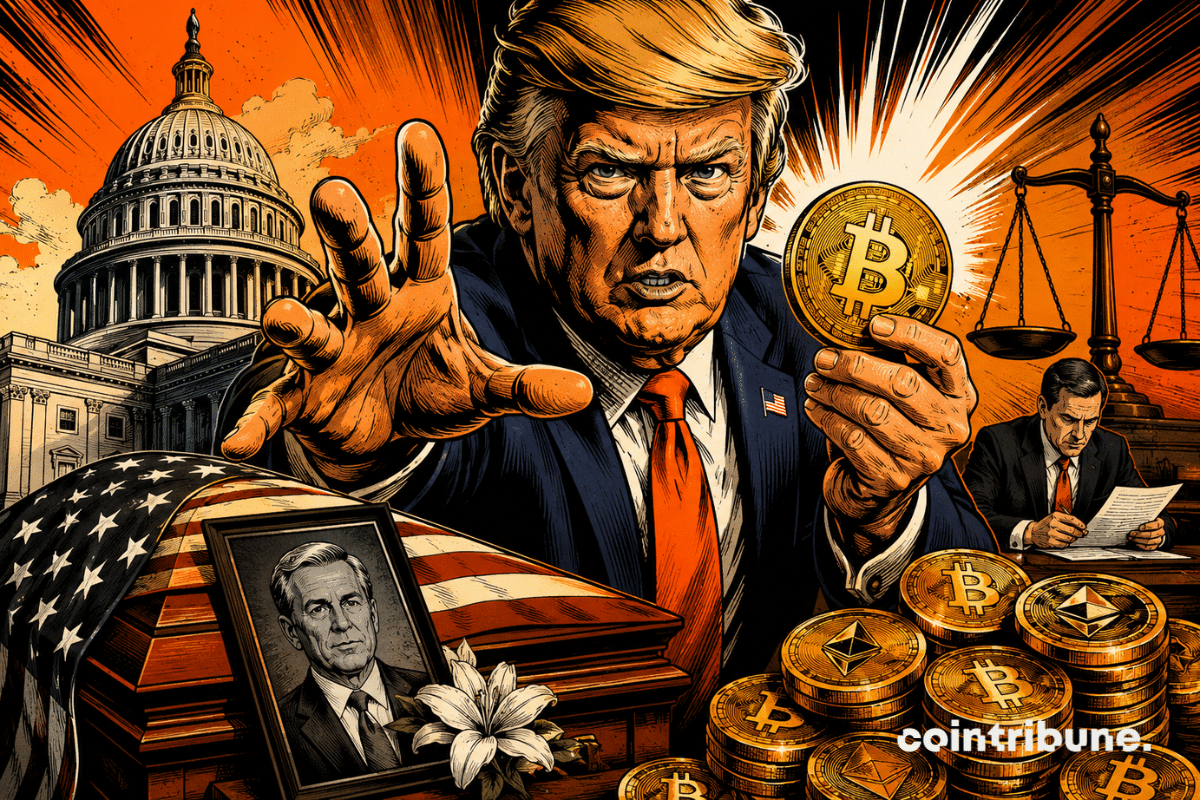
Trump posted Monday on Truth Social a call to the Senate to vote for the CLARITY Act “in tribute” to Lindsey Graham, a senator who died Saturday at the age of 71. A call that comes as the weakened Republican majority no longer has the 60 votes needed to pass the crypto reform. Will this strategy be enough to rally the Democrats?
In brief
- Donald Trump called on the Senate to vote for the Digital Asset Market Clarity Act on Monday, July 13, the day after Senator Lindsey Graham’s death at 71.
- The Republican majority falls to 51 seats against 47 after Graham’s death and Mitch McConnell’s hospitalization, requiring the support of at least nine Democrats to reach the 60 votes needed.
- Five Democratic senators have demanded an audit of Trump’s 2025 asset declaration, in which he declares $1.4 billion in crypto-related income.
Contested tribute, Graham, true supporter of the CLARITY Act?
The death of Lindsey Graham, combined with Mitch McConnell’s hospitalization, weakens the Republican majority in the Senate, now reduced to 51 seats against 47. Under these conditions, Republicans will have to convince at least nine Democratic senators to reach the 60 votes threshold required to pass the CLARITY Act.
€20 bonus for registering on BitvavoThis link uses an affiliate program.It is in this context that Donald Trump called on senators to vote for the text “in tribute” to Lindsey Graham, whom he describes on Truth Social as “a fervent supporter” of the CLARITY Act.
However, the available facts do not support this claim. Elected from South Carolina since 2003, Graham did not sit on either the banking committee or the agriculture committee during this legislature, the two committees responsible for reviewing the bill. He also did not participate in any votes on the CLARITY Act and never publicly expressed his support for this text.
His only official commitment to cryptocurrency-related legislation dates back to 2025 when he voted in favor of the GENIUS Act dedicated to stablecoins. However, no public statement establishes that he also supported the CLARITY Act.
Nevertheless, Republican Senator Cynthia Lummis supported Donald Trump’s remarks on X, stating that Lindsey Graham was “passionate about ensuring that American leadership remains at the forefront in all areas, including digital assets“. Lummis’s office had not responded to Cointelegraph’s requests for clarification at the time of writing.
Before August 7, eight legislative days to act
The Senate has eight legislative days before the summer recess on August 7. The merged version of the CLARITY Act is expected to be released as early as the week of July 13, before a targeted vote on July 20.
Republican leaders, Tim Scott on the banking committee and John Thune leading the majority, are coordinating their efforts to meet this schedule.
We can no longer afford to delay things.
Patrick Witt, White House crypto advisor
More than 200 crypto sector companies, including Coinbase and Ripple, had already called in early July for a swift vote before the summer break. According to Galaxy Research, the chances of a federal crypto regulatory framework by the end of 2026 have fallen to 50-50. The White House, for its part, has neither validated the merged version nor participated in the last negotiations.
Conflicts of interest, Democrats set their conditions
Democrats condition their support on an ethical provision: banning senior government officials, including the president, from having business ties with the crypto sector. Two senators who are nevertheless in favor of the text in the banking committee threaten to withdraw their support as long as this aspect remains unclear.
Trump declared about $1.4 billion in crypto-related income in his 2025 asset declaration. Last week, five Democratic senators called for an audit of this document, stating that these figures “heighten concerns” about the pressures exerted on Congress to adopt legislation that precisely benefits the sector from which he profits.
The planned transfer of digital asset oversight powers from the SEC to the CFTC remains at the heart of the text. But internal tensions within the Republican camp also complicate its passage in the House of Representatives, a necessary step after a possible Senate vote.
For the crypto industry, the window from July 13 to August 7 represents the last real chance to obtain digital asset regulation in the United States before the midterm elections. The Republican majority now holds only 51 seats, making any vote impossible without the Democrats. The latter await ethical guarantees that the White House is slow to offer. July will be decisive.