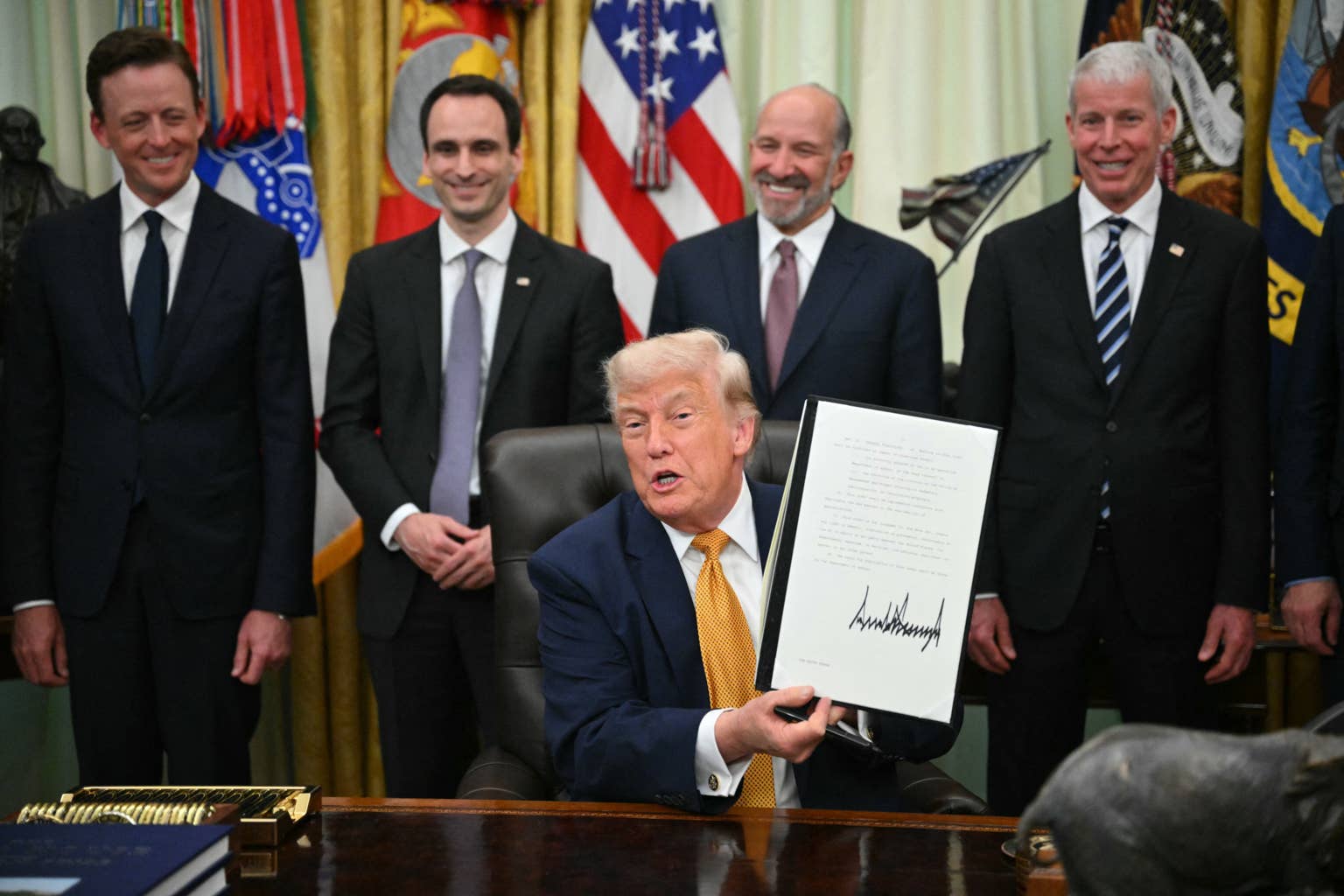
President Donald Trump signed two executive orders on June 22 aimed at cementing the United States' leadership in quantum computing. The orders advance Washington's preparations for "Q-Day,"
President Donald Trump signed two executive orders on June 22 aimed at cementing the United States' leadership in quantum computing.
The orders advance Washington's preparations for "Q-Day," the hypothetical point at which quantum computers could crack the encryption that protects everything from government networks to cryptocurrency wallets.
This comes as the federal government shifts its focus to post-quantum cryptography.
"Quantum technologies represents the next generation of innovation across computing, sensing, and networking with enormous significance for our country's economic growth, scientific research and cyber security. It's really a big deal that we're doing today and the country's doing really well," Trump said during the signing event on Monday at the White House.
Related: Quantum threat forces 63-year old investment bank to abandon Bitcoin
What the executive orders do
The first order, Executive Order 14411, establishes the Quantum Computer for Application Development and Discovery Science (QC-ADDS) Effort, a national push to deliver at least one advanced quantum computer to a Department of Energy facility and, where possible, make it available to the scientific community.
The Department of Energy must identify the technical specifications within 90 days and explore private-sector partnership models, while the Secretary of Commerce develops a plan, potentially including advance market commitments, to draw contributions from commercial quantum computing firms.
The same order directs Commerce, the National Science Foundation (NSF), the Department of Energy and NASA to each draft five-year plans for advancing quantum sensing and networking, and tasks the Secretary of War with identifying at least three next-generation quantum sensor projects to field by Sep. 30, 2028.
It also moves to strengthen domestic quantum supply chains, expand the quantum workforce, and protect the sector from adversaries, including an expanded FBI counterintelligence team focused on quantum research.
U.S. President Donald Trump signs an executive order in the Oval Office of the White House in Washington, DC, on June 22, 2026.
AFP via Getty Images
Most relevant to crypto, the order directs intelligence officials to assess the national security implications of increasingly powerful commercial quantum computers, explicitly including the migration to post-quantum cryptography.
The second order targets cybersecurity directly. It directs the Office of Management and Budget (OMB) and the National Cyber Director to lead an accelerated, nationwide PQC migration, with Commerce, the National Security Agency (NSA) and the Department of Homeland Security (DHS) delivering practical guidance to agencies.
Agencies must designate a PQC migration lead and transition high-value assets by 2030 and 2031, depending on the use case, while the Department of Commerce runs a pilot project to be completed by December 31, 2027.
The order reaches beyond federal systems, directing the State Department to help critical infrastructure operators and foreign partners make the same shift, and tasking the Federal Acquisition Regulatory Council with requiring covered contractors to meet certain cybersecurity standards by the end of 2030.
The White House framed the effort as protecting power grids, water systems and transportation networks as quantum technology matures.
Trending on TheStreet Roundtable:
Why crypto is racing to prepare
Quantum computers process information fundamentally differently from traditional computers. Where a standard computer works with binary data, ones and zeros, a quantum computer uses quantum bits, or qubits, which can exist in multiple states simultaneously.
This allows quantum machines to solve certain complex problems exponentially faster than anything currently available.
It also poses a significant threat to existing encryption standards, which is why the transition to quantum-resistant cryptography has become a priority for governments worldwide.
The timing lands as the crypto industry accelerates its own defenses. Bitcoin and most major cryptocurrencies rely on elliptic curve cryptography to secure wallets and transactions, the same class of encryption that quantum computers could eventually break.
The crypto industry has been watching quantum developments closely, with researchers already working on quantum-resistant blockchain protocols. Google set a 2029 deadline to adopt post-quantum cryptography, while developers proposed BIP-360 and BIP-361 to introduce quantum-resistant Bitcoin (BTC) addresses and eventually freeze coins left in vulnerable legacy addresses.
In June, just a few days ago, Coinbase's quantum advisory council warned that roughly 7 million BTC could eventually be exposed.
Related: Quantum-resistant token crashes brutally amid counterfeit concerns