Key Insights New Trump tariffs could target China and 15 other economies. Japan, South Korea and the EU could face duties below 16%. Jamieson Greer could release industrial subsidy investigat
Key Insights
- New Trump tariffs could target China and 15 other economies.
- Japan, South Korea and the EU could face duties below 16%.
- Jamieson Greer could release industrial subsidy investigation findings this week.
New Trump tariffs could target China, the European Union (EU) and 14 other economies. The Wall Street Journal reported on Nov. 24 that Washington was preparing higher duties over foreign industrial subsidies.
U.S. stock futures fell further after the report, according to MarketWatch. Renewed trade restrictions matter to crypto investors because import costs can influence inflation and Federal Reserve policy. Research from the International Monetary Fund (IMF) linked tighter monetary conditions to weaker cryptocurrency prices.
Trump Tariffs Could Reach 15% for Some Trading Partners
The Wall Street Journal reported that U.S. Trade Representative Jamieson Greer could release investigation findings this week. However, the administration had not settled the final rates, and the announcement’s timing remained uncertain.
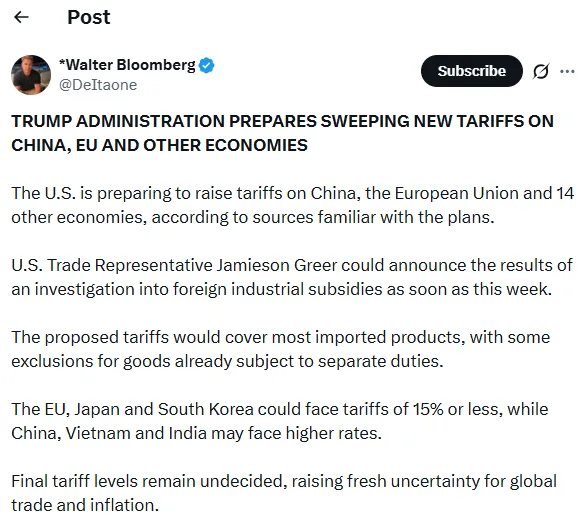
U.S. Prepares New Tariff Hikes A Credit: Walter Bloomberg/X
Anadolu Agency, citing the Journal, outlined differing rates across major trading partners. Japan, South Korea and the EU could face levies of 15% or less. Proposed China tariffs could exceed EU tariffs, while Vietnam and India also faced higher rates.
MarketWatch reported that S&P 500 futures traded at 7,186.50 before Tuesday’s tariff report. The contract fell to 7,172.50 within two minutes. That move provided an early indication of investors’ sensitivity to renewed trade policy uncertainty.
Section 301 Provides Legal Basis for Trump Tariffs
Greer initiated the investigations on March 11 under Section 301 of the Trade Act of 1974. His office examined whether foreign manufacturing practices unfairly restricted or burdened American commerce.
The trade representative argued that government support encouraged production beyond domestic demand in several economies. He said excess output displaced American manufacturing and discouraged investment in domestic factories. Those assertions formed the basis of the inquiry rather than its final findings.
A government fact sheet identified subsidized credit, wage suppression and restrictions on market access among potential concerns. It also identified state-owned enterprises and government policies that encouraged industrial output despite weak demand.
The inquiry covered manufacturing industries ranging from steel and automobiles to semiconductors and electronics. However, that list described areas of concern rather than an approved schedule of taxable imports.
The agency’s procedural records showed that public comments closed on April 15. Officials subsequently held hearings from May 5 through May 8, gathering evidence across the investigated economies.
Section 301 authorizes the trade representative to impose import duties following qualifying findings. The statute also permits negotiated agreements and other restrictions on goods and services. Section 304 requires officials to decide what action, if any, follows an affirmative finding.
The statute also allows duties on goods outside the industries implicated in the investigation. That provision broadens the potential scope of enforcement.
Publication of the investigation’s results would not necessarily coincide with the introduction of new duties. The distinction matters for importers assessing when their customs costs could rise.
U.S. Inflation Risks Return Ahead of Fed Meeting
Federal Reserve Bank of New York researchers examined the consumer impact of 2025 import duties. Economists Mary Amiti, Sebastian Heise and David Weinstein estimated that 26% of tariff increases reached consumer prices.
Their September 2026 study also identified two channels through which duties affected prices. Imported goods became more expensive, while domestic producers faced higher input costs and reduced foreign competition. Indirect price effects took nine to twelve months to materialize.
Those findings provide historical context for the latest tariff hikes rather than a forecast of future inflation. The economic consequences of a broader global trade war would depend on actual duties and trading partners’ responses.
Meanwhile, the Federal Reserve’sOctober meeting minutes showed policymakers remained concerned about persistent inflation. Officials voted 10-2 to maintain interest rates at 3.75%–4%, with two members favoring an increase.
The minutes showed that almost all participants anticipated further monetary tightening under their baseline economic forecasts. Policymakers nevertheless tied their future decisions to incoming economic data.
IMF research from August 2023 found that monetary tightening reduced a common component of cryptocurrency returns. The researchers also identified closer links between digital assets and equities as institutional participation increased.
The research explains why Bitcoin investors monitor U.S. tariffs alongside central bank decisions. It does not establish that Tuesday’s report caused any specific cryptocurrency price movement.
Greer could release findings on the Trump tariffs before the week ends. The Federal Reserve’s official calendar scheduled its next policy meeting for Dec. 8–9.
This article provides general economic and financial information, not investment advice. Trade policies, interest rates and financial markets remain subject to uncertainty.
Update, November 24, 2026: updated information
The post Trump Tariffs: China, EU and 14 Other Economies Face New Hikes appeared first on The Coin Republic.
