President Donald Trump weighed in on the prediction markets fight Tuesday, posting on Truth Social that the Commodity Futures Trading Commission (CFTC) should be the only regulator with autho
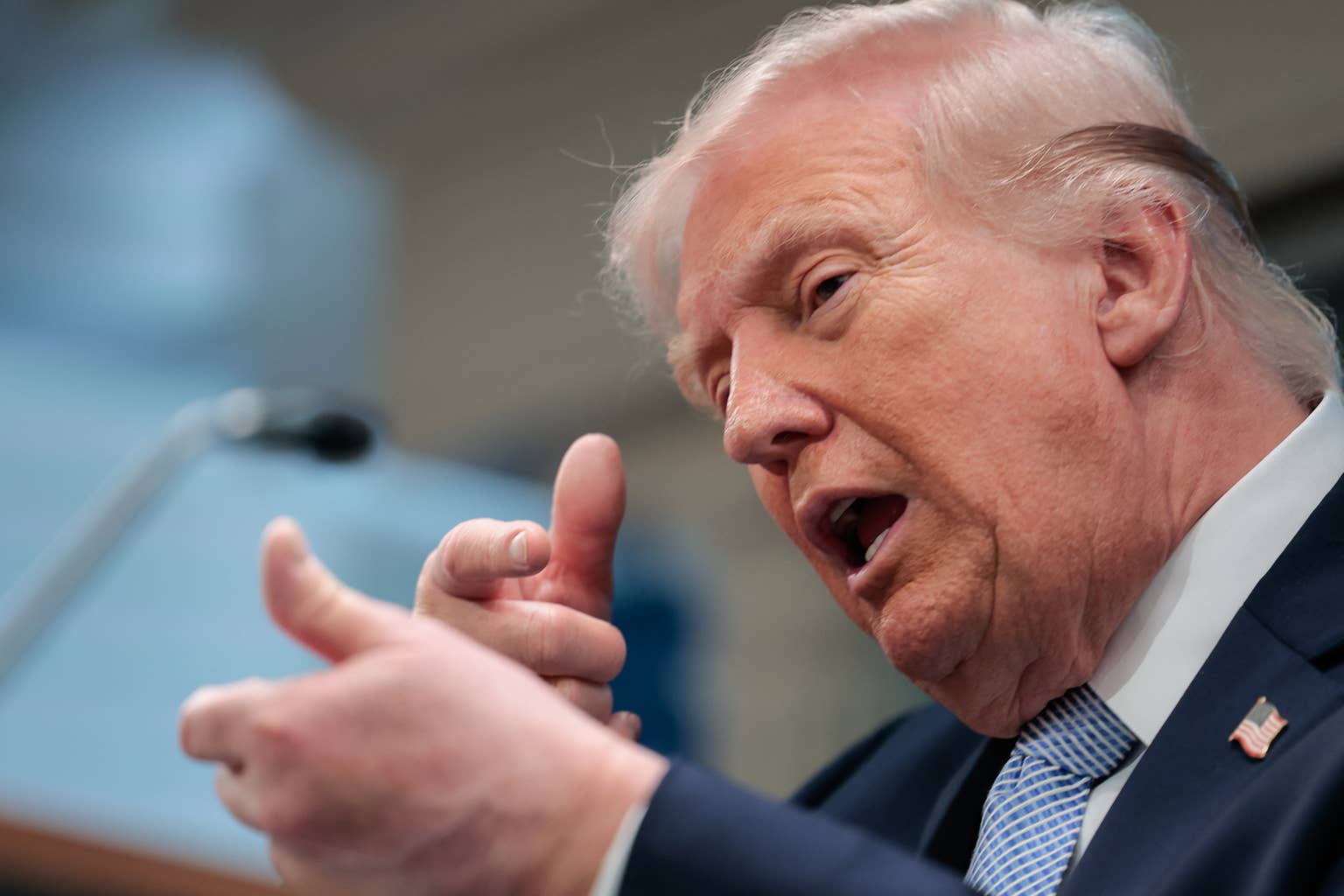
President Donald Trump weighed in on the prediction markets fight Tuesday, posting on Truth Social that the Commodity Futures Trading Commission (CFTC) should be the only regulator with authority over the industry and calling politicians who oppose that position "scum."
"It is critically important that the CFTC's exclusive authority over Prediction Markets is maintained, and that they will thrive. Under my leadership, we are setting 'rules of the road' that are the Gold Standard for the States. We cannot have SCUM like Chris Christie, Letitia James, Tim Walz, and JB Pritzker setting the rules!"
Trump also tied prediction markets to the broader crypto industry, saying other countries are trying to overtake the U.S. in both sectors.
"Other Countries are after this new form of Financial Market, and we want to remain at the top. Likewise, and even more importantly, where we are currently the Crypto (Bitcoin, etc.) Capital of the World, other Countries are trying diligently to replace us in that capacity, but we won't let that happen. It is a major Industry, and we must protect it."
He praised CFTC Chairman Mike Selig, calling him "respected by all" and saying he is "doing a great job."
Related: Over 43% chance of U.S. government shutdown in 2025: Polymarket
What the fight is actually about
Prediction markets are platforms where people buy and sell contracts based on the outcome of future events.
If you think the Fed will cut rates in September, you buy a contract that pays out if it happens.
If you think the Yankees will win the World Series, same thing. You are not placing a bet with a bookie. You are buying a contract on a regulated exchange, and that contract trades like a derivative.
The question at the center of this fight is whether those contracts are financial products regulated by the federal government, or gambling products regulated by the states.
The answer determines who has authority over a market that has exploded in size over the past two years.
The CFTC says prediction markets fall under the Commodity Exchange Act, which gives the agency exclusive jurisdiction over derivatives and futures contracts.
Under that framework, platforms like Kalshi and Polymarket operate as designated contract markets, the same regulatory classification as the Chicago Mercantile Exchange.
Related: Trump admin reveals major stablecoin legislation announcement
More than a dozen states disagree.
They argue that many of these contracts, especially sports-related ones, are functionally identical to sports betting and should be regulated under state gambling laws.
New York Attorney General Letitia James joined a bipartisan coalition of 37 attorneys general in filing an amicus brief accusing prediction markets of operating as "unregulated gambling."
Chris Christie, the former governor of New Jersey, has been publicly calling prediction markets "illegal" and arguing they are breaking state gambling laws. Tim Walz signed the nation's first law banning prediction market sites from operating in Minnesota.
Those are the four people Trump called "scum" in his post.
The fifth he named was JB Pritzker, the governor of Illinois, where the CFTC has also filed suit to block state enforcement against prediction market platforms.
The federal government is suing states
The Trump administration has been actively suing states to protect prediction markets from state-level crackdowns.
On April 2, the CFTC filed lawsuits against Arizona, Connecticut, and Illinois, seeking injunctions to block state enforcement against Kalshi and Polymarket.
The agency has since filed additional suits against New York and Wisconsin, and submitted amicus briefs in cases in several other states.
As of this week, 13 states have active enforcement actions, litigation, or both against prediction market platforms.
The CFTC's position under Chairman Selig has been unambiguous. In an interview with CoinDesk, Selig said the agency will continue to defend its "exclusive regulatory authority" over prediction markets regardless of what those markets cover.
In a separate interview with Axios, he drew a clear line between prediction markets and traditional sportsbooks, calling them "two separate things."
Why sports contracts are at the center
The reason this fight has escalated is sports. When prediction markets were primarily about elections, economic data, and crypto prices, states largely left them alone. But sports contracts changed the equation.
As of February 2026, roughly 87% of Kalshi's $39.7 billion traded in the past year was on sports.
Prediction market traders pushed April 2026 volume to $8.6 billion, with Kalshi taking the lead. Kalshi and Polymarket together now control an estimated 85% to 95% of total prediction market volume.
States with legalized sports betting see prediction market sports contracts as direct competition to their regulated sportsbooks.
State gambling commissions collect licensing fees and tax revenue from sportsbooks. Prediction markets operating under federal CFTC oversight pay none of that. From the states' perspective, these platforms are offering the same product without the same regulatory obligations.
The industry sees it differently.
Prediction market contracts settle based on real-world outcomes, trade on regulated exchanges, and function like financial derivatives. A contract on whether the Fed will cut rates and a contract on whether the Chiefs will win the Super Bowl are structurally identical on the platform. The only difference is the underlying event.
Trending on TheStreet Roundtable
Polymarket's latest move
The timing of Trump's post is notable.
Last week, on May 20, Polymarket's U.S. subsidiary QCX LLC filed a self-certification request with the CFTC to launch parlay-style sports contracts, which it calls Combinatorial Athletic Outcome Contracts.
A parlay requires every leg to hit in order to pay out. If you bundle three NBA game outcomes into one contract and two of the three hit, you get nothing.
Polymarket already operates a dual structure. Its largest exchange is domiciled offshore and blocks U.S. users.
Its smaller CFTC-regulated exchange, acquired through QCX, serves U.S. customers. The parlay filing signals Polymarket is pushing deeper into regulated U.S. sports markets, which will further intensify the federal-vs.-state fight.
Congress weighs-in
The fight is not just between the executive branch and the states. Congress has started to weigh in.
A group of Democratic lawmakers sent a letter to the CFTC in late April urging the agency to bar insider trading on prediction markets and rein in event contracts on war, elections, government actions, and sports. In March, Senators Curtis and Schiff introduced the Prediction Markets Are Gambling Act, which would clarify that the Commodity Exchange Act does not authorize sports-style wagering and would restrict platforms like Kalshi and Polymarket from offering those contracts.
Kalshi and Polymarket have both ramped up lobbying efforts in Washington in response.
The CFTC under Chairman Selig has already withdrawn a 2024 proposed rule that would have restricted certain event contracts and has instead moved to write new rules that explicitly regulate prediction markets.
Related: Cathie Wood predicts Trump won't be a 'lame duck' in 2026