A U.S. court filing docketed as a civil forfeiture matter references cryptocurrency seized from Tether Ltd. and an associated wallet address, placing a stablecoin-linked entity name at the ce
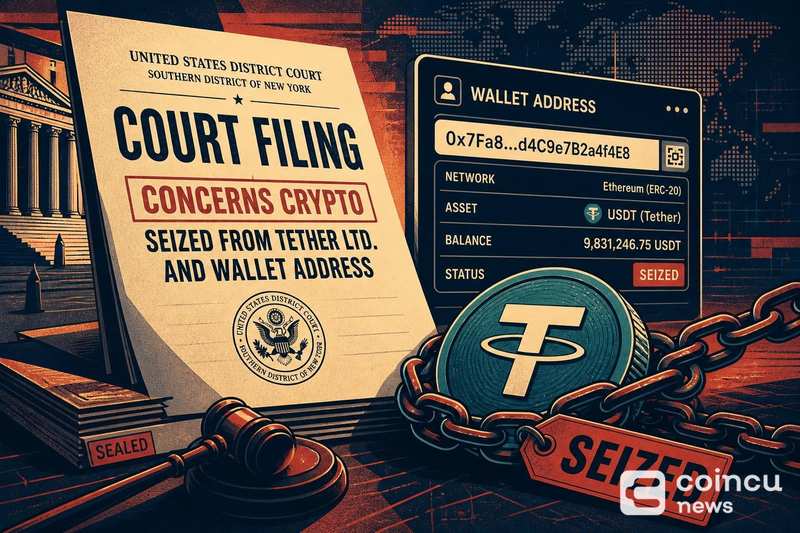
A U.S. court filing docketed as a civil forfeiture matter references cryptocurrency seized from Tether Ltd. and an associated wallet address, placing a stablecoin-linked entity name at the center of a federal asset-recovery proceeding whose specific allegations remain unverified in the available record.
The proceeding appears on the federal docket under a caption naming "any and all cryptocurrency seized from Tether Ltd. or" an associated address, according to the CourtListener docket entry for the case. Civil forfeiture actions of this type name the property itself, not a defendant, which is why the seized cryptocurrency and the wallet appear in the case title rather than a person or company. For related coverage, see Crypto Trade Group Warns Fed Banking Access Could Pressure Digital Asset Firms.
The research available for this story is limited, and the underlying complaint's precise claims could not be independently confirmed. What can be stated is procedural: the matter is filed as a forfeiture action, and the caption ties the seized assets to the Tether Ltd. name and a wallet address. For related coverage, see Three iPhone Users Sue Apple Over $1.8M Bitcoin Loss in Fake Sparrow Wallet Scam.
Why a company name in a case caption is not an accusation of wrongdoing
In an in rem civil forfeiture, the government moves against property alleged to be connected to unlawful conduct, and the entity or address named in the caption identifies where the assets were seized from, not who is charged. No finding of liability against Tether Ltd. is established by the caption or by the docket's existence.
Blockchain traceability explains why a specific wallet address surfaces in filings like this: on-chain transactions are publicly visible, letting investigators follow funds to the address where they were frozen or seized. Association between an address and a named party does not by itself prove beneficial ownership or control, a distinction that repeatedly surfaces in crypto-related enforcement, including a New York court matter that turned on the identity behind dormant addresses.
Where the filing sits in the broader forfeiture pipeline
Federal prosecutors have used civil forfeiture to recover crypto in multiple recent actions, including a Massachusetts U.S. Attorney's Office filing to recover roughly $34 million in cryptocurrency tied to fraud proceeds. A separate Northern District of Ohio action sought forfeiture of about $200,000 in Tether (USDT), underscoring that stablecoin-denominated assets are now routine targets of seizure.
These parallel cases establish the mechanics, not the substance, of the Tether Ltd. docket: forfeiture is a procedural step, distinct from any final judgment, and its filing signals an enforcement posture rather than a resolved dispute. Enforcement actions touching stablecoin-adjacent names draw outsized attention because of the sector's compliance sensitivity, a dynamic also visible when a crypto trade group warned about regulatory pressure on digital-asset firms.
What remains unclear
Several core facts are not established in the available record: the dollar value of the seized cryptocurrency, the token type, the wallet address string itself, the alleged predicate conduct, and whether Tether Ltd. or any other party has filed a response. Early court documents are frequently incomplete, and the docket entry alone does not disclose the complaint's specifics.
Investigations that involve individual actors and traced funds can evolve substantially after the initial filing, as seen in cases ranging from a former FBI agent charged over stolen crypto to a South Dakota investor indicted in an alleged fraud. The concrete triggers to watch are the docketing of the underlying complaint, any claim filed by an interested party asserting ownership of the assets, and any public statement from Tether Ltd. addressing the seizure.
Disclaimer: This article is for informational purposes only and does not constitute financial or investment advice. Cryptocurrency and digital asset markets carry significant risk. Always do your own research before making decisions.
The post U.S. Court Filing Concerns Crypto Seized From Tether Ltd. and Wallet Address was initially published on Coincu.