Key Highlights Uber has partnered with Israel’s Autobrains to introduce an autonomous taxi service in Munich, subject to regulatory clearance. The initiative will utilize Nvidia’s Drive Hyper
Key Highlights
- Uber has partnered with Israel’s Autobrains to introduce an autonomous taxi service in Munich, subject to regulatory clearance.
- The initiative will utilize Nvidia’s Drive Hyperion platform combined with Autobrains’ agentic AI technology.
- The solution features an “OEM-agnostic” architecture, enabling deployment across various vehicle manufacturers and urban markets.
- Autobrains employs specialized AI agents that make independent driving decisions using conventional automotive sensors.
- Munich has been on Uber’s autonomous vehicle roadmap since the company announced planned trials beginning in 2026.
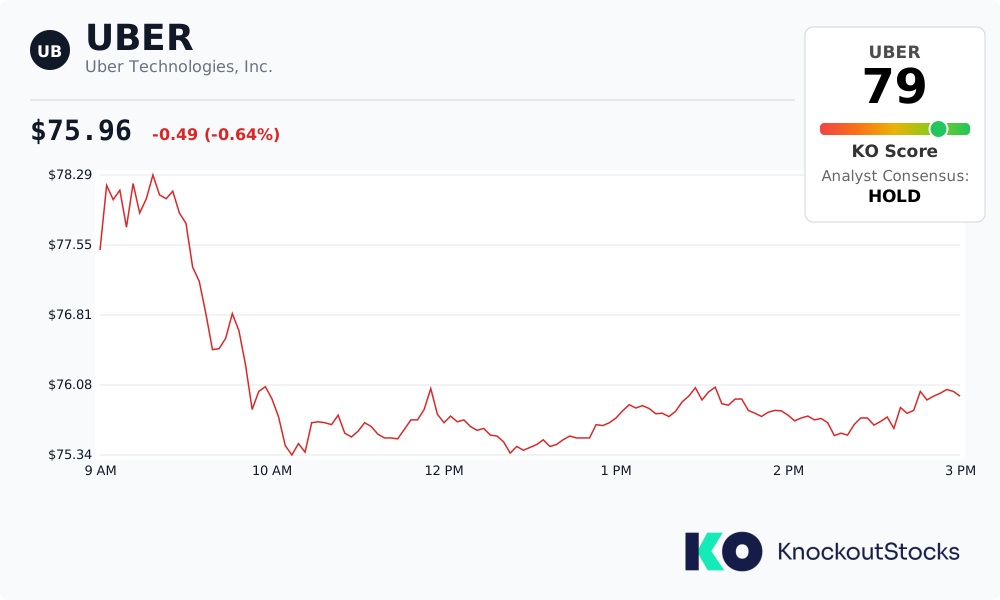
Shares of Uber declined 0.73% while Nvidia dropped 1.45% on Monday following the joint announcement by the companies alongside Israel’s Autobrains regarding their Munich robotaxi initiative.
 Uber Technologies, Inc., UBER
The partnership was revealed on June 1, 2026, representing a significant advancement toward commercial autonomous transportation services in the European market.
The collaboration brings together Uber’s established ride-hailing infrastructure with Autobrains’ specialized agentic AI driving technology, all powered by Nvidia’s Drive Hyperion computing platform.
Munich has been selected as the initial launch city for this autonomous vehicle program, though implementation remains contingent upon receiving regulatory authorization from German government agencies.
The Technology Behind the System
Autobrains has developed a distinctive methodology for autonomous vehicle operation by distributing driving responsibilities among multiple specialized AI agents rather than using a single monolithic system.
Each individual agent manages a distinct aspect of vehicle operation, enabling the car to make immediate decisions using standard automotive sensor technology without requiring specialized or expensive hardware components.
This architectural choice is significant. By relying on commercially available sensors, the platform becomes more economically viable and easier to implement across diverse vehicle fleets.
A central feature of this partnership is the platform’s “OEM-agnostic” framework, designed to function seamlessly with vehicles from multiple automotive manufacturers rather than being restricted to a single brand.
This approach provides Uber with operational versatility. Rather than committing to a specific vehicle manufacturer or hardware ecosystem, the service can adapt to whatever automotive options are available in different geographical markets.
According to the partnering companies, the objective is to transition robotaxi operations from isolated experimental programs to a scalable solution deployable across multiple metropolitan areas.
The selection of Munich was strategic rather than arbitrary. Uber had previously identified the Bavarian capital as a target location for autonomous vehicle testing commencing in 2026, making this announcement a fulfillment of earlier commitments.
Germany has gradually been establishing regulatory frameworks for autonomous vehicle experimentation, with Munich emerging as one of Europe’s most active testing locations for self-driving technology.
Nvidia’s participation via its Drive Hyperion platform brings established credibility to the venture. The computational system has already been adopted by numerous automotive manufacturers developing advanced driver assistance and fully autonomous capabilities.
Autobrains is an Israeli artificial intelligence firm specializing in autonomous mobility solutions. Its participation in this collaboration illustrates the growing involvement of technology startups alongside established automotive and tech giants in the autonomous vehicle sector.
A definitive launch date has not been announced. The project timeline is largely dependent upon securing the necessary regulatory approvals from German authorities.
Uber’s stock performance has experienced fluctuations recently, with Monday’s 0.73% decline occurring during a session when technology stocks broadly experienced downward pressure.
Nvidia’s shares fell 1.45% during the same trading session, though neither company’s stock movement was exclusively linked to this robotaxi announcement.
If regulatory approval is granted, this program would mark Uber’s inaugural commercial autonomous taxi operation on the European continent.
The post Uber (UBER) Partners With Autobrains and Nvidia (NVDA) for Munich Autonomous Taxi Service appeared first on Blockonomi.