The UK Crypto Business Council (UKCBC) has published a report opposing bank restrictions on customer transfers to cryptocurrency exchanges, arguing that broad payment blocks harm consumers an
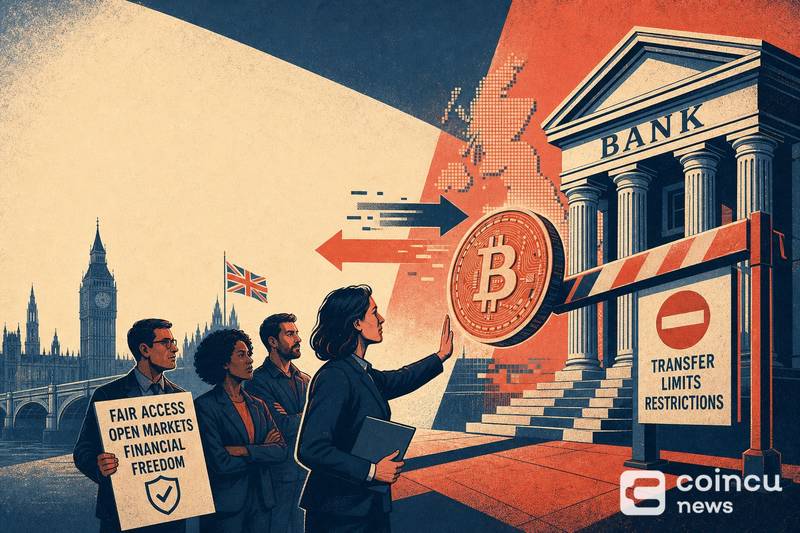
The UK Crypto Business Council (UKCBC) has published a report opposing bank restrictions on customer transfers to cryptocurrency exchanges, arguing that broad payment blocks harm consumers and undermine the country's digital asset economy.
The report, titled "Locked Out: Debanking the UK Digital Asset Economy," details how major UK banks have implemented blanket restrictions or outright blocks on payments to regulated crypto exchanges. The UKCBC argues these measures go beyond proportionate risk management and effectively cut off lawful access to digital asset markets for millions of UK residents.
What the UKCBC Report Challenges
The UKCBC report focuses specifically on restrictions that prevent bank customers from transferring funds to cryptocurrency exchanges. These include daily or monthly caps on outgoing payments, complete blocks on transfers to known exchange payment processors, and account closures triggered by crypto-related activity.
The advocacy group distinguishes between targeted fraud intervention, which it supports, and blanket restrictions that treat all crypto exchange transfers as inherently suspect. The council contends that broad payment blocks penalize compliant users and regulated platforms alike.
The dispute centers on the difference between risk-based decision-making and category-wide exclusion. When a bank blocks all transfers to FCA-registered exchanges rather than flagging individual suspicious transactions, the UKCBC argues it crosses the line from consumer protection into market suppression.
Why UK Banks Are Blocking Crypto Payments
Banks typically justify restrictions on crypto exchange transfers through fraud prevention and regulatory compliance obligations. UK financial institutions are required under the Money Laundering Regulations 2017 to monitor and manage the risk of financial crime, which some banks interpret as grounds for restricting entire payment categories.
The consumer protection argument carries weight. Crypto investment scams have been a persistent problem in the UK, and banks face potential liability when customers lose funds to fraudulent schemes accessed through exchange accounts.
However, the UKCBC and other industry participants argue that the banking response has become disproportionate. Rather than screening individual transactions for fraud indicators, some institutions have opted for wholesale restrictions that are cheaper to administer but far broader in impact. This approach treats regulated exchanges the same as unregistered platforms, a distinction the advocacy group considers fundamentally unfair.
Impact on UK Crypto Users and Exchanges
For retail users, bank restrictions on exchange transfers create immediate friction. Customers who cannot send funds from their bank account to a regulated exchange may turn to peer-to-peer markets or offshore platforms with weaker consumer protections, an outcome that arguably increases rather than decreases risk.
Centralized exchanges operating in the UK face direct commercial consequences. When banks block transactions to crypto platforms, it disrupts onboarding for new customers and complicates routine account funding for existing ones. The scale of exchange activity affected is significant; platforms like Binance continue to process billions in net flows globally, but UK-specific volumes face downward pressure when banking rails are restricted.
Fiat on-ramp and off-ramp access remains a core choke point for broader crypto adoption, and banking restrictions tighten that bottleneck further. The issue extends beyond individual inconvenience, as exchanges that cannot reliably process GBP deposits face pressure to reduce UK operations or relocate.
Policy Implications for UK Digital Asset Regulation
The UKCBC's public opposition to bank restrictions is designed to pressure both financial institutions and regulators to clarify expectations around crypto payment access. The council's campaign calls for a framework that distinguishes between proportionate fraud controls and blanket market exclusion.
The dispute highlights a tension at the center of UK crypto policy: balancing consumer protection against open market access. Banks argue they are fulfilling their regulatory obligations; crypto advocates argue those obligations do not require cutting off access to lawful services.
The FCA has conducted its own consumer research on cryptoasset usage, which provides data on how UK residents interact with digital assets. This research informs the regulatory backdrop against which both banks and crypto businesses operate.
Resolution could take several forms: clearer FCA guidance on when payment restrictions are justified, legislative action to prevent discriminatory debanking of lawful industries, or voluntary commitments from banks to maintain access to FCA-registered platforms. The UKCBC report appears aimed at accelerating all three.
Meanwhile, the broader crypto industry continues to evolve. New platforms like trading terminals offering novel incentive structures and projects exploring AI-driven personalization underscore the pace of innovation that banking restrictions risk sidelining UK users from.
FAQ About UK Bank Restrictions on Crypto Transfers
What are bank restrictions on crypto transfers?These are limits or blocks imposed by UK banks on outgoing payments to cryptocurrency exchanges. They range from daily transfer caps to complete payment blocks targeting known exchange payment processors.
Can UK users still fund exchange accounts?Options vary by bank. Some institutions allow transfers with reduced limits, while others block them entirely. Users affected by restrictions may be able to use alternative payment methods such as debit cards or third-party payment processors, though these often carry higher fees.
Why do advocacy groups oppose these restrictions?Groups like the UKCBC argue that blanket restrictions are disproportionate and harm consumers by limiting access to regulated platforms. They support targeted fraud prevention but oppose measures that treat all crypto exchange activity as inherently risky.
Do these restrictions apply to all UK banks?No. Policies vary across institutions. Some banks have imposed strict limits while others maintain relatively open access to crypto exchange transfers. The inconsistency itself is part of the UKCBC's complaint, as it creates an uneven landscape for both consumers and exchanges.
Disclaimer: This article is for informational purposes only and does not constitute financial or investment advice. Cryptocurrency and digital asset markets carry significant risk. Always do your own research before making decisions.
The post UK Crypto Group Opposes Bank Limits on Exchange Transfers was initially published on Coincu.