UK Digital Currency Policy: BoE Told to Drive Payments Innovation London, August 26, 2026 (as of report time)- The United Kingdom government has unveiled a fresh UK digital currency policy sh
UK Digital Currency Policy: BoE Told to Drive Payments Innovation
London, August 26, 2026 (as of report time)- The United Kingdom government has unveiled a fresh UK digital currency policy shift, handing the Bank of England a new secondary mandate to actively support innovation in digital money and payments.
According to aBloomberg report published Wednesday, HM Treasury confirmed this expanded role will sit alongside, not replace, the central bank's core job of protecting financial stability.
The move comes amid criticism that the Bank of England has been overly cautious in embracing emerging payment technologies, and it marks one of the most direct signals yet of a digital finance innovation push at the policy level.
What Did the UK Treasury Announce?
The new UK digital currency policy framework extends an existing innovation duty that previously applied only to central counterparties and central securities depositories, now stretching it into BoE payment system oversight as a whole.
This builds on thecentral bank's existing innovation objective, first introduced for financial market infrastructure. Key details:
The Bank of England must report annually to Parliament on how it is advancing this objective
Financial stability remains the primary objective; is explicitly secondary
Deputy Governor Sarah Breeden publicly welcomed the announcement
City Minister Lucy Rigby said developments including tokenization have the potential to reshape financial markets while keeping the globally competitive
Scope
Before This Announcement
After This Announcement
Innovation duty applies to
CCPs and CSDs only
CCPs, CSDs, and full payment systems
Reporting requirement
None specified
Annual report to Parliament
Stated goal
Financial stability only
Stability + innovation (secondary)
Bank of England Digital Currency Mandate: Why It Matters for Crypto
This BoE mandate doesn't exist in isolation. It follows two earlier moves that already pointed toward friendlier Treasury digital assets policy:
In June 2026, the central bank finalized its stablecoin framework, scaling back planned capital requirements for issuers and lifting proposed caps on how much individuals and businesses could hold in stablecoins
The United Kingdom and US had already formed a joint working group focused on advancing stablecoin applications across borders
Together, these steps suggest UK stablecoin regulation is shifting from a defensive posture toward active facilitation, positioning currency payments UK-wide as a growth priority rather than a risk to be contained.
Boosting UK Crypto Competitiveness
Treasury officials framed the change as central to improving United Kingdom crypto competitiveness on the global stage, particularly as jurisdictions like the US and EU race to formalize their own digital asset frameworks.
For crypto news today, this ranks among the more consequential UK regulatory developments of the year, since it reshapes how the BoE balances caution against going forward.
The story was also flagged in real time by industry accounts. WuBlockchain also covered this news in a tweet summarizing the Treasury's announcement.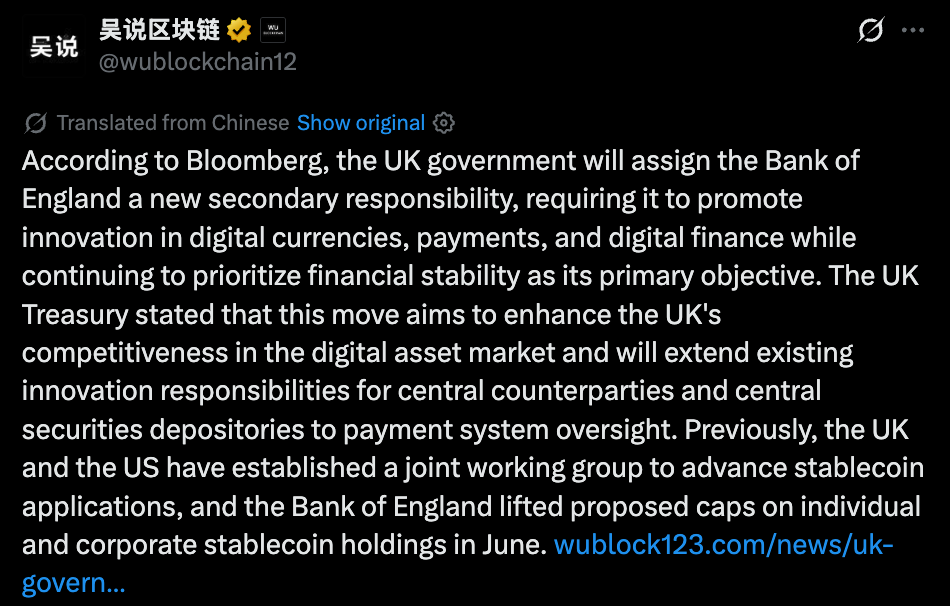
Source: WuBlockchain X Post
Expert Opinion
Analysts tracking United Kingdom financial regulation suggest this expanded mandate could accelerate how quickly stablecoin and tokenization proposals move from consultation to implementation, making it a development worth watching in the broader Crypto Newslandscape.
Since the Bank of England now has an explicit institutional incentive to unblock innovation rather than simply gatekeep it, regulatory progress could potentially accelerate.
The annual parliamentary reporting requirement may also increase public scrutiny of how fast, or slowly, that actually materializes.
Any near-term market impact will likely depend on how the Bank defines "innovation" in practice over the coming months.
Disclaimer: This article is for informational purposes only and does not constitute financial or investment advice. Regulatory frameworks referenced here may change; readers should verify current rules with official UK government and Bank of England sources before making decisions.