A UK High Court ruling in the case involving Qian Zhimin and 61,000 Bitcoin has left a pivotal question unresolved: whether alleged victims of the underlying fraud retain a viable route to pu
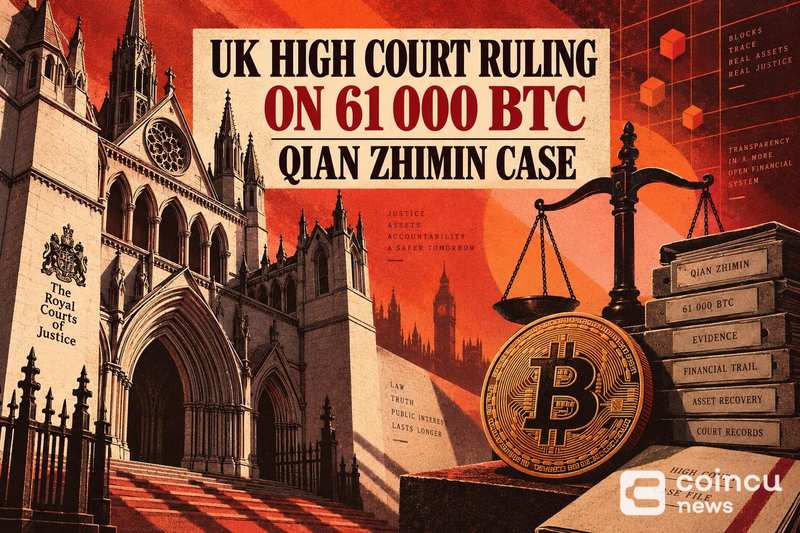
A UK High Court ruling in the case involving Qian Zhimin and 61,000 Bitcoin has left a pivotal question unresolved: whether alleged victims of the underlying fraud retain a viable route to pursue a property-rights appeal over the seized holdings, whose current value runs into the billions of dollars at prevailing market prices.
What the UK High Court decided, and what it did not
The ruling addressed specific procedural and jurisdictional questions in the Qian Zhimin matter but stopped short of settling the overarching dispute over who holds enforceable rights to the 61,000 BTC at the center of the case. In a related prior decision, the court determined that Chinese law governs the Bitcoin recovery question, a threshold finding that shapes which legal standards apply to any subsequent ownership claim. For related coverage, see Sam Bankman-Fried Appeals Fraud Conviction to Supreme Court.
The distinction between issues the court decided and issues it expressly left open matters because it determines the procedural path forward. A ruling that resolves jurisdiction without resolving property rights preserves, rather than forecloses, the appeal avenue for claimants who argue the bitcoin belongs to them rather than to the state or another party. For related coverage, see U.S. Supreme Court Delays Decision on Trump's Tariffs Amidst Crypto Market Rally.
Why a victim property-rights appeal remains procedurally possible
When a court issues a ruling that does not address a claim on the merits, the affected party typically retains standing to seek permission to appeal or to raise the unresolved issue in subsequent proceedings. In this case, the property-rights question, namely whether identifiable victims of the alleged fraud can assert a direct ownership interest in the 61,000 BTC, was not adjudicated to finality, leaving that avenue open as a matter of procedural law. For related coverage, see Why Is Beldex (BDX) Price Surging Today? Bridge Risks Explained.
Whether permission to appeal would be granted, and whether such an appeal would succeed, are separate and unresolved questions. An open appeal route is not a guarantee of recovery; it is a precondition for it. Courts evaluating property rights in seized cryptocurrency typically weigh traceability of funds, chain-of-custody records, and the applicable civil or criminal forfeiture framework, which in this proceeding is informed by the court's earlier finding on Chinese law.
What competing interests are at stake in seized-bitcoin disputes
Cases involving large-scale Bitcoin seizures routinely implicate three distinct classes of claimant: the state seeking civil or criminal forfeiture, identified victims asserting restitution rights, and any third parties with documented ownership claims. When the volume involved is as large as 61,000 BTC, the economic stakes create strong incentives for each class to litigate aggressively, as courts in comparable proceedings, such as the Sao Paulo court order requiring Coinbase to return funds after a wallet theft, have recognized that custodial and evidentiary records are outcome-determinative.
Traceability is particularly consequential in Bitcoin matters because the public ledger allows parties to argue, with varying degrees of forensic confidence, that specific satoshis correspond to specific alleged losses. Whether that traceability argument can be converted into a cognizable property right under the applicable legal framework, here Chinese law as determined by the High Court, is the core unresolved question victims would need to win on appeal.
What to watch after the High Court decision
The next concrete procedural trigger is any filing seeking permission to appeal the property-rights question, which would set a timeline for the court to rule on whether that challenge may proceed. Separately, any court order affecting custody, disposition, or interim management of the 61,000 BTC would materially change the posture of all parties. Attribution of any such filings or orders to official case records, rather than secondary reporting, will be the authoritative signal that the dispute has moved to its next phase.
FAQ: UK High Court 61,000 BTC Qian Zhimin case
What did the UK High Court decide in the 61,000 BTC case? The court issued a ruling addressing specific issues in the Qian Zhimin matter, including a prior determination that Chinese law governs the Bitcoin recovery question. The property-rights claims of alleged victims were not resolved to finality.
Can victims still appeal over property rights? Yes, procedurally. Because the court did not adjudicate the property-rights question on its merits, that issue remains open and subject to a potential appeal or further proceedings.
Does an open appeal mean the bitcoin will be returned? No. An open appeal route means the question has not been finally closed; it does not predict the outcome. Permission to appeal must be sought and granted, and the merits would then need to be argued and decided.
What developments should readers watch next? Any official filing for permission to appeal the property-rights question, any court order affecting custody or disposition of the 61,000 BTC, and any substantive ruling on the application of Chinese law to the specific ownership claims raised by alleged victims.
Additional source references: source document 1, source document 2.
Disclaimer: This article is for informational purposes only and does not constitute financial or investment advice. Cryptocurrency and digital asset markets carry significant risk. Always do your own research before making decisions.
The post UK High Court Ruling on 61,000 BTC Qian Zhimin Case was initially published on Coincu.