The United Kingdom on 26 May 2026 imposed sanctions on a cryptocurrency network it says claimed to have moved more than $90 billion for Russia last year, applying the same correspondent-banki
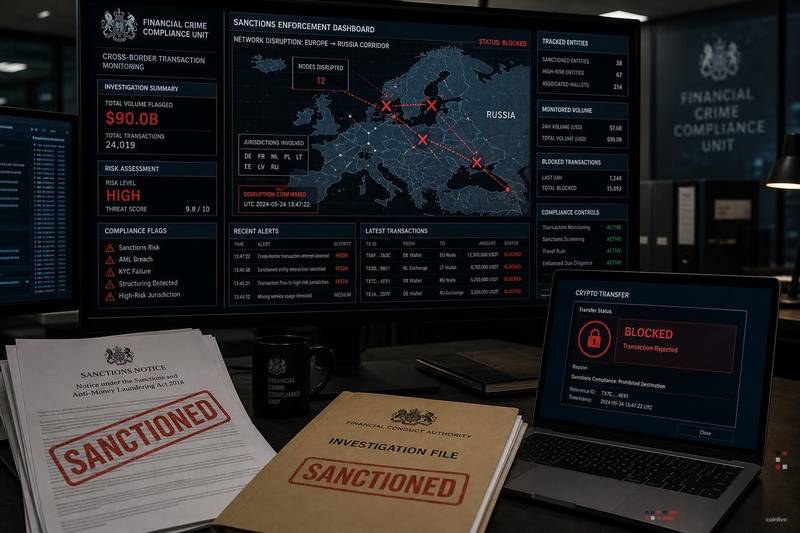
The United Kingdom on 26 May 2026 imposed sanctions on a cryptocurrency network it says claimed to have moved more than $90 billion for Russia last year, applying the same correspondent-banking and payment-processing prohibitions typically reserved for traditional financial institutions.
What the UK action against the crypto network means
The UK government announced 18 new designations targeting cryptocurrency exchanges and the A7 network, a Russia-linked payment infrastructure that operates the ruble-pegged stablecoin A7A5. The measures took effect immediately.
What sets this action apart is the type of restrictions applied. The UK sanctions notice imposed correspondent-banking relationship prohibitions and payment-processing bans on named A7-linked entities, including Aifory LLC and Eurasian Savings Bank. These are bank-style restrictions being applied to crypto-native infrastructure for the first time in a UK sanctions package of this scale.
Huobi Global S.A., the entity behind the HTX exchange, was also designated on suspicion of providing financial services to A7 LLC and Garantex Europe OU. HTX has publicly denied the allegations, stating it refused an A7A5 listing.
The approach mirrors how regulators have historically treated sanctioned banks, signaling that crypto payment rails handling sovereign-scale volumes will face equivalent scrutiny. This resembles the posture seen in previous U.S. enforcement actions targeting crypto-facilitated sanctions evasion.
Why the alleged $90 billion Russia-linked processing claim matters
The UK said the A7 network claimed to have moved more than $90 billion last year, a figure it noted was roughly half of Russia's yearly military expenditure.
UK's stated A7 flow claim more than $90 billion The UK said the A7 network claimed to have moved more than $90 billion last year. Source: GOV.UK
That volume, if accurate, would place the A7 network among the largest payment processors operating outside regulated banking channels globally. The figure is presented as the UK government's assessment based on the network's own claims, not as an independently audited total.
The same UK release alleged that a major global cryptocurrency exchange channeled over $1.5 billion back into Kremlin-linked hands.
Exchange flow allegation over $1.5 billion The same UK release alleged that a major exchange channeled over $1.5 billion back into Kremlin-linked hands. Source: GOV.UK
A7A5, the stablecoin at the center of the network, currently trades at $0.013 with a market capitalization of approximately $516 million. CoinDesk previously described A7A5 as a ruble-pegged stablecoin built to move money around banking restrictions, positioning it as infrastructure for cross-border Russian trade settlement.
UK Home Secretary Yvette Cooper framed the action in direct terms:
"We are tracking down and shutting off the financial lifelines that sustain Putin's war machine."
— Yvette Cooper, UK Home Secretary
What this could mean for crypto compliance and market sentiment
The designations were made under the UK's Russia (Sanctions) (EU Exit) Regulations 2019. By extending correspondent-banking prohibitions to crypto-linked entities, the UK has established a precedent that decentralized payment networks processing sovereign-scale volumes can be treated identically to traditional financial institutions under sanctions law.
Exchanges and counterparties with any exposure to A7-linked entities now face immediate compliance obligations. The Crypto Fear & Greed Index sits at 28, reflecting broader market unease that extends beyond this single enforcement action.
The practical consequence for the industry is clear: regulators are no longer content to simply blacklist individual wallets or tokens. They are now applying the full architecture of banking sanctions, including relationship prohibitions and payment-processing bans, to crypto infrastructure they deem systemically important to sanctions evasion.
Disclaimer: This article is for informational purposes only and does not constitute financial or investment advice. Cryptocurrency and digital asset markets carry significant risk. Always do your own research before making decisions.
Read original article on coinlive.me