Ukraine's Asset Recovery and Management Agency, known as ARMA, has for the first time transferred seized cryptocurrency into state management, crediting more than 8.3 million USDT to the agen
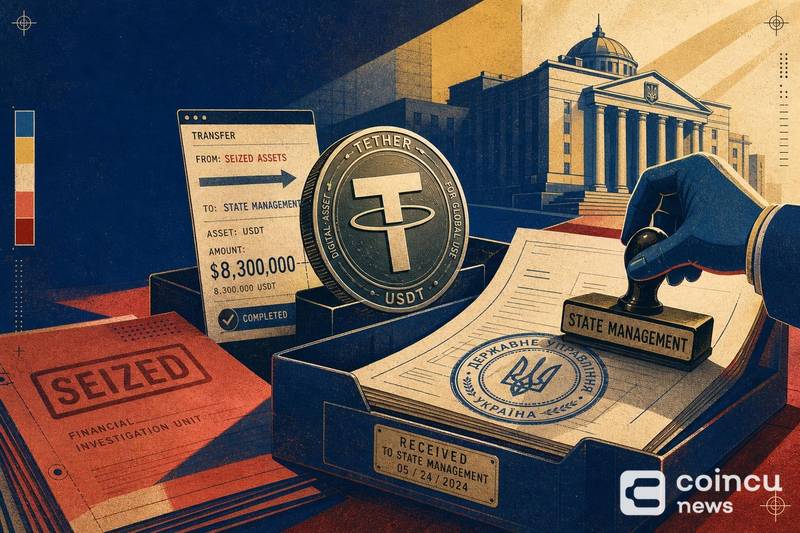
Ukraine's Asset Recovery and Management Agency, known as ARMA, has for the first time transferred seized cryptocurrency into state management, crediting more than 8.3 million USDT to the agency's official crypto wallet. The transfer, valued at more than 372 million Ukrainian hryvnias, marks a concrete milestone in how the country handles digital assets confiscated in criminal proceedings.
ARMA Confirms the First Seized USDT Transfer Into State Management
ARMA announced on June 27, 2026, that more than 8.3 million USDT had been credited to the agency's official crypto wallet. The agency described this as the first practical case of seized digital assets being transferred into its management. For related coverage, see Gate DEX Launches Welfare Center With 5,400+ USDT Rewards.
Seized USDT transferred 8.3M USDT Ukraine's ARMA says the credited amount marks the first practical state-management transfer of seized crypto assets.
ARMA valued the transferred amount at more than 372 million UAH, providing a local-currency benchmark for what is a significant law enforcement action in the country's history. For related coverage, see WEEX Zero-Fee Trading Event Offers 30,000 USDT Airdrop.
Hryvnia equivalent 372M UAH ARMA presented the transfer's local-currency value at more than 372 million hryvnias.
The distinction matters: this is a transfer into state custody and administration, not a liquidation or sale on the open market. ARMA now holds and manages the seized USDT on behalf of the state while the underlying criminal case proceeds.
How the Seized Crypto Reached State Management
The transfer was executed pursuant to a court decision, according to ARMA's announcement. The process involved coordination between multiple state bodies, including the State Bureau of Investigation and the Office of the Prosecutor General of Ukraine.
Prosecutor General Ruslan Kravchenko confirmed the transfer through Ukrainian media, stating that this was the first time in Ukraine's history that seized virtual assets had been transferred to ARMA's management.
In practical terms, "state management" means ARMA serves as the custodial authority for seized assets. The agency receives, holds, and administers property under court-ordered arrest until the court issues a final ruling on its disposition. For crypto assets specifically, this means the USDT sits in a wallet controlled by the agency rather than remaining frozen on an exchange or in an intermediary's custody.
The involvement of both prosecutorial and investigative branches indicates that Ukraine's legal apparatus for handling digital assets has advanced beyond policy discussions into operational execution. The country previously lacked a tested mechanism for physically transferring seized crypto into a state-run wallet.
What the Hacker Case Reveals About the Seized Funds
The seized USDT originated from a criminal case tied to an international hacker group that allegedly targeted individuals and companies across Europe and the United States. The group is accused of demanding ransoms and laundering proceeds through Ukraine.
ARMA stated that estimated damages from the group's activities exceed $100 million, a figure that puts the $8.3 million transfer into perspective as a partial recovery from a much larger criminal operation.
Four suspects, including the alleged organizer, were detained in connection with the case. Total seized assets across the investigation exceed $11.1 million, of which the USDT portion now transferred to ARMA's wallet represents the largest single block.
The gap between the $11.1 million in total seizures and the more than $100 million in estimated damages underscores the challenge law enforcement agencies face in recovering the full scope of illicit proceeds, particularly when crypto assets can be moved across jurisdictions rapidly.
Why This Matters for Ukraine's Crypto Enforcement Framework
This event sets a precedent for how Ukraine processes seized digital assets within its existing asset-recovery system. Before this transfer, the country had no completed case of crypto moving from investigative seizure into formal state management under ARMA's authority.
The transfer does not represent a new regulation or rule governing USDT or stablecoins more broadly. It is an operational execution within Ukraine's current legal framework, demonstrating that the existing asset-recovery machinery can be applied to virtual assets in practice.
For context, Ukraine has been navigating its relationship with digital assets on multiple fronts. The country blocked Polymarket over legal issues earlier this year, reflecting ongoing regulatory friction. The ARMA transfer, by contrast, shows a constructive application of state authority over crypto, one focused on enforcement rather than restriction.
The precedent could matter for future cases. With a tested workflow now in place for transferring seized crypto to ARMA, prosecutors and investigators have a clear procedural path to follow. This may accelerate the handling of digital assets in other criminal proceedings across the country.
What Is Known, What Is Missing, and the Market Context
What happened? ARMA received more than 8.3 million USDT into its official crypto wallet, marking the first time seized digital assets have been formally transferred into state management in Ukraine.
Why is this a first? Ukraine previously had no completed instance of crypto assets moving from investigative seizure through the courts and into ARMA's custodial management. The legal and institutional pathway existed in theory but had not been executed until this case.
Is there on-chain proof? No public wallet address or transaction hash was disclosed in any of the sourced reporting. The transfer cannot be independently verified on a block explorer at this time, a gap that limits external confirmation of the exact amount and timing.
Did it affect USDT markets? The event was treated by coverage outlets as a legal and operational precedent, not a market-moving development. USDT traded at $0.998 at press time with a market capitalization exceeding $186 billion and 24-hour trading volume above $48.8 billion. An $8.3 million transfer represents a negligible fraction of daily USDT volume.
The broader crypto market was sitting at an extreme fear reading of 12 on the Fear and Greed Index at the time of the announcement, though the sentiment was driven by macro factors unrelated to Ukraine's enforcement action.
The significance of this transfer lies not in its market impact but in its institutional implications. Ukraine now has a demonstrated, court-backed process for moving seized crypto into state management, a capability that did not exist in practice before June 27, 2026.
Disclaimer: This article is for informational purposes only and does not constitute financial or investment advice. Cryptocurrency and digital asset markets carry significant risk. Always do your own research before making decisions.
The post Ukraine Transfers $8.3M in Seized USDT to State Management for First Time was initially published on Coincu.