Nvidia’s robotics chief is praising OpenAI’s new GPT-6 Astra model as good news for robots. However, independent tests show it is still too slow, too costly and too imprecise for real work. D
Nvidia’s robotics chief is praising OpenAI’s new GPT-6 Astra model as good news for robots. However, independent tests show it is still too slow, too costly and too imprecise for real work.
Deepu Talla’s comments come as Nvidia (NASDAQ: NVDA) deals with the exit of its CEO, Jensen Huang.
Why is Nvidia’s robotics chief praising a rival’s AI model now?
Nvidia’s (NASDAQ: NVDA) robotics chief, Deepu Talla, is publicly calling OpenAI’s GPT-6 Astraa win for robotics. He says a model built to understand and use language could help machines move and work in the real world.
The timing of Talla’s comments is awkward for the company. Jensen Huang just recently stepped down as Nvidia’s CEO amid scrutiny of his conduct. Cryptopolitan’s live coverage linked weakness in tech stocks to the uncertainty around his exit.
Nvidia has also been in the news over Megaspeed, a Singapore-based company that bought its chips. The U.S. Departments of Commerce and Justice issued a joint statement on the case, despite the fact that they rarely comment on ongoing investigations. The joint statement was issued in order to clear up what they described as inaccurate information about the case that had been circulating in public reporting.
According to the statement, the Commerce Department opened an investigation in 2024 into possible export control violations after spotting suspicious activity while monitoring for diversion of sensitive chips.
In May 2025, its investigators asked Nvidia for records on direct or indirect sales to Megaspeed and later in June 2025, Nvidia put Megaspeed on its “no sell” list.
That same month, agents from the Commerce Department’s Bureau of Industry and Security worked with Singaporean law enforcement to carry out an on-site check at Megaspeed and interviewed its CEO, Alice Huang.
Following the on-site inspection, the Justice Department took the lead in a criminal investigation. The two departments said they will use the full extent of the law against Megaspeed for any criminal conduct that may have occurred.
They also said that under the Trump administration, 17 people across six cases have been charged over alleged smuggling of billions of dollars’ worth of chips. The statement does not accuse Nvidia of any wrongdoing.
Is Astra really ready to run robots?
Despite Talla’s comments, independent tests show that Astra is not yet ready for deployment. One such test called AA-Robotics v0.1, a research preview from Artificial Analysis, shows that GPT-6 Astra came first among five top AI models with a score of 69. GPT-6.1 Sol, Gemini 4 Argon and two Claude models trailed it.
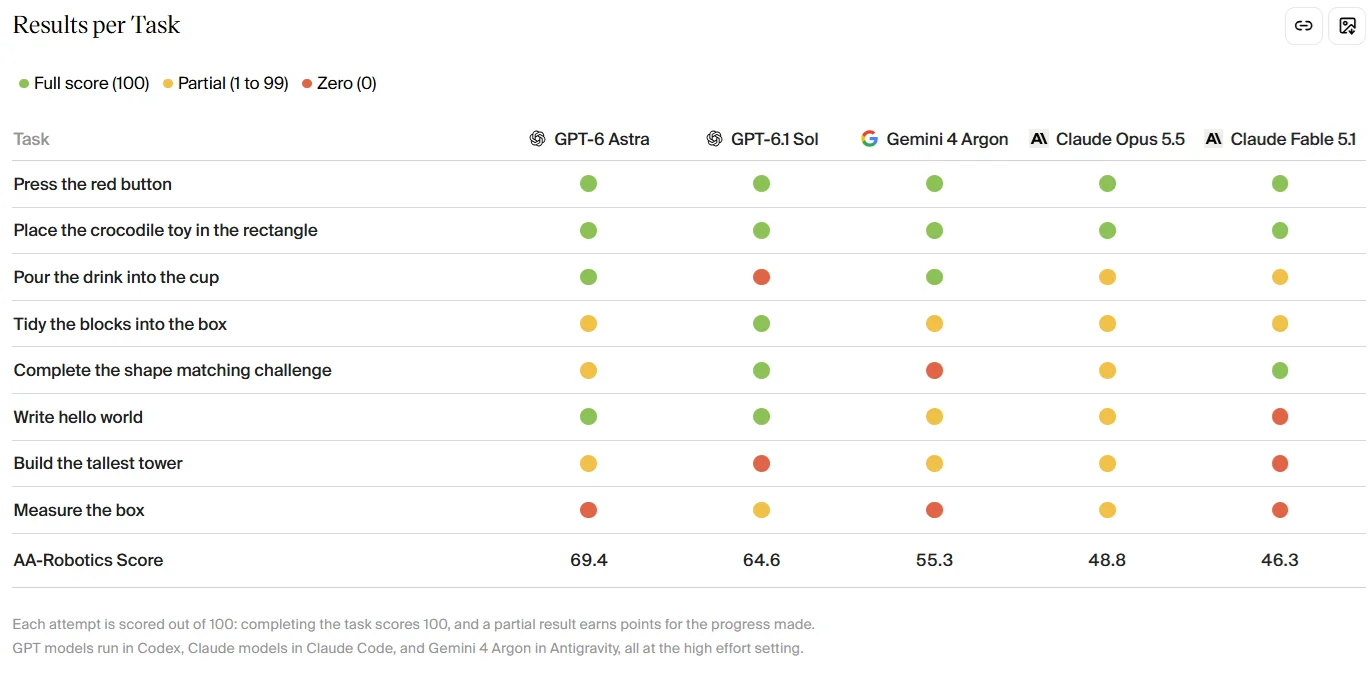
OpenAI’s GPT-6 Astra outperformed competing models in AA-Robotics v0.1 with a score of 69. Source:
Artificial Analysis
Each model controlled a robot arm with six joints and was given a goal in plain language across eight tabletop tasks. But despite the seemingly impressive results, the models were about 100 times slower than a person. A human needs about 20 seconds per task, while Astra needed about half an hour.
Astra was also the most expensive at $16.36 per task. Artificial Analysis said that the current language models are too slow and costly for real production robotics.
Beyond speed and cost, they also lack precision. RoboCurve, a public benefit corporation, reportedly tested Astra’s performance in real robot arms. Astra was able to successfully put a block in a bowl in 19 out of 20 tries, recording a 95% success rate at $0.94 per try. Meanwhile, Anthropic’s Claude Fable 5.1 succeeded only 40% of the time.
However, when given a harder job of pressing a puzzle piece into a tight round slot with millimeter accuracy, Astra got it right just 2 times in 20, or 10%, the same as Fable 5.1.
Unitree CEO Wang Xingxing has said that small errors build up with every move a robot makes, a problem that digital models do not face. RoboCurve’s Jay Chooi was more hopeful, saying that if current progress continues, language models could guide robot arms in real time within two to three years.
Nvidia has been promising a breakthrough for a while. At CES in January, Huang said the “ChatGPT moment” for physical AI was “nearly here.” A year earlier, he said it was “around the corner.”
In a study called “Astranomy,” Nvidia’s Seattle Robotics Lab tested a setup that uses Astra. The study was presented at CoRL 2026.
The setup scored 74.8% on RoboLab-120, which is a test where robots pick up objects and place them somewhere else. That was 23.8 points higher than the best earlier method. But each decision took 18.56 seconds, and one successful run used 30.9 million tokens, which cost about $36.40.
The Astranomy study clearly states that delay and cost are major obstacles to Astra’s real life use, which matches what the independent tests keep finding.
The smartest crypto minds already read our newsletter. Want in? Join them.