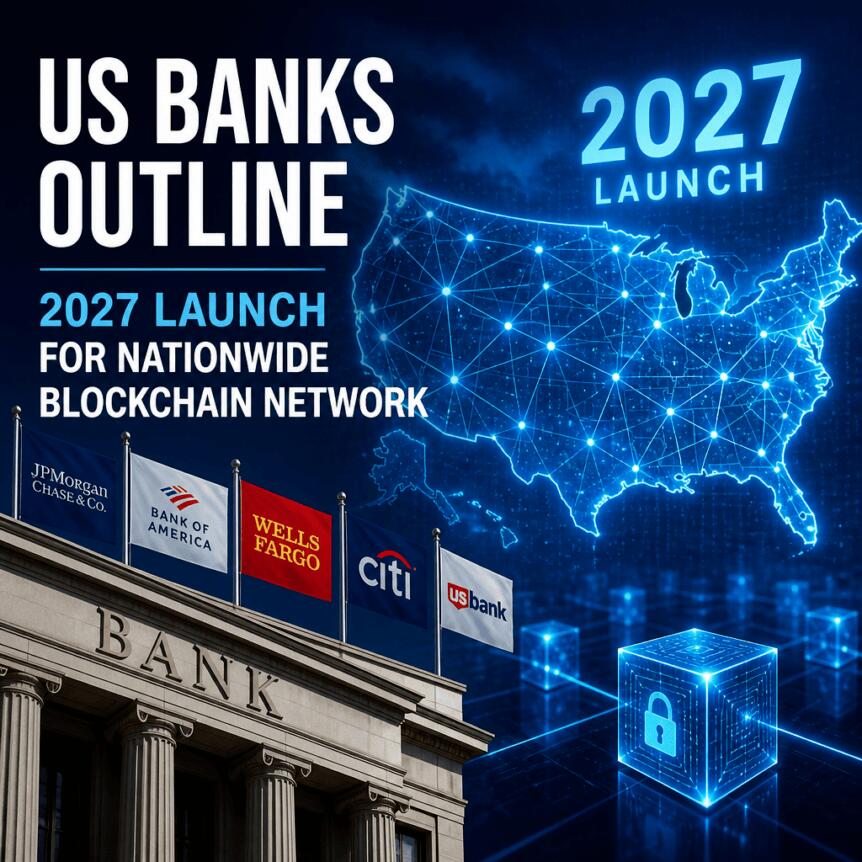
BankChain Alliance, a group formed by 39 US state banking associations, says it is building an industry-owned blockchain network for banks with a targeted launch in 2027. The network is inten
BankChain Alliance, a group formed by 39 US state banking associations, says it is building an industry-owned blockchain network for banks with a targeted launch in 2027. The network is intended to support capabilities such as smart payment tools, tokenized deposits, stablecoins, and automated settlement.
In an announcement shared Tuesday, BankChain said it wants the system to be interoperable with other blockchains and that it is currently selecting a technology partner. While the alliance says the participating associations represent thousands of financial institutions across the United States and plans to invite banks nationwide to take ownership of stakes, the release did not specify which individual banks have committed, nor did it outline governance or funding details.
Key takeaways
- BankChain Alliance is targeting a 2027 launch for a bank-owned blockchain network backed by 39 state banking associations.
- The planned use cases include smart payments, tokenized deposits, stablecoins, and automated settlement.
- BankChain says it is aiming for interoperability with other blockchains, while also selecting a technology partner.
- The announcement does not name committed banks or explain how the network will be governed and financed.
- BankChain joins multiple US bank-led initiatives developing onchain rails for regulated deposits and payments.
A new bank-led network with broad onchain ambitions
BankChain’s pitch is notably wide compared with many early banking pilots that focus on a narrow slice of payments infrastructure. According to the alliance’s announcement, the network is intended to handle both programmable payment functions and settlement automation, while also extending into areas that are often politically and operationally sensitive for traditional banks—especially tokenized deposits and stablecoins.
Just as important for adoption, BankChain frames tokenized deposits as part of the “bank money” landscape rather than an alternative outside the regulated system. The broader implication is that the network could enable near real-time or always-on transfer experiences without changing the fundamental legal and accounting nature of customer funds.
Tokenized deposits: why “programmability” is the central difference
One recurring theme across US banking initiatives is the distinction between independently issued stablecoins and tokenized deposits. In related reporting from the industry’s onchain efforts, The Clearing House previously described an “onchain money” concept aimed at clearing and settling tokenized deposits between banks while connecting blockchain activity to existing payment systems.
That distinction matters because tokenized deposits represent claims on specific banks. As The Clearing House’s plan (as cited in earlier coverage) is designed to keep customers’ funds on bank balance sheets, it potentially allows banks to offer automated, programmable transfers while preserving how those funds are treated within the banking framework.
For investors and practitioners watching the sector, this approach highlights a practical path toward onchain utility: rather than relying solely on stablecoins issued by third parties, banks can experiment with programmable rails that remain grounded in regulated deposit structures.
How BankChain fits into a wave of onchain consortiums
BankChain is not developing in isolation. Since late 2025, multiple US banking consortia have been announced or accelerated, often targeting shared infrastructure for deposits and payments while trying to satisfy compliance and operational requirements.
In June, The Clearing House announced an onchain money initiative with support from major institutions including JPMorgan Chase, Bank of America, Citi, BNY, and Wells Fargo. The concept described in that announcement focuses on clearing and settlement for tokenized deposits between banks and on bridging blockchain activity with existing payment systems.
Regional banks are also pursuing separate models. According to the Cari network update cited in earlier coverage, Cari—built with Huntington, First Horizon, M&T Bank, KeyBank, and Old National—launched a minimum viable product in March and had attracted more than 30 participating banks by July. Another initiative, the DTX Consortium, has been advanced by the Independent Bankers Association of Texas; IBAT said in June that membership exceeded 50 banks as it prepared a tokenized-deposit pilot.
BankChain’s addition reinforces a clear pattern: instead of a single unified standard emerging immediately, the US banking ecosystem appears to be experimenting with multiple consortium architectures in parallel, each with different partners, scopes, and timelines.
Stablecoins inside bank networks: interoperability and governance remain open questions
BankChain’s inclusion of stablecoins alongside tokenized deposits and settlement automation reflects a broader trend in which dollar-linked assets are increasingly discussed not just as consumer-facing products, but as plumbing within banking infrastructure. However, how such assets would be used—and under what oversight—remains central to how these networks could scale responsibly.
The announcement also points to interoperability as a design goal, saying the network will be interoperable with other blockchains. For banks, interoperability is attractive because it can reduce lock-in and potentially simplify integration with existing workflows and future rails. At the same time, achieving interoperability at institutional grade typically requires careful standards around identity, settlement finality, risk controls, and messaging—areas not addressed in the BankChain release.
Just as notable is what BankChain did not disclose. The announcement did not name specific banks that have committed to join, and it did not provide details on governance or funding. Those omissions are significant because governance determines who can change network rules, manage risk parameters, and define upgrade paths—while funding impacts timelines, incentives, and long-term operational sustainability.
Until those details are clarified, the most actionable signal for market participants may be the network’s stated direction rather than its near-term operating reality: a coordinated industry approach aimed at bringing onchain settlement closer to mainstream bank rails.
What to watch next
For the next phase, readers should focus on whether BankChain identifies participating banks publicly, provides a clearer governance and funding model, and details how its interoperability plan will work in practice—especially around how tokenized deposits and stablecoins would be introduced and controlled within a regulated environment.
This article was originally published as US Banks Outline 2027 Launch for Nationwide Blockchain Network on Crypto Breaking News – your trusted source for crypto news, Bitcoin news, and blockchain updates.