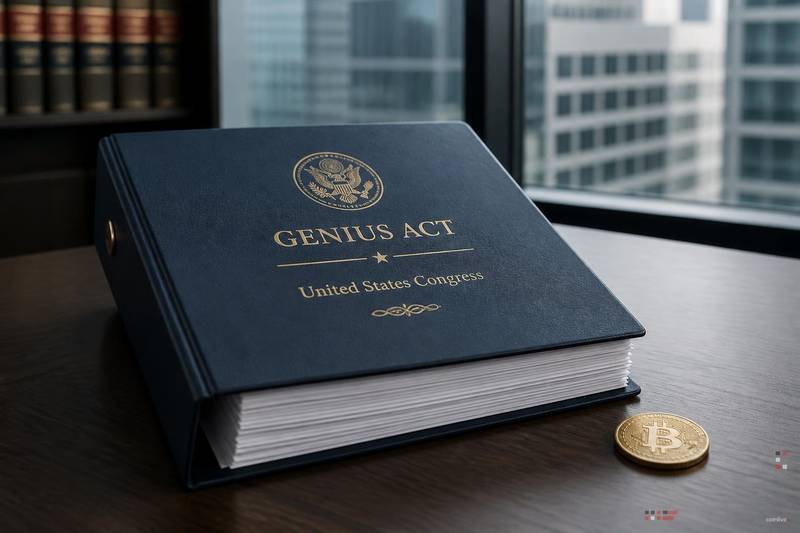
The United States has codified the GENIUS Act into federal law and moved to establish a national Bitcoin reserve, marking one of the most consequential shifts in US crypto policy to date. The
The United States has codified the GENIUS Act into federal law and moved to establish a national Bitcoin reserve, marking one of the most consequential shifts in US crypto policy to date. The dual development pairs a formal statutory framework with a sovereign-level Bitcoin position, signaling a firmer federal commitment to digital assets.
TLDR Keypoints
- The US signed the GENIUS Act into law, moving it from proposal to codified statute.
- A Strategic Bitcoin Reserve places the federal government in a sovereign Bitcoin holding position.
- Legal codification and reserve creation are two distinct policy signals within one story.
What the US codified in the GENIUS Act
President Donald J. Trump signed the GENIUS Act into law, according to a White House fact sheet. The signing moves the measure from legislative proposal into formal statutory status. For related coverage, see Drake Mentions Bitcoin in New Song: Crypto Culture Impact.
Codification means the framework is no longer a matter of policy discussion or a pending bill; it now carries the force of enacted law, recorded in the public statute record at GovInfo. For related coverage, see White House spotlights Bitcoin perpetual futures approval and Hyperliquid US push.
The shift matters because it establishes a durable federal reference point for digital asset policy, replacing prior uncertainty over where Washington stood. That change is central to the current US crypto regulatory landscape.
Why a US Bitcoin reserve changes the crypto narrative
Alongside the legislation, the US moved to establish a Strategic Bitcoin Reserve, formalized through a presidential action creating the reserve and a US digital asset stockpile. In practical terms, this positions the federal government as a holder of Bitcoin at the sovereign level.
A national reserve carries symbolic and strategic weight because it treats Bitcoin as an asset worth holding rather than merely regulating. The step follows earlier signals, including when Trump said the US was considering sizable Bitcoin purchases.
The reserve is distinct from the GENIUS Act itself. One codifies a legal framework; the other establishes a holding, and the two should be read as separate policy signals rather than a single action.
The idea has been building in policy circles for some time, including a proposal by a US congressman for a strategic Bitcoin reserve, and the debate has also drawn scrutiny over sanctions risk tied to reserve assets.
What this could mean for crypto markets and policy watchers
Combining enacted legislation with a Bitcoin reserve suggests a stronger federal commitment to crypto than statements or proposals alone conveyed. For market participants, that combination is the story's central hook.
Policymakers and industry observers are likely to read the paired announcement as a signal that US digital asset policy has entered a more formalized phase, one that could shape sentiment and regulatory expectations going forward.
The concrete facts here are limited to the codification and the reserve's establishment. Beyond those, this article makes no forecast on price direction, and the near-term market impact will depend on how the framework is implemented.
Disclaimer: This article is for informational purposes only and does not constitute financial or investment advice. Cryptocurrency and digital asset markets carry significant risk. Always do your own research before making decisions.
Read original article on coinlive.me