US Iran Trade Expands to Crypto, Gold, Technology, Aviation, Shipping The latest chapter in US-Iran trade news today centers on a sweeping expansion of secondary sanctions announced by the US
US Iran Trade Expands to Crypto, Gold, Technology, Aviation, Shipping
The latest chapter in US-Iran trade news today centers on a sweeping expansion of secondary sanctions announced by the US Treasury Department.
Unlike earlier rounds focused mainly on oil and shipping, this action pulls digital assets and crypto activity squarely into the enforcement net alongside more traditional targets like gold and aviation.
For businesses, banks, and crypto platforms with any exposure to Iran-linked counterparties, the announcement raises the stakes considerably.
At a Glance
The US Treasury has expanded secondary sanctions against Iran to squeeze the country's overseas revenue.
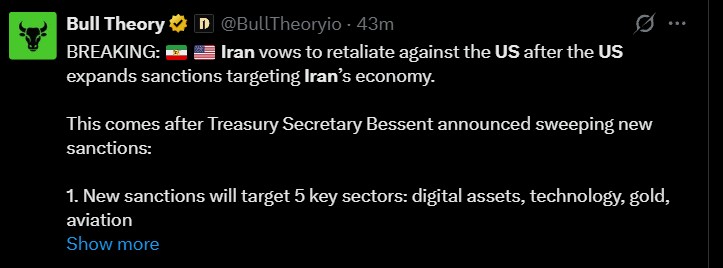
Five sectors are now in scope: digital assets, technology, aviation, gold, and shipping.
Foreign companies and banks still dealing with sanctioned Iranian entities now face a heightened risk of being cut off from the US financial system.
Bitcoin wallets and other digital asset addresses were named directly in the latest round of designations.
The move builds on earlier action against Iran's crypto exchange Nobitex and adds to nearly $1 billion in Iran-linked crypto assets already seized.
Treasury Expands Secondary Sanctions on Iran
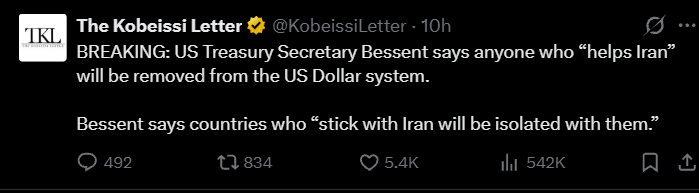
Treasury Secretary Scott Bessent unveiled the plan during a Monday press briefing, describing it as part of a broader effort some officials have nicknamed an "economic D-Day."
The core message: any foreign entity that keeps doing business with Iran-linked actors now faces a materially higher chance of being pulled into US sanctions itself. Bessent said the new measures expand secondary sanctions risk for those still willing to work with the Iranian regime, while speeding up enforcement.
Treasury, the State Department, and US military officials are reportedly coordinating with international partners, and Bessent indicated each country has been given its own timeline to wind down the flagged activity.
The Kobeissi Letter
Five Key Sectors Targeted Under the New Sanctions
The expanded measures zero in on five areas Treasury sees as central to Iran's ability to generate revenue abroad: digital assets, technology, aviation, gold, and shipping.
Each plays a distinct role in keeping money and goods moving in and out of the country. Gold and shipping have long served as workaround channels once oil sales get squeezed; technology and aviation access help sustain military and industrial capacity; and digital assets have increasingly become a way to move value across borders without touching the traditional banking system that sanctions already restrict.
Bull Theory
Digital Assets and Bitcoin Wallets in the Crosshairs
Crypto's inclusion is the sharpest departure from past rounds. Treasury named specific digital asset addresses in Monday's action, including a Bitcoin wallet the department says is tied to an individual identified as Arman Kahzadian, who allegedly took control of a wallet holding a significant amount of Bitcoin (BTC) back in 2023.
Naming wallet addresses directly means US persons and, by extension, many global exchanges and payment processors are now expected to screen transactions against these addresses, not just against named individuals or companies.
Nobitex and Iran's Wider Crypto Network
This latest step builds on earlier action against Nobitex, described as Iran's largest crypto exchange. US officials previously accused Nobitex of facilitating sanctions evasion, moving funds linked to terrorist financing, and processing transactions connected to Iran's Islamic Revolutionary Guard Corps.
Treasury has said that by May, close to $1 billion in Iran-related crypto assets had already been seized, underscoring how central digital assets have become to Iran's efforts to route money around the traditional financial system.
The Hormuz Letter
What the 'Economic D-Day' Warning Means for Global Businesses
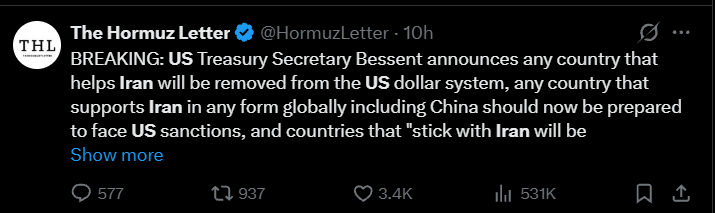
Beyond the specific sectors, Bessent's language carries a broader warning: countries and companies seen as helping Iran evade sanctions risk losing access to the US dollar system altogether. That's a serious threat given how much international trade still runs through dollar-denominated transactions and US-linked banking rails.
For multinational firms, the message is that compliance teams need to widen their due diligence beyond Iran-based entities to include intermediaries, shell structures, and crypto addresses that could tie back to sanctioned parties.
Possible Ripple Effects on Global Trade and Crypto
Banks, shipping firms, technology exporters, and crypto exchanges with any international footprint are likely to face increased compliance scrutiny in the wake of this announcement. Expect tighter transaction monitoring, more frequent wallet-address screening, and possibly slower onboarding for clients or counterparties based in regions with elevated sanctions exposure.
Some analysts caution this kind of pressure can also push affected countries to lean harder on alternative payment systems outside US oversight, a tradeoff Washington appears willing to accept in exchange for tighter near-term leverage.
What Happens Next in the US-Iran Economic Standoff
Treasury, the State Department, and the Pentagon are reportedly working with international partners on enforcement timelines, with Bessent suggesting countries have been given individual deadlines to unwind flagged activity.
Businesses operating in high-risk jurisdictions, or with any exposure to Iran-linked digital asset addresses, should watch for further designations, updated compliance guidance, and possible follow-on sanctions targeting entities that fail to comply.
Conclusion
This round of sanctions marks a notable widening of the US pressure campaign against Iran, folding digital assets and blockchain-based activity in alongside long-standing targets like oil prices, shipping, and gold. For global businesses and crypto platforms, the practical takeaway is straightforward: sanctions risk no longer stops at named entities — it now extends to specific wallet addresses and the broader networks connected to them.
Disclaimer: This article is for informational purposes only and should not be considered financial, investment, legal, or compliance advice. Sanctions regulations can change rapidly, and individuals or businesses should consult qualified legal and compliance professionals before engaging in transactions involving sanctioned countries, entities, or digital asset addresses.