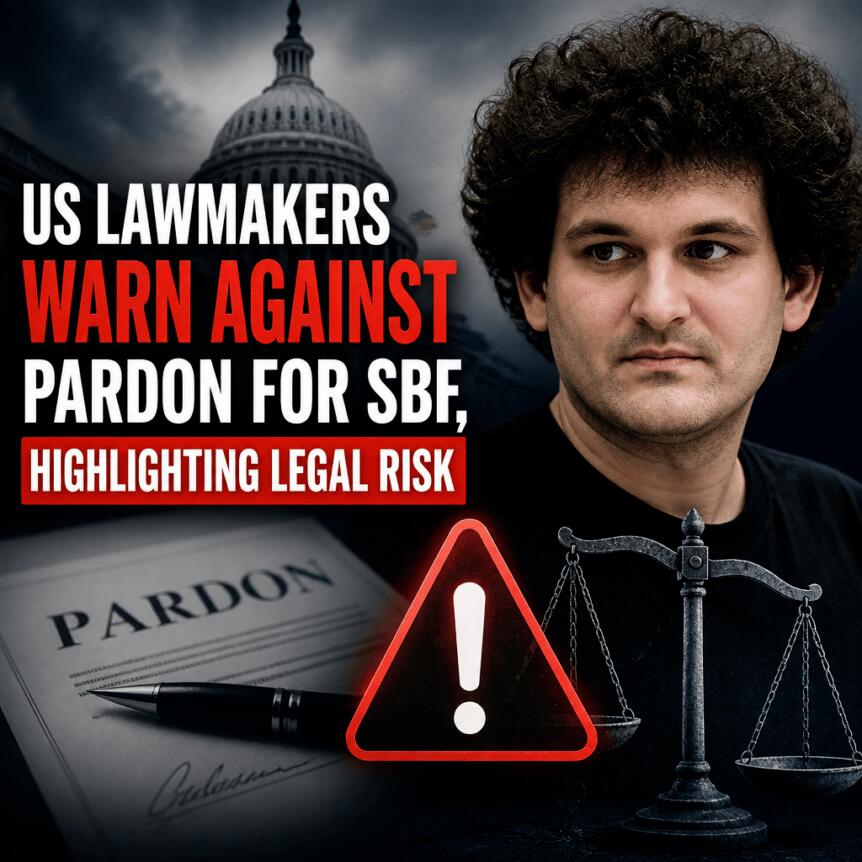
Two US senators—Cynthia Lummis, a Republican, and Rubén Gallego, a Democrat—are co-sponsoring a congressional resolution urging President Donald Trump to deny any request for executive clemen
Two US senators—Cynthia Lummis, a Republican, and Rubén Gallego, a Democrat—are co-sponsoring a congressional resolution urging President Donald Trump to deny any request for executive clemency for convicted FTX founder Sam Bankman-Fried. The move highlights how high-profile enforcement outcomes in the cryptocurrency sector are increasingly becoming part of the broader political and compliance landscape around financial fraud and accountability.
The proposed resolution, to be introduced Wednesday, is framed as non-binding, while acknowledging that clemency decisions remain constitutionally within the president’s authority. Still, the senators argue that granting a pardon or commutation would undermine deterrence and could be read as a signal that large-scale financial misconduct can avoid lasting consequences.
Key takeaways
- Lummis and Gallego plan to introduce a non-binding Senate resolution discouraging any executive clemency for Sam Bankman-Fried.
- The resolution argues that Bankman-Fried’s 25-year sentence reflects the scale and deliberateness of the crimes and supports justice and deterrence.
- The proposal follows formal steps by Bankman-Fried to seek a presidential pardon after an appeals court upheld his conviction and sentence.
- The case remains politically and compliance significant, given its connection to the misuse of FTX customer funds and the resulting broader scrutiny of crypto-related governance and AML-type controls.
Senate resolution targets any clemency for Bankman-Fried
According to the draft resolution, the Senate would “affirm” that Bankman-Fried’s 25-year prison sentence appropriately reflects what the lawmakers characterize as the extraordinary scale and deliberate nature of his offenses, along with the alleged absence of remorse and the “catastrophic harm” to victims.
The senators’ core concern is prospective: if a pardon were granted, they argue it would effectively erase the conviction, weaken deterrence, and send what they describe as a “deeply damaging message” regarding accountability for large-scale financial fraud.
While such resolutions do not alter the legal effect of a presidential pardon, they can still influence how institutions—exchanges, banks, custodians, and compliance officers—interpret enforcement risk and the perceived stability of consequences following convictions.
Why the timing matters after appeals and a clemency request
The resolution comes after Bankman-Fried formally applied to President Trump for a pardon following the upholding of his conviction and 25-year sentence by a federal appeals court. With the appeals process having concluded in his favor only in part—leaving him no clear standard route besides further review at the Supreme Court or a presidential pardon—clemency becomes the central remaining legal channel.
The underlying criminal case dates to the collapse of the cryptocurrency exchange FTX in 2022. Bankman-Fried was convicted in November 2023 on seven felony counts connected to the misuse of FTX user funds. He was subsequently sentenced to 25 years in prison.
In practical compliance terms, the post-conviction phase is where governance lessons can solidify into policy expectations. For financial institutions evaluating crypto counterparties, the posture of enforcement—particularly where misuse of customer assets is alleged—often becomes part of risk assessments and supervisory scrutiny under broader fraud, AML/CFT, and consumer protection frameworks, even when the primary legal theory arises under criminal statutes rather than market-structure rules.
Cointelegraph previously reported on Bankman-Fried’s clemency bid and on the appeals court’s decision to uphold the sentence. The congressional resolution further underscores that the outcome is not only a judicial matter but also a regulatory and institutional signal.
Non-binding, constitutional clemency power—and the message problem
The resolution’s non-binding nature reflects the separation of powers in the US system. The president’s pardon power is constitutionally established, meaning that a Senate resolution cannot compel a specific outcome.
However, the lawmakers contend that a pardon would carry consequences beyond the individual case by reshaping deterrence perceptions. This “message” argument is particularly salient in the crypto context, where regulators and supervised entities are still working to translate lessons from high-profile failures into durable compliance controls—such as segregation of customer assets, effective custody arrangements, transaction monitoring, and accountability for executive conduct.
For institutional readers, the unresolved question is how presidential decision-making will be evaluated relative to enforcement outcomes. Even if clemency is legally permissible, supporters and opponents may read it as either a correction of perceived severity or as a precedent-like event affecting future compliance risk calculations across the sector.
Bankman-Fried is not the only prominent figure from the FTX ecosystem whose criminal case has continued to shape the sector’s compliance narrative. Several former executives and associates have already received sentences that range from cooperation-based outcomes to longer terms.
Cointelegraph’s reporting notes that Caroline Ellison, former CEO of Alameda Research, received a two-year sentence in 2024 and was released early in January after 14 months. Nishad Singh, a former engineering director, and Gary Wang, an FTX co-founder, were sentenced to time served, with both having testified against Bankman-Fried at trial.
Other individuals have faced additional consequences. Ryan Salame, co-CEO of FTX Digital Markets, was sentenced to 90 months in prison related to unlawful political contributions and conspiracy to operate an unlicensed money-transmitting business. Separately, reporting also indicates that Salame’s wife, Michelle Bond, was indicted in connection with alleged illegal campaign financing tied to her 2022 run for Congress.
These proceedings collectively matter to compliance teams because they span multiple enforcement categories—fraud, financial services licensing, and campaign finance allegations—demonstrating that crypto-related misconduct can implicate different regulatory regimes simultaneously.
Closing perspective: what to monitor next
As the Senate resolution proceeds, the key variable will remain the timing and substance of any presidential action following Bankman-Fried’s clemency application. Even without legal effect on a pardon’s enforceability, the political and institutional response to any decision is likely to influence how banks, custodians, and exchanges calibrate compliance programs and risk frameworks for customer-asset protection and executive accountability.
This article was originally published as US Lawmakers Warn Against Pardon for SBF, Highlighting Legal Risk on Crypto Breaking News – your trusted source for crypto news, Bitcoin news, and blockchain updates.