Can US PPI Inflation, Retail Sales and Jobless Claims Shift Fed Rate? Markets are on edge after a hotter-than-expected September CPI report. Today, three new releases could shape the Federal
Can US PPI Inflation, Retail Sales and Jobless Claims Shift Fed Rate?
Markets are on edge after a hotter-than-expected September CPI report. Today, three new releases could shape the Federal Reserve next move. US PPI inflation, retail sales and jobless claims all arrive at 8:30 AM ET on October 15, 2026.
Investors want to know one thing. Will the numbers show that prices are staying stubborn, or that demand and hiring are starting to cool?
At a Glance: Three US Economic Reports to Watch
Release time: 8:30 AM ET on Thursday, October 15, 2026 (6:00 PM IST)
September PPI: Measures price pressure faced by producers
September retail sales: Shows whether higher prices are slowing consumer spending
Weekly initial jobless claims: A quick check on the US labour market
Next Fed meeting: October 27 to 28
US PPI Inflation: Will Producer Prices Add to the Fed’s Concerns?
The Producer Price Index tracks the prices businesses receive for their goods and services. Rising producer costs can signal that inflation is sticky. Economists expect PPI to rise 0.5% month over month and 5.4% year over year in September.
Both figures are forecasts, not confirmed results. Analysts link the expected jump largely to shifting energy costs.
Yesterday Hot CPI Data report set a tense backdrop. The Bureau of Labor Statistics said headline CPI rose 0.6% in September and 3.7% over the past year. Core CPI, which removes food and energy, rose 0.3% on the month and 2.6% annually. Both core readings were above forecasts of 0.2% and 2.5%.
PPI and CPI measure different stages of the price chain. A hot producer reading does not automatically mean consumers will pay more. Still, it adds to inflation worries.
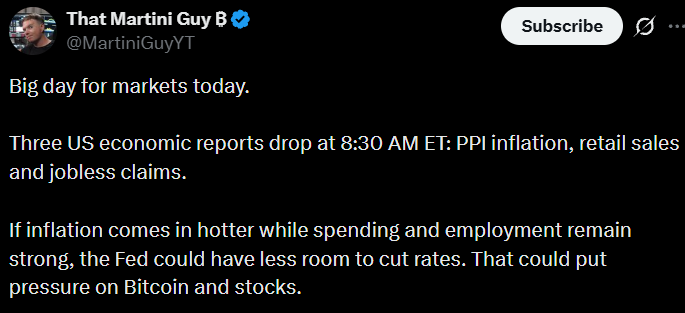
Source: The Martini Guy
Retail Sales and Jobless Claims: Is the US Economy Cooling?
Retail sales are expected to rise 0.3% in September after a 1.2% jump in August. Traders want to see whether high prices are actually reducing spending. Strong sales alongside hot producer prices would raise a fair question. Where is the slowdown that should bring inflation down?
Initial jobless claims are expected to edge up to about 200,000 from 197,000 the week before. A notable rise could suggest the labour market is weakening while inflation stays high.
That mix would be hard for the Federal Reserve to manage. One report cannot prove a recession or decide policy. The pattern across all three matters more.
US Economic Data: Forecasts Versus Previous Readings
Indicator
Previous reading
October 15 expectation
Why it matters
PPI
Not confirmed in supplied reports
+0.5% MoM, +5.4% YoY
Producer inflation
Retail sales
+1.2% in August
+0.3% MoM
Consumer demand
Jobless claims
197,000
About 200,000
Labour market health
Timeline: From September CPI to Fed Rate Cut Decision
October 14:September CPI shows 3.7% annual inflation.
October 15, 8:30 AM ET: PPI, retail sales, and jobless claims are released.
October 15, after the data: Markets weigh Treasury yields, the dollar and equity futures.
October 27 to 28: The Federal Open Market Committee meets.
This is a schedule of events, not a forecast of the Fed Rate Cut decision.
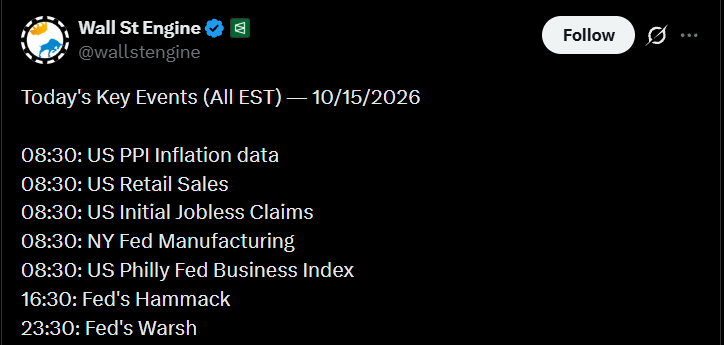
Source: Wall St Engine
What Could Results Mean for Bitcoin, Stocks and Fed Rate Expectations?
Futures show how nervous traders are. Dow futures rose about 0.46% near 52,090 during European hours, while S&P 500 futures slipped 0.33% and Nasdaq 100 futures fell 1.30%.
On Wednesday, the S&P 500 fell 1.11% and the Nasdaq Composite fell 1.88%. Deutsche Bank analysts pointed to AI-related worries weighing on chip stocks and data centers.
Rate hike odds have also moved. CME FedWatch showed roughly a 31.6% chance of a hike in October after the Hot CPI Data Report, though other market commentary cited about 29%. Odds vary by time of day. December expectations look firmer than October.
Three scenarios are worth watching:
Hot inflation and strong spending: This could lift Treasury yields and the dollar, and weigh on stocks and Bitcoin.
Cooler inflation and softer demand: This could support a less hawkish Fed, though the full data picture will matter.
Rising claims with sticky inflation: This could leave the Fed with fewer good options.
Bitcoin price and stocks both react to interest rate expectations, liquidity, and risk appetite. Weak data is not always bullish, because recession fears can hurt risk assets too.
Conclusion: What Investors Should Watch After the Releases
The direction of US PPI inflation, retail sales and jobless claims together matters more than any single headline number. Compare each result with its forecast. Then watch Treasury yields, the dollar, and Fed official commentary, including speeches from Hammack and Warsh later today, before concluding on Bitcoin or stocks.
YMYL Disclaimer: This article is for informational and educational purposes only and is not financial or investment advice. Economic releases and market reactions are uncertain. Cryptocurrency and stock investments carry high risk, including the loss of your capital. Do your own research and consider your finances before making any decision.