The U.S. Securities and Exchange Commission (SEC) has updated its guidance on how federal securities laws apply to “certain types of crypto assets and certain transactions involving crypto as
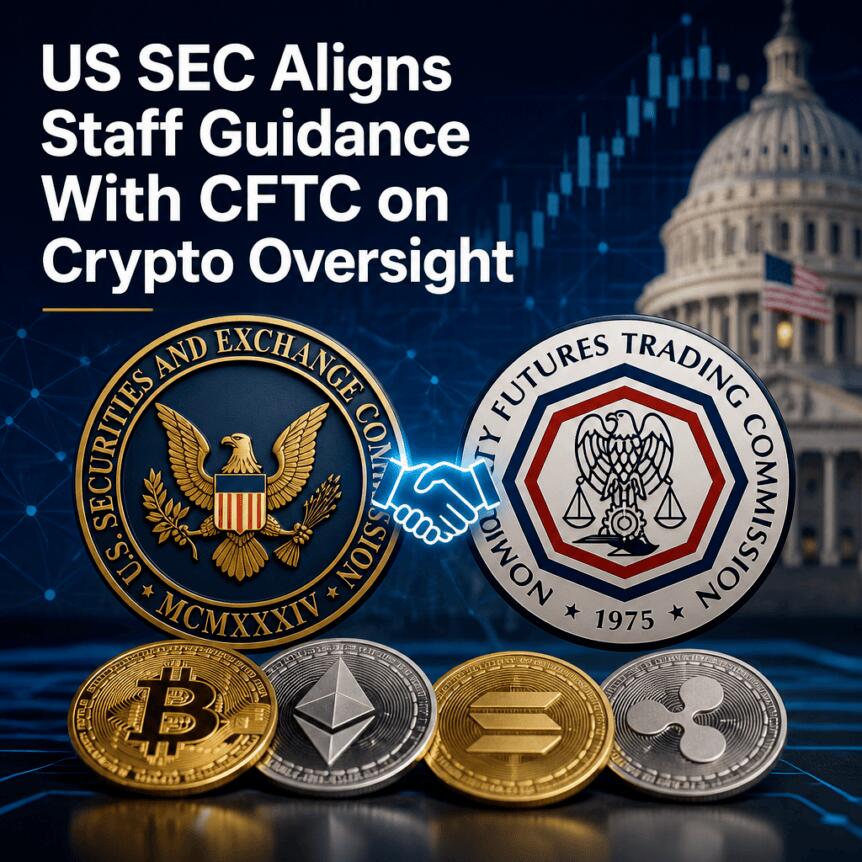
The U.S. Securities and Exchange Commission (SEC) has updated its guidance on how federal securities laws apply to “certain types of crypto assets and certain transactions involving crypto assets,” expanding on the framework it outlined in March. The new clarification arrived via an update to the agency’s frequently asked questions, and it follows a similar move from the Commodity Futures Trading Commission (CFTC) earlier last week.
In the Friday update to its crypto FAQs, the SEC emphasized that the guidance is non-binding. The agency said the interpretation has “no legal force or effect,” does not amend existing law, and does not create additional obligations for any person. The FAQ material is intended to explain how the SEC would analyze whether certain digital asset products could be considered investment contracts under the Howey test.
Key takeaways
- The SEC’s refreshed crypto FAQ reiterates that it is non-binding and does not change applicable securities laws.
- The SEC’s Howey analysis is framed around whether token-related activities involve “essential managerial efforts,” including in contexts such as buybacks and network functions.
- Token issuer buyback programs may not automatically trigger securities classification if the underlying setup remains decentralized and lacks a central party.
- Network operations and certain staking receipt tokens may not always be treated as securities, depending on how the facts map to Howey.
- The SEC’s update comes shortly after the CFTC provided its own token guidance, while Congress did not advance a proposed crypto market structure bill.
SEC FAQ update: non-binding, but aimed at the Howey test
The SEC’s revised FAQ is designed to guide market participants on how the agency approaches crypto arrangements that could be viewed as investment contracts. As the SEC noted, the FAQ is part of a continuing effort to clarify its position without rewriting law.
Central to the SEC’s approach is the Howey test, which examines whether a digital asset arrangement amounts to an investment contract—often summarized as requiring an investment of money in a common enterprise with a reasonable expectation of profits to be derived from the efforts of others.
The SEC’s updated FAQs focus specifically on how it might consider “digital asset products” that fall within that investment-contract framework.
Buybacks, network functionality, and what “central party” implies
One practical area the SEC addressed is token issuers conducting customer buyback programs. The regulator indicated that buybacks may be permissible without necessarily leading to an investment-contract conclusion, provided the relevant conditions are met.
According to the SEC, such buyback activity could be viewed as non-securities behavior where “a crypto system is functional and has no central party.” In that scenario, the agency suggested that the buyback would not necessarily amount to “a representation or promise to undertake essential managerial efforts”—a key concept in its investment-contract analysis.
The SEC’s reasoning highlights the importance of decentralization in its securities assessment: the more a system relies on a central actor performing managerial or profit-driving efforts, the more likely the SEC could view token holders’ profit expectations as tied to those efforts.
The SEC also extended similar logic to crypto networks. It stated that a system described as “functional,” and that includes services meant to “secure, maintain, improve, or enhance such a system or its functionality,” or to “facilitate network effects,” would not necessarily satisfy the agency’s Howey test.
In other words, routine network maintenance and enhancements—if they do not cross the SEC’s threshold into managerial efforts tied to profits—may not automatically trigger securities treatment.
Staking receipt tokens: not automatically securities
The SEC also addressed staking receipt tokens. The regulator said staking receipt tokens “would not always” classify as securities, reinforcing that the outcome depends on how the particular staking arrangement is structured and how it fits within Howey.
This phrasing matters for market participants because staking is often treated as a core utility feature in many crypto ecosystems. The SEC’s updated position suggests that staking mechanisms are not automatically securities by virtue of being “receipts,” but could become so if a reasonable investor’s profits are expected to come from the efforts of others in a way the SEC considers essential to the arrangement.
For builders and token issuers, the takeaway is not that staking is safe by default, but that facts and design choices remain central. What the SEC “would” treat as an investment contract continues to hinge on whether efforts are sufficiently managerial and linked to profit expectations.
Regulatory momentum across agencies—and Congress stalled
The SEC’s action followed a similar step by the CFTC, which also issued guidance to token issuers. Both staff answers were released days after the Senate failed to advance a crypto market structure bill that many industry participants had expected would provide greater clarity around how the two regulators would share oversight.
In the absence of new federal legislation, SEC and CFTC leadership signaled that agencies may continue addressing crypto regulation without Congress first acting. The SEC update therefore lands in a context where compliance expectations are being shaped through agency guidance rather than statutory change.
For investors and traders, these updates can influence how exchanges, custodians, and market platforms think about listing decisions and risk management. While the SEC emphasized that its FAQ guidance is not legally binding, it still functions as a roadmap for how the agency may interpret securities laws in enforcement or regulatory engagement.
Meanwhile, Hester Peirce is set to leave the SEC
Separately from the FAQ update, SEC Commissioner Hester Peirce announced that she planned to resign on Oct. 2 after serving eight years. Peirce, often described in industry circles as a leading advocate for more crypto-friendly regulatory approaches, is expected to join the law school of Regent University in Virginia as an associate professor in November.
With Peirce’s departure, the SEC’s top leadership role will rest primarily with Chair Paul Atkins and Commissioner Mark Uyeda. Both are Republican commissioners on a panel that typically includes five members. As of Monday, the White House had not announced potential replacements for Peirce or for two remaining Democratic SEC seats.
That shift in leadership composition could affect how aggressively the SEC pursues enforcement versus how it balances guidance and engagement—especially in a period when Congress has yet to provide a broader statutory framework for digital asset markets.
Going forward, market participants will likely watch whether the SEC and CFTC’s guidance leads to more consistent compliance standards across token types, and whether the post-Peirce leadership changes how quickly additional interpretive steps are taken—particularly around buybacks, staking arrangements, and network governance.
This article was originally published as US SEC Aligns Staff Guidance With CFTC on Crypto Oversight on Crypto Breaking News – your trusted source for crypto news, Bitcoin news, and blockchain updates.