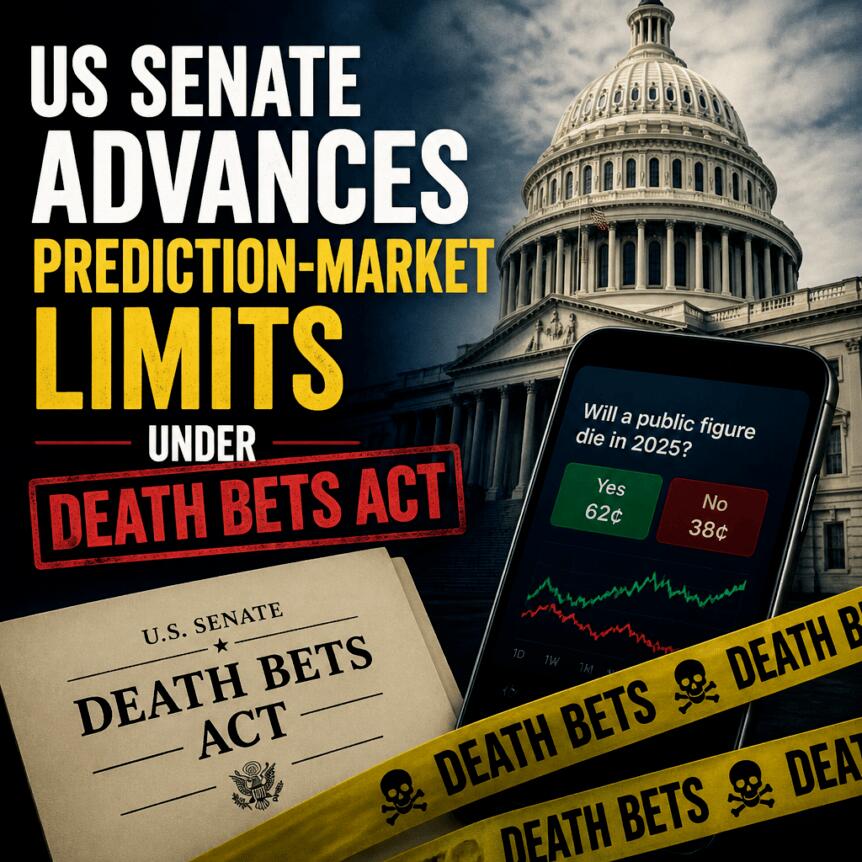
The U.S. Senate has passed legislation that would restrict federally regulated prediction markets from offering contracts tied to death, war, terrorism, and assassinations. The bill, known as
The U.S. Senate has passed legislation that would restrict federally regulated prediction markets from offering contracts tied to death, war, terrorism, and assassinations. The bill, known as the DEATH BETS Act, now heads to the House of Representatives after clearing the Senate by voice vote.
If enacted, the measure would amend the Commodity Exchange Act to bar CFTC-registered exchanges from listing or clearing prediction-market contracts tied to specified violent events, and it would grant the Commodity Futures Trading Commission authority to identify similar activities that should be covered.
Key takeaways
- The Senate passed the DEATH BETS Act by voice vote, sending the bill to the House for consideration.
- The legislation would prohibit CFTC-registered exchanges from listing or clearing contracts tied to war, terrorism, assassination, and events primarily determined by an individual’s death.
- It also covers contracts tied to U.S. military operations and would let the CFTC define additional comparable activities that fall under the ban.
- The House must approve the bill before it can be presented to President Donald Trump for signature.
What the DEATH BETS Act would change
Introduced by Democratic Sen. Adam Schiff in March, the DEATH BETS Act would modify the Commodity Exchange Act to directly limit the types of outcomes that regulated prediction markets may offer. According to the bill text on Congress.gov, the core prohibition would target contracts tied to war, terrorism, assassination, and events primarily determined by a person’s death.
The proposed rules are not limited to a narrow set of labels. The legislation also covers contracts referencing U.S. military operations. In addition, it would give the CFTC power to identify other activities that should be treated as covered events, extending the reach beyond the exact scenarios spelled out in the initial draft.
Under the framework described in the bill, contracts would also be prohibited when they are “reasonably expected” to be settled primarily based on an individual’s death at the time the contract is listed. That “reasonably expected to be settled” standard is significant because it focuses on what market participants and exchanges can anticipate before trading begins, rather than only on outcomes that later turn out to be death-related.
Why Schiff pushed the proposal
Schiff’s push for the DEATH BETS Act was framed around national security and the risk that prediction-market trading could intersect with misuse of sensitive information. In remarks accompanying the bill’s introduction, Schiff warned that allowing traders to profit from violent events could encourage the misuse of classified information, threaten national security, and create incentives for violence.
As the bill advanced, the policy concern was reinforced by earlier reporting that triggered political momentum for the measure. Earlier coverage from Cointelegraph noted that the proposal gained traction amid insider-trading concerns after six Polymarket traders reportedly earned $1 million by betting on the timing of U.S. strikes against Iran. Cointelegraph also reported that several wagers were placed just hours before the first reported explosions in Tehran, contributing to suspicions that traders may have had access to nonpublic information.
While the DEATH BETS Act targets federally regulated prediction markets—via the CFTC-registered exchange framework in the Commodity Exchange Act—the broader debate around Polymarket helped shape the political narrative around whether markets that settle on real-world violence create unacceptable risks.
How the bill’s regulatory scope could affect prediction markets
A central feature of the legislation is that it would operate through the gatekeeping role of CFTC registration. The bill would prohibit exchanges that are registered with the CFTC from listing or clearing contracts that fall within the defined categories. That approach differs from an outright ban on all prediction markets or all forms of political or event-based speculation; instead, it focuses on the most sensitive outcome types.
For market operators and participants, the likely practical impact is an additional compliance burden: exchanges would need to screen contract proposals and settlement mechanics to ensure they are not tied to covered events, including death-related outcomes expected to drive settlement. The inclusion of U.S. military operations within the covered set could also affect how contracts related to geopolitical developments are structured.
The bill’s provision allowing the CFTC to identify comparable activities introduces another layer of uncertainty for the industry. Even if a contract does not explicitly mention the listed categories, the regulator could potentially determine that it is functionally similar and falls under the ban. That means market designers may need to watch for forthcoming regulatory interpretations and enforcement priorities if the legislation advances.
Next steps in the legislative process
With Senate passage secured, the next phase is consideration in the House of Representatives. The bill must pass there before it can be sent to President Donald Trump for signature. Until the House acts, the fate of the bill remains uncertain.
For participants in the prediction-market ecosystem, the key question now is not only whether the House will approve the DEATH BETS Act, but also whether any changes will be made to its scope or enforcement mechanisms during House deliberations. Readers should watch for how lawmakers in the House respond to the Senate’s approach—particularly the extent of the CFTC’s authority to expand the categories of covered activities—and whether that power is preserved, narrowed, or refined.
This article was originally published as US Senate Advances Prediction-Market Limits Under DEATH BETS Act on Crypto Breaking News – your trusted source for crypto news, Bitcoin news, and blockchain updates.