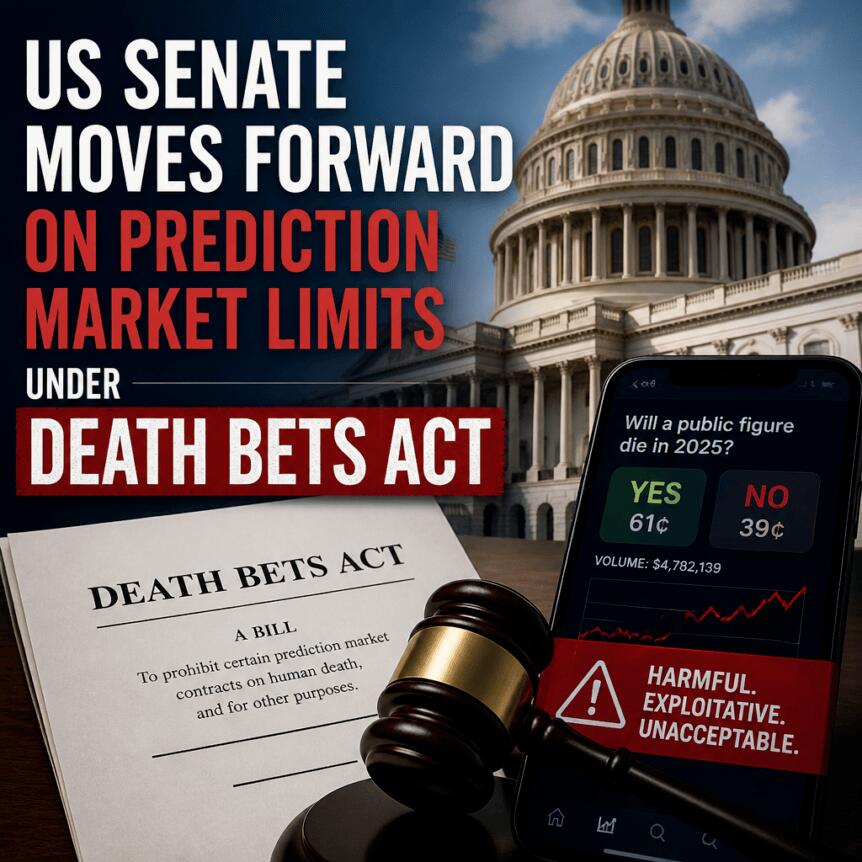
The U.S. Senate has passed a bill aimed at restricting federally regulated prediction markets from offering contracts tied to some of the most sensitive categories of real-world events, inclu
The U.S. Senate has passed a bill aimed at restricting federally regulated prediction markets from offering contracts tied to some of the most sensitive categories of real-world events, including war, terrorism, assassination, and outcomes “primarily determined” by a person’s death. The legislation now heads to the House of Representatives for further consideration.
The measure, known as the DEATH BETS Act, was introduced by Democratic Sen. Adam Schiff in March. According to the bill text and its progress on Congress.gov, it would amend the Commodity Exchange Act to bar CFTC-registered exchanges from listing or clearing certain contract types.
Key takeaways
- The Senate passed the DEATH BETS Act by voice vote, sending it to the House after adopting an amendment by unanimous consent.
- The proposed change would limit CFTC-regulated prediction markets from listing or clearing contracts tied to war, terrorism, assassination, or events where death is the dominant determining factor.
- The bill also addresses contracts tied to US military operations and grants the CFTC authority to identify additional activities that should fall under the ban.
- If Congress passes the bill in the House, it would move to President Donald Trump for signature.
What the DEATH BETS Act would change
In its current form, the DEATH BETS Act would directly modify rules governing federally regulated prediction markets. Specifically, it targets contracts offered by exchanges registered with the U.S. Commodity Futures Trading Commission (CFTC) that reference certain violent or death-linked scenarios.
As described in the legislation on Congress.gov, the bill includes several overlapping restrictions:
- War, terrorism, and assassination-linked contracts would be prohibited from being listed or cleared.
- Contracts referencing US military operations would also fall under the restriction.
- The CFTC would be empowered to identify similar activities that meet the same underlying criteria and should therefore be covered by the ban.
- Contracts would be prohibited where, at the time of listing, they are reasonably expected to be settled primarily based on an individual’s death.
That “reasonably expected” standard is important because it shifts the focus from only completed outcomes to how the contract is likely to be resolved when it is first offered—potentially tightening compliance expectations for exchanges assessing what drives settlement.
Why Sen. Adam Schiff says the ban is necessary
Schiff’s rationale centers on concerns that markets built around violent events could create incentives to exploit sensitive information. When introducing the bill, he argued that allowing traders to profit from events involving violence could encourage misuse of classified information, pose national security risks, and create additional incentives for wrongdoing.
These concerns were reflected in Schiff’s press materials when he introduced the legislation, which are posted on his official Senate website. As the press release describes, the senator framed the initiative as a way to draw a clear boundary around prediction contracts that could intersect with sensitive operational or security information.
Polymarket controversy adds urgency
The bill’s push gained prominence against the backdrop of insider-trading allegations involving Polymarket. Earlier coverage noted that, following reports that six Polymarket traders earned about $1 million betting on the timing of US strikes against Iran, lawmakers and watchdogs questioned whether the wagers were made using nonpublic information.
Earlier reporting by Cointelegraph described how several of those bets were placed shortly before explosions were reported in Tehran, heightening suspicion that traders may have had access to information not yet publicly available. Cointelegraph also covered Schiff’s broader initiative, stating it was introduced in March amid these concerns.
The DEATH BETS Act does not directly label any specific platform or traders, but its structure closely mirrors the kinds of scenarios raised in the Polymarket-related dispute: violent, time-sensitive events, and outcomes where death is a primary driver of settlement.
What happens next in Congress
With Senate passage, the proposal now moves to the House of Representatives. The bill must clear the House before advancing to President Donald Trump for signature, a step that could determine whether the restrictions apply immediately after enactment or after any implementation timelines set by regulators.
For operators of CFTC-registered prediction market exchanges, the near-term question will be how the CFTC interprets the bill’s scope—particularly the boundary between “similar activities” the agency can designate and the specific contract framing exchanges use to determine settlement drivers. For traders and users, the practical impact will depend on whether exchanges adjust listing policies quickly and how they document that contracts are not “reasonably expected” to settle primarily based on a person’s death.
As the bill moves to the House, market participants should watch for any changes in definitions, enforcement mechanics, and the CFTC’s expected regulatory approach to the “reasonably expected” standard—issues that could shape how broadly the ban affects real-time, event-driven forecasting markets.
This article was originally published as US Senate Moves Forward on Prediction Market Limits Under DEATH BETS Act on Crypto Breaking News – your trusted source for crypto news, Bitcoin news, and blockchain updates.