Washington sanctioned Shelbit and Aban Tether on August 7, 2026, accusing the two crypto platforms of supporting financial networks linked to Iran. Behind these little-known names lies a netw
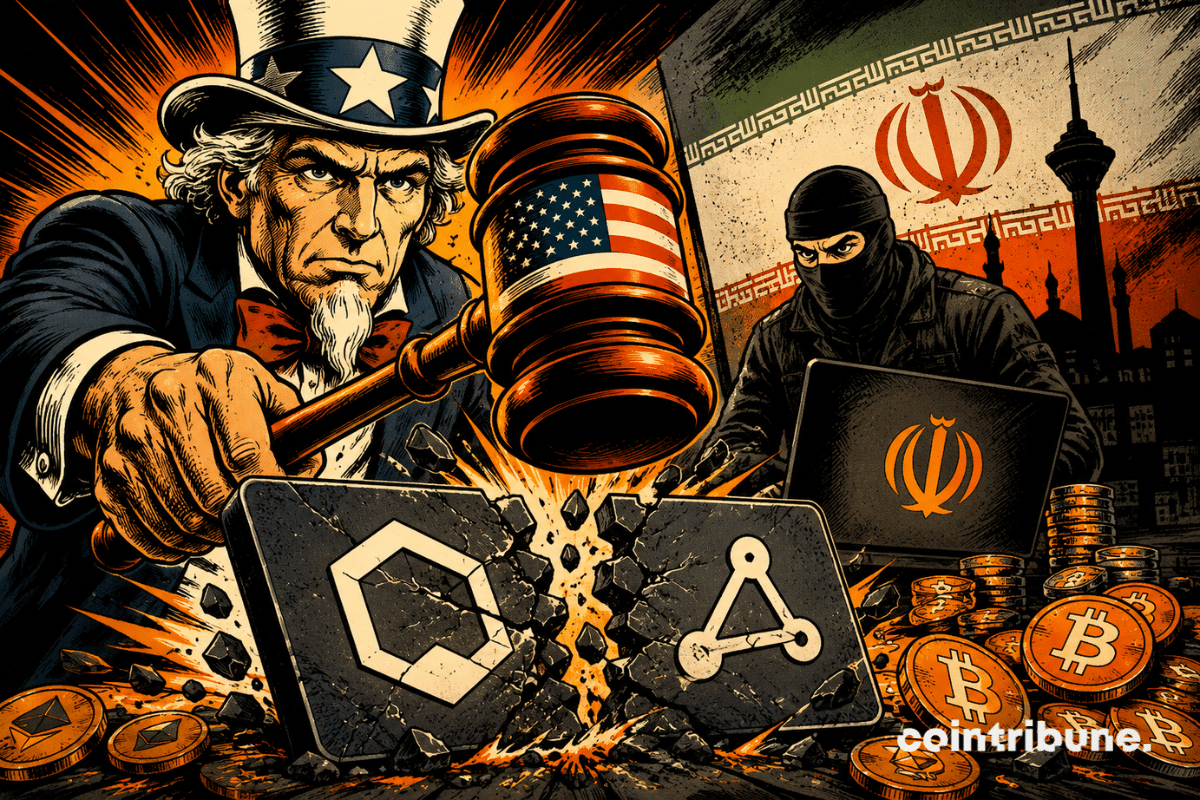
Washington sanctioned Shelbit and Aban Tether on August 7, 2026, accusing the two crypto platforms of supporting financial networks linked to Iran. Behind these little-known names lies a network of companies, online betting, and wallets associated with the Revolutionary Guards.
In brief
- The OFAC listed Shelbit, Aban Tether, and several related persons and companies on its sanctions lists on August 7, 2026.
- The U.S. Treasury describes three categories of crypto transfers of more than 1 million, 2 million, and 2 million dollars around Shelbit, the IRGC, and Nobitex.
- Assets under U.S. jurisdiction are blocked, while actors continuing certain transactions face sanctions.
Shelbit and Aban Tether enter OFAC’s crosshairs
Shelbit was already under the spotlight before the American decision. Cointribune had recently documented the Shelbit dossier and its transfers to Binance, amid suspicions of money laundering and sanctions evasion. On August 7, Washington took a step further by directly listing the platform and its alleged operator in its sanctions framework.
Your 1st cryptos with BitpandaThis link uses an affiliate program.In its press release published on August 7, 2026, the Office of Foreign Assets Control (OFAC), a branch of the U.S. Treasury responsible for enforcing economic sanctions, targets two platforms: Shelbit and Aban Tether. The agency also targets Siavash Kayvanpour, described as the head of a network of companies established notably in Georgia, the United Arab Emirates, and Poland.
The initial assessment reported by Cointelegraph mentions more than 5 million dollars in transfers detailed by the administration. However, the official statement distinguishes several movements: over 1 million dollars are said to have circulated from wallets controlled by the Islamic Revolutionary Guard Corps (IRGC) to Shelbit, more than 2 million from Shelbit to the IRGC, then over 2 million from addresses linked to Kayvanpour to Nobitex.
This breakdown does not allow to confirm that all these amounts represent entirely distinct funds.
Aban Tether follows a different mechanism. According to OFAC, this Iranian platform processed millions of dollars in transactions with Nobitex, Wallex, Bitpin, and Ramzinex, four Iranian exchanges already designated by Washington. The agency sanctions Aban Tether under its activity in the Iranian financial sector.
A network of companies and betting behind crypto flows
The dossier goes beyond the two platforms displayed on the list. The Treasury describes Shelbit as the gateway for a vast network of Persian betting sites, run by two Iranian influencers convicted in 2023 for illegal gambling. Tens of millions of dollars from this group are said to have passed through Shelbit, while these sites retained access to the Iranian payment system.
Washington also links several companies to Kayvanpour: SHPS Shelbit in Georgia, Shelbit General Trading in the United Arab Emirates, Shelbit Technologies in Poland, as well as Crypto Home DMCC and NFT Home DMCC in Dubai. The Emirati regulator VARA had already taken measures against Shelbit General Trading in January 2025 and July 2026. Despite these interventions, the activity continued.
This offensive is part of a larger sequence. In May, Scott Bessent claimed that the United States had recovered one billion dollars of cryptos linked to Iran, without detailing all the operations involved. The new decision is therefore not an isolated strike: it expands American pressure to providers connecting wallets, local platforms, and commercial networks.
We will continue to increase economic pressure. Whether in dollars, rials, or crypto, the Treasury will track and dismantle illicit financial networks keeping the regime afloat.
Scott Bessent, U.S. Treasury Secretary
The State Department also offers up to 15 million dollars for any information that can disrupt the IRGC’s and its branches’ financial mechanisms. This amount shows the priority given to monitoring these networks.
What the sanctions change for crypto actors
Being listed on OFAC’s lists has immediate effects. Properties and interests held in the United States, or controlled by Americans, must be blocked and reported. The rule extends to entities owned 50% or more, directly or indirectly, by one or more sanctioned persons.
Restrictions do not stop at U.S. borders. Financial institutions and foreign companies can face sanctions if they conduct certain operations with designated persons. OFAC can also impose civil penalties based on strict liability without having to prove intent to circumvent rules.
This is the sensitive point for exchanges. Transfers on a public blockchain leave traces, but identifying real beneficiaries still depends on internal controls, customer data, and cooperation between authorities. A platform that maintains relationships with a sanctioned address or company can therefore see its access to banking partners and the U.S. market severely compromised.
In short, Washington tightens the noose on the infrastructure enabling funds to circulate, not just on their final holders. The designation of Shelbit, targeting of Aban Tether, and threat of secondary sanctions push intermediaries to review their controls. The risk of sanctions for maritime companies had already shown how far this exposure could extend. Now, crypto platforms are warned.