US Treasury News: Why Is Washington Buying Back Billions in Debt? Fresh US Treasury News just landed straight from the source. The Treasury Department completed a debt buyback operation today
US Treasury News: Why Is Washington Buying Back Billions in Debt?
Fresh US Treasury News just landed straight from the source. The Treasury Department completed a debt buyback operation today, repurchasing $2.385 billion in government securities from the market.
This isn't a one-off move; it's part of a broader, already-announced strategy to keep the bond market functioning smoothly, and it's the kind of quiet operational detail that can still ripple into stocks and even crypto markets.
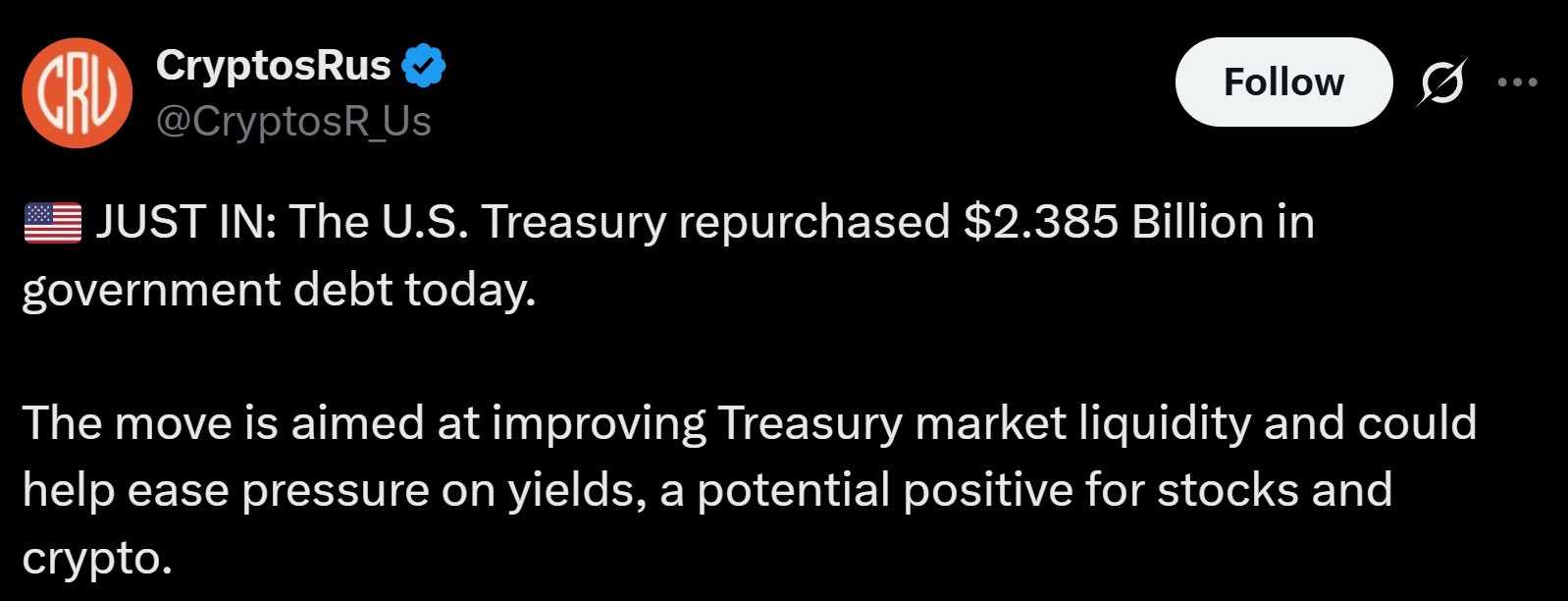
Source: CryptoRus on X
What Actually Happened Today
According to the document published by the US Treasury, today's operation repurchased $2.385 billion worth of outstanding Treasury debt.
This falls under what Treasury calls its liquidity support buyback program, where the department buys back older, less-traded ("off-the-run") securities directly from the market.
The goal is straightforward: keep trading in these securities smooth and functional, rather than letting older bonds sit around with thin liquidity and wider bid-ask spreads.
The Bigger Program Behind This Operation
This isn't happening in isolation. Back in August, the Treasury announced it was significantly ramping up the size of these liquidity support operations.
Here's the key context:
Detail
Figure
Previous max size per operation
$2 billion
New max size per operation
At least $4 billion
Effective date
September 9, 2026
The program runs through
November 4, 2026
Sectors covered
10-to-20-year and 20-to-30-year nominal coupons
Treasury explained the increase came from what it called "consistent strong sponsorship" from market participants, essentially meaning dealers had been offering more bonds into these operations than Treasury was actually buying, leaving clear room to scale up without straining the mechanism.
Why the Treasury Buys Its Own Debt Back
It might sound unusual for a government to repurchase its own securities, but this has actually been a standing program since May 2024.
A few basics worth understanding:
Treasury buys back older bonds, notes, and TIPS, but not bills, floating rate notes, or STRIPS
The authority for this comes from Section 3111 of Title 31 of the US Code
The stated purpose is liquidity support, keeping the massive Treasury market functioning smoothly rather than managing the debt level itself
Operations are announced on a regular, published schedule, with results posted publicly after each one
This kind of transparency is actually part of the point, since keeping the process predictable helps avoid market surprises around how and when Treasury steps in.
The Market Reaction Angle
Part of what makes this US Treasury News genuinely relevant to more than just bond traders is how markets have responded to similar moves recently.
When the original size increase was first announced back in August, long-dated Treasury yields fell, with the 10-year note dropping 6 basis points and the 30-year bond shedding 9 basis points on the news alone.
Lower yields on government debt tend to have knock-on effects elsewhere, since they can ease pressure across borrowing costs more broadly and sometimes shift investor appetite toward riskier assets, including equities and crypto.
What to Watch Going Forward
With the expanded buyback program running through early November, more operations like today's are already scheduled.
A few things worth tracking:
Treasury is set to conduct a 7-to-10-year nominal coupon buyback around September 18, sized at $4 billion or more
Another 20-to-30-year sector operation is scheduled for around September 25
Treasury has said it will share more detail on future buyback sizes at its next Quarterly Refunding, set for November 4, 2026
Conclusion
Today's $2.385 billion buyback operation is a small but concrete data point inside a much larger liquidity support strategy the Treasury has been actively scaling up since August.
With buyback sizes doubled and more operations already scheduled through early November, this piece of US Treasury News is likely just one entry in a longer-running story about how the government is working to keep the bond market steady, with effects that could keep showing up well beyond just Treasury markets themselves.
Disclaimer
This article is for educational and informational purposes only and should not be considered financial or investment advice. Always conduct your own research before making investment decisions.