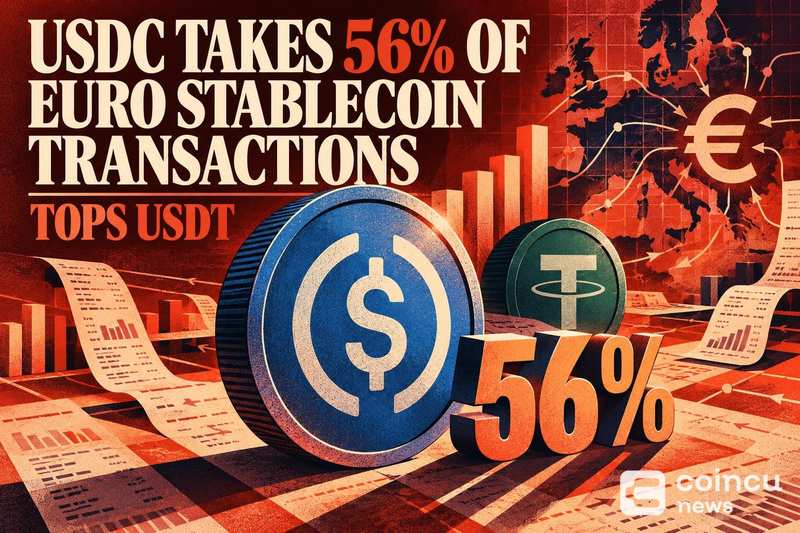
USDC captured a reported 56% share of euro stablecoin transactions, surpassing Tether's USDT in that specific segment of the market, according to circulating reports as of late October 2026.
USDC captured a reported 56% share of euro stablecoin transactions, surpassing Tether's USDT in that specific segment of the market, according to circulating reports as of late October 2026. The crossover marks a notable shift in euro-denominated stablecoin activity, a segment that has grown in strategic importance as regulators in the European Union push for clearer stablecoin frameworks under MiCA.
USDC Reaches 56% of Euro Stablecoin Transactions
The reported figure places USDC ahead of USDT specifically within the euro stablecoin transaction segment, not across the entire global stablecoin market. The distinction matters: transaction share in a currency-denominated segment can diverge sharply from broader measures such as total market capitalization or cross-chain circulating supply, where USDT retains a commanding lead across dollar-pegged activity. What the 56% transaction-share reading signals, if confirmed, is that entities settling or transacting in euro-referenced stablecoins are routing more activity through Circle's USDC than through Tether's USDT. For related coverage, see Best Stablecoin Wallets in 2026: 7 Self-Custody Options for USDT, USDC and DAI.
Euro stablecoin transactions represent a distinct and growing slice of on-chain settlement activity, driven largely by European institutional participants, regulated exchanges operating under EU licensing requirements, and DeFi protocols that have added euro-denominated liquidity pools. A transaction-share crossover within this segment does not constitute overall market dominance, but it does indicate where regulated demand is concentrating at this point in time. For related coverage, see Best Crypto Wallets for Everyday Spending in 2026: eSIM, Travel, and Stablecoin Utility.
How USDC Moved Ahead of USDT in Euro Activity
USDC's architecture positions it differently from USDT in the context of European regulatory compliance. Circle, the issuer of USDC, has actively engaged with regulators on stablecoin standards; the company formally called for global stablecoin standards in comments submitted to the OCC, signaling a compliance-forward posture that European institutional users have increasingly factored into their counterparty selection. Circle has also launched a stablecoin settlement solution targeting traditional financial institutions, expanding USDC's reach into the settlement layer where euro-denominated activity is concentrated.
USDT, issued by Tether, carries a larger global circulating supply and dominates dollar-pegged stablecoin volume across most chains and trading pairs. Within the euro-specific transaction segment, however, regulatory perception and issuer domicile appear to influence routing decisions, particularly among institutions subject to MiCA compliance obligations. A stablecoin issuer registered in the EU or compliant with MiCA's e-money token requirements presents lower regulatory friction for European-facing entities than one operating outside that framework.
The reported 56% transaction share for USDC represents a transaction-count or transaction-volume lead within euro stablecoin activity, not a market capitalization lead. Readers should avoid conflating this metric with statements about which stablecoin is larger in supply or more widely held globally. The two stablecoins serve overlapping but distinct user bases, and euro-transaction concentration is a narrower signal than aggregate market size.
What the Shift Means for the Euro Stablecoin Market
A change in observed euro stablecoin transaction mix carries practical implications for liquidity routing, DeFi pool composition, and the on-ramp/off-ramp infrastructure that European exchanges and payment providers maintain. If USDC has durably crossed 56% of euro stablecoin transaction activity, liquidity providers and market makers operating in euro pairs will gradually adjust inventory weightings toward USDC to minimize slippage and rebalancing costs. That operational adjustment, if it materializes, can become self-reinforcing: deeper USDC liquidity in euro-denominated pools attracts more USDC-denominated flow.
The development also lands against the backdrop of MiCA's phased implementation, which places new disclosure, reserve, and operational requirements on stablecoin issuers serving EU-based users. Stablecoins that fail to achieve MiCA authorization face potential restrictions on EU-based trading venues, creating a structural incentive for exchanges and settlement networks to route euro activity toward MiCA-compliant instruments. That regulatory context provides a plausible structural reason why euro transaction share might shift toward USDC, though the reported 56% figure has not yet been confirmed by a named primary data source, and a single transaction-share snapshot does not establish a durable trend.
Caution is warranted before drawing long-horizon conclusions. Transaction share at a single point in time can be influenced by large institutional flows, protocol-specific liquidity incentives, or one-time settlement events that do not persist. Additional readings over subsequent weeks would be needed to determine whether USDC's euro transaction lead represents a structural shift or a temporary concentration driven by a narrow set of counterparties.
Key Metrics to Watch After USDC's Euro Transaction Lead
The 56% figure is a snapshot. Readers and market participants following euro stablecoin activity should track several follow-up data points to assess whether the lead persists or reverts. Future euro stablecoin transaction-share readings are the most direct confirmation signal; a sustained reading above 50% across multiple reporting periods would strengthen the case for a structural shift, while a reversion toward parity would suggest the current reading reflects transient flow concentration.
USDC and USDT transaction volumes on euro-denominated trading pairs across major European exchanges offer a complementary check. Volume data on venues licensed under MiCA or operating under EU financial regulation captures the regulated segment of euro stablecoin activity most directly. On-chain metrics, including the number of unique wallets transacting in USDC versus USDT on Ethereum and other chains that support euro stablecoin pools, provide a decentralized view of activity distribution that complements centralized exchange data.
Circulating supply figures for euro-native stablecoins such as EURC (Circle's euro-backed stablecoin) and EURS also bear watching, as growth in euro-native instruments could eventually absorb transaction share from both USDC and USDT in euro-denominated settlement. Current stablecoin supply and chain distribution data is tracked in real time at aggregators such as DeFiLlama's stablecoin dashboard, which shows circulating supply across chains and provides a benchmark for how euro-adjacent stablecoin activity is distributed. For those holding or transacting with either stablecoin, infrastructure choices such as self-custody wallet selection also intersect with the euro stablecoin landscape, as covered in Coincu's guide to stablecoin wallets in 2026.
Security considerations remain a parallel factor. A recent incident involving an exploit targeting USDC bridge reserves on the Initia network in late October 2026 illustrates that infrastructure risk is not uniformly distributed across stablecoin issuers and networks. Participants routing large euro stablecoin transaction volumes should assess bridge and custody risk as a component of stablecoin selection, independent of transaction-share statistics.
FAQ: USDC and Euro Stablecoin Transactions
What share of euro stablecoin transactions did USDC reach?
USDC is reported to have reached a 56% share of euro stablecoin transactions, according to circulating reports as of late October 2026. This figure has not yet been confirmed by a named, publicly accessible primary data source, and should be treated as an unconfirmed claim pending further verification.
Which stablecoin did USDC surpass?
The reported 56% figure places USDC ahead of Tether's USDT specifically within the euro stablecoin transaction segment. USDT retains a larger share of global dollar-pegged stablecoin supply and volume across most trading pairs and chains.
Does this result describe the entire stablecoin market?
No. The reported metric is limited to euro stablecoin transactions, a specific segment of the broader stablecoin market. It does not describe USDC's position in the global stablecoin market by market capitalization, circulating supply, or total transaction volume across all currency pairs. Confusing this euro-segment metric with statements about global stablecoin dominance would misrepresent the data.
What is the difference between transaction share and market capitalization?
Transaction share measures the proportion of transaction activity, by count or volume, attributed to a given instrument within a defined market segment. Market capitalization measures total circulating supply multiplied by the asset's value. A stablecoin can hold a minority market capitalization position in a segment while generating the majority of transaction activity, if it is used more frequently for settlement, payments, or DeFi interactions within that segment. The 56% euro transaction-share figure for USDC speaks to activity frequency and volume routing, not to the relative size of USDC versus USDT supply.
What regulatory context surrounds euro stablecoin activity in 2026?
The EU's Markets in Crypto-Assets regulation, MiCA, has introduced licensing and reserve requirements for stablecoin issuers serving European users, with phased enforcement that has been progressing through 2025 and 2026. MiCA compliance status has become a material factor in how regulated European institutions and exchanges select stablecoin counterparties, creating a structural incentive to route activity toward issuers that have obtained or actively pursued MiCA authorization. Circle's public regulatory engagement, including its formal submissions to the OCC on global stablecoin standards, reflects the compliance posture that euro-market participants are increasingly weighting in routing decisions. The next concrete regulatory milestone to watch is the completion of MiCA's full enforcement phase and the publication of authorized stablecoin issuer lists by EU member-state competent authorities, which will determine which instruments can be freely offered on EU-regulated venues without restriction.
Disclaimer: This article is for informational purposes only and does not constitute financial or investment advice. Cryptocurrency and digital asset markets carry significant risk. Always do your own research before making decisions.
The post USDC Takes 56% of Euro Stablecoin Transactions, Tops USDT was initially published on Coincu.