A reported regulatory action valued at $3.3 billion targeting TerraUSD (UST) and its associated entities marks one of the largest enforcement proceedings ever directed at an algorithmic stabl
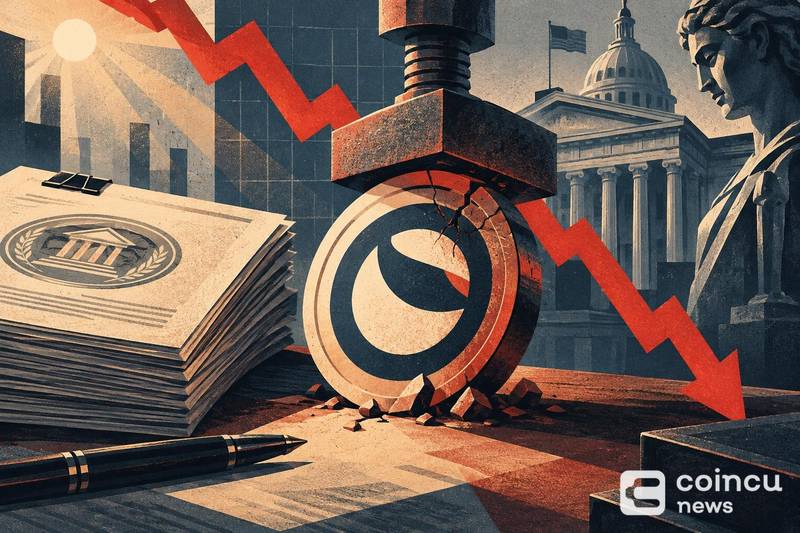
A reported regulatory action valued at $3.3 billion targeting TerraUSD (UST) and its associated entities marks one of the largest enforcement proceedings ever directed at an algorithmic stablecoin, according to filings listed on SEC litigation releases and corresponding agency press rooms. The scale of the claimed liability signals that U.S. regulators are treating the collapse of UST not as a market accident but as a matter of investor protection and securities law.
What the $3.3 Billion Action Against UST Involves
The action, as framed in available regulatory filings, targets conduct related to TerraUSD and the broader Terra ecosystem. Regulatory enforcement at this scale typically encompasses one or more of three instruments: a civil penalty, a disgorgement order requiring the return of allegedly ill-gotten gains, or a combined judgment that includes both. Whether the $3.3 billion figure represents a proposed liability, a final judgment, or a settlement demand has not been confirmed by a verified primary source at the time of publication; readers should treat it as an alleged or reported amount until official court documents establish the final figure. For related coverage, see Why Is Polkadot (DOT) Price Surging Today? Key Drivers.
The two agencies with primary jurisdiction over this matter are the SEC, which has pursued securities law violations related to UST and its sister token LUNA, and the CFTC, which has authority over digital assets that qualify as commodities. Overlapping jurisdiction between the two agencies is common in large-scale stablecoin enforcement, and the combined liability figure may reflect parallel proceedings rather than a single unified action. For related coverage, see SkyAI Suspected of Moving 468,000 SOL Worth $51.1M.
Why Regulators Are Scrutinizing UST
UST was an algorithmic stablecoin: it maintained its dollar peg not through fiat reserves but through an on-chain arbitrage mechanism linked to LUNA. When that mechanism broke down in May 2022, roughly $40 billion in combined market value was wiped out within days. Regulators have since focused on whether UST's design and the representations made to investors about its stability constituted unregistered securities offerings or fraudulent conduct, questions that sit at the core of both SEC and CFTC enforcement frameworks. For related coverage, see HSBC, Ant Digital Test AI-Agent Payments.
Algorithmic stablecoins occupy contested regulatory ground. Unlike fiat-backed stablecoins, they carry no auditable reserve, making investor protection claims harder to verify. The scale of the $3.3 billion action suggests regulators concluded that the conduct went well beyond a technical design failure. Enforcement actions of this magnitude typically allege that investors were misled about material risks, not merely that a product performed poorly. Similar enforcement logic has appeared in other large-scale crypto cases tracked through SEC litigation releases, though the UST case is distinguished by the speed and size of its collapse.
What the Action Could Mean for Terra, UST, and Stablecoin Oversight
A liability figure of this size, if upheld or settled at comparable terms, would function as a precedent-setting data point for how regulators price the harm caused by failed algorithmic stablecoins. For the Terra ecosystem specifically, a final judgment of this magnitude would effectively exhaust any meaningful recovery for the entities involved, as the reported figure likely exceeds recoverable assets.
For the wider stablecoin market, the proceeding reinforces a pattern visible across multiple enforcement actions: regulators are applying securities and commodities law to crypto assets that were marketed as low-risk instruments. Projects that issue stablecoins with yield mechanisms, algorithmic pegs, or governance tokens should expect heightened disclosure requirements as a direct consequence of actions like this one. The CFTC's public press releases have consistently characterized such mechanisms as falling within its anti-fraud and anti-manipulation authority.
Exchanges and custodians that listed UST or provided liquidity during the relevant period may also face secondary scrutiny depending on the scope of the final order, particularly if the action includes provisions addressing those who facilitated distribution. That risk has already prompted several platforms to re-examine custodial and listing due diligence across their stablecoin offerings.
What Investors and UST Users Should Watch Next
The most important near-term signal is whether the reported $3.3 billion figure reflects a final court judgment, a proposed order, or an opening position in a settlement negotiation. Those three scenarios carry materially different implications for timeline, enforceability, and any residual recovery for affected holders. Official confirmation will appear in court dockets and through SEC litigation release updates as proceedings advance.
Users with any remaining exposure to Terra-ecosystem tokens should also monitor whether the action includes provisions that affect specific exchanges, wallets, or counterparties. Enforcement orders sometimes carry injunctive terms that restrict transfers or require asset freezes, steps that can affect liquidity even for parties not named in the primary action. Any new UST exposure ahead of a final ruling would carry elevated legal and liquidity risk given the unresolved scope of the proceedings.
FAQ: UST and the $3.3 Billion Regulatory Action
What is the $3.3 billion UST action? It is a reported regulatory enforcement proceeding targeting TerraUSD and its associated entities, with an alleged liability or judgment figure of $3.3 billion. The exact legal instrument, whether a penalty, disgorgement order, or settlement, has not been confirmed by a verified primary source at publication.
Does the action immediately affect UST holders? Not directly, unless the final order includes provisions targeting specific exchanges or custodians. The primary named parties are the entities behind Terra, not individual token holders. However, secondary liquidity effects are possible if the action triggers exchange delistings or asset freezes against counterparties.
Is the $3.3 billion a fine, settlement, claim, or proposed liability? This remains unconfirmed. Readers should consult official court documents and SEC filings referencing TerraUSD directly for the authoritative characterization before drawing conclusions about finality or enforceability.
What should UST users monitor next? Court docket updates, official SEC and CFTC press releases, and any exchange communications about listing status for Terra-ecosystem tokens. If the proceeding includes a payment schedule or asset freeze, those terms will appear in the formal order and will be the definitive guide to any downstream market impact. Broader regulatory treatment of algorithmic stablecoins, already a focus for legislators, is likely to accelerate as this case reaches resolution, a dynamic worth tracking alongside institutional positioning shifts in regulated crypto products.
Disclaimer: This article is for informational purposes only and does not constitute financial or investment advice. Cryptocurrency and digital asset markets carry significant risk. Always do your own research before making decisions.
The post UST Under Regulatory Pressure: What the $3.3B Action Means was initially published on Coincu.