Vietnam Crypto Fines Reshape the Country’s New Digital Asset Market Vietnam crypto fines officially begin on September 1, marking the government's toughest crackdown yet on unlicensed digital
Vietnam Crypto Fines Reshape the Country’s New Digital Asset Market
Vietnam crypto fines officially begin on September 1, marking the government's toughest crackdown yet on unlicensed digital asset trading.
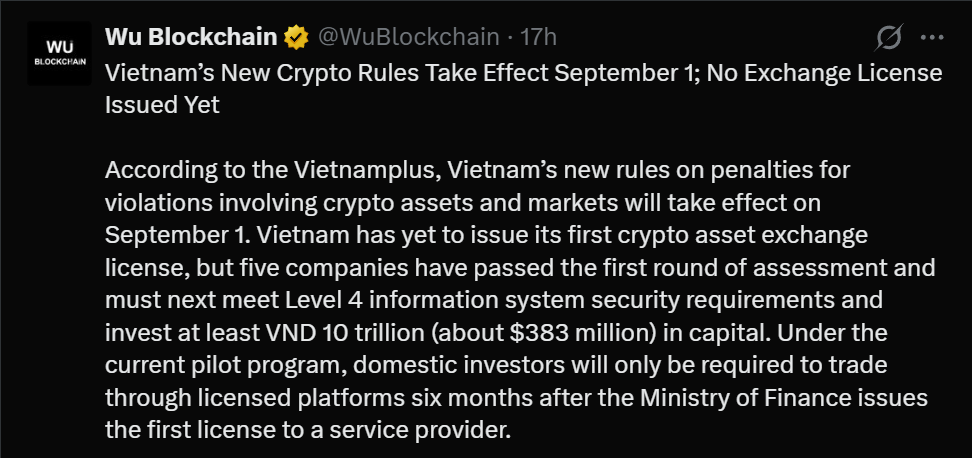
Source: WuBlockchain on X
The new penalty framework arrives alongside a broader five-year pilot program aimed at building a regulated market for tokenized real-world assets, starting with foreign investors before domestic access opens later.
What The New Decree Actually Penalizes
The rules come fromDecree No. 284/2026/ND-CP, signed by the government on July 16, 2026, and taking effect September 1—the same date this round of Vietnam crypto fines becomes enforceable.
Under the decree, individual investors caught trading through platforms not licensed by the Ministry of Finance face penalties ranging from 30 million to 50 million Vietnamese dong, or roughly $1,140 to $1,900.
Anyone trading assets that were specifically issued or offered to foreign users faces an even steeper fine of up to 100 million dong, or around $3,800.
Organizations offering crypto services or advertising an exchange without a license face the harshest penalties, reaching 200 million dong.
Key elements of this fine structure include:
Individual penalties of 30 to 50 million dong for using unlicensed platforms
Higher penalties up to 100 million dong for trading foreign-issued crypto assets
Organizational penalties up to 200 million dong for unlicensed service offerings
Additional charges of 50 to 70 million for firms failing to properly verify customers
Authorities empowered to order removal of related websites, software, and trading systems
How The Underlying Pilot Program Is Structured
This wave of Vietnam crypto fines sits inside a much larger five-year pilot framework established under Resolution 05/2025/NQ-CP, which was issued back in September 2025 and is scheduled to run through September 2030.
The decree itself will stay in force for as long as that underlying resolution remains active, rather than existing as a standalone permanent law.
This structure signals the government is treating the entire regulated market as an experiment first, with the enforcement rules built specifically around that testing window.
Five Companies Have Cleared The First Licensing Review
According to a disclosure made at the Vietnam RWA Summit 2026 by an official from the country's Digital Asset Trading Market Board, five companies have passed an initial assessment toward becoming licensed crypto service providers.
The group includes firms linked to major domestic banks, a stockbroker, and a larger business conglomerate, though authorities have not publicly named the applicants or confirmed a timeline for final approval.
Passing this early review does not yet authorize any of these firms to actually operate an exchange.
Reports also indicate that full licensing will require applicants to meet Level 4 security standards alongside a capital requirement said to be around $383M—a bar high enough to limit the pool of realistic applicants.
Pilot Program Snapshot
Detail
Information
Governing decree
Decree No. 284/2026/ND-CP
Effective date
September 1, 2026
Underlying pilot framework
Resolution 05/2025/NQ-CP
Pilot program duration
Five years, through September 2030
Individual fine range
30 to 50 million dong
Foreign asset trading fine
Up to 100 million dong
Organizational fine ceiling
200 million dong
Companies cleared in first review
Five
Why The Rollout Targets Foreign Investors Before Domestic Ones
A notable feature of this framework is its sequencing, rather than opening the market to everyone at once.
The penalty regime and the broader pilot are structured to prioritize tokenized real-world assets for foreign investors first, with wider domestic investor access only following roughly six months after the first licensed platform actually launches.
No exchange had received a final license at the time the fine structure took effect, meaning that transition window has not yet formally begun.
This phased approach appears designed to let regulators observe how the market behaves under foreign participation before expanding exposure to the country's own retail investor base.
Why This Market Is Under Such Close Watch
The stakes behind this regulatory push are notably high.
Vietnam has ranked among the top countries globally for crypto adoption in recent industry tracking, with hundreds of billions of dollars in estimated transaction volume flowing through the market over the past couple of years, largely via offshore platforms operating outside any domestic licensing framework.
That backdrop helps explain why officials are moving carefully, layering fines, a five-year testing window, and a foreign-first rollout sequence rather than opening a fully domestic market in one step.
Conclusion
With Vietnam Crypto Fines now in force alongside a five-year pilot built around tokenized assets, the country is attempting to balance its ambition to build a regulated digital asset hub against the risk of moving too quickly.
With five firms already through initial screening and steep penalties now discouraging unlicensed trading, the coming months should show how many companies actually clear the higher capital and security bar required for a full license and how quickly domestic investors eventually gain broader access.
Disclaimer
This article is for informational purposes only and is not financial, investment, legal, tax, or trading advice. Cryptocurrency and digital asset markets are highly volatile and risky. Conduct your own research and consult a qualified professional before making any decisions.