Vietnam's Deputy Finance Minister Nguyen Duc Chi told Austria's Financial Market Authority on September 15, 2026, that the country has established a pilot legal framework for crypto assets an
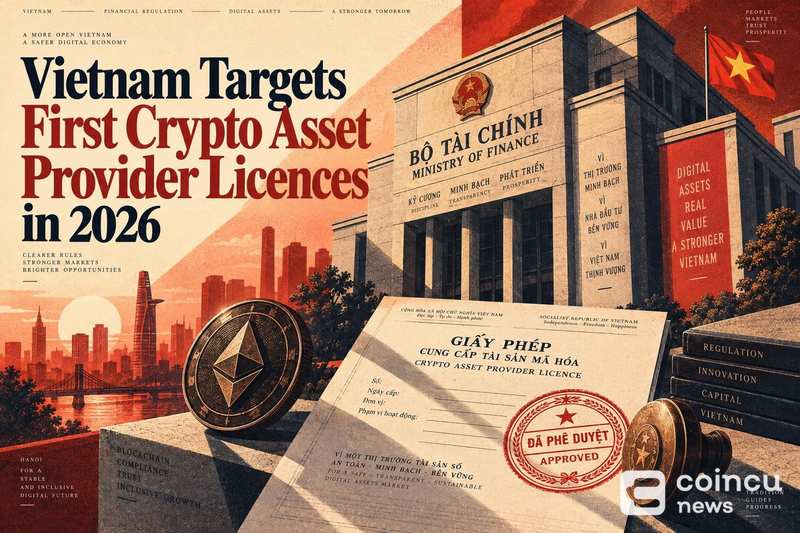
Vietnam's Deputy Finance Minister Nguyen Duc Chi told Austria's Financial Market Authority on September 15, 2026, that the country has established a pilot legal framework for crypto assets and expects its first crypto-asset service providers to be licensed and operating in 2026, marking a concrete regulatory milestone for one of Southeast Asia's largest retail crypto markets.
Chi met FMA Executive Director Mariana Kuhnel in Vienna to exchange supervisory experience and discuss bilateral cooperation, according to Voice of Vietnam. The session signals that Hanoi is moving from policy design into implementation, with the 2026 licensing window anchored to Government Resolution 05/2025/NQ-CP, the pilot instrument hosted by the State Securities Commission of Vietnam.
Vietnam's plan for first crypto-asset service provider licences in 2026
Chi stated that Vietnam had established a pilot legal framework and expected the first crypto-asset service providers to be licensed and begin operating in 2026. That target is an official expectation under a pilot, not confirmation that any licences have already been issued or that applicants have been formally approved. For related coverage, see Deutsche Bank Plans Bitcoin Custody Launch by End of 2026.
Vietnam crypto-asset pilot
2026
Expected first licensing and operations for crypto-asset service providers, according to Vietnamese officials.
State Securities Commission chairwoman Vu Thi Chan Phuong said the SSC is developing a supervisory mechanism for service providers and investor transactions built around Financial Action Task Force recommendations, with emphasis on risk management, investor-asset protection, and anti-money-laundering compliance. The SSC's role as the body developing the supervisory mechanism, rather than a dedicated crypto regulator, places Vietnam's framework closer to securities-law models seen in other emerging markets that have adopted FATF-aligned regimes. The Vietnam crypto-asset pilot framework has been under development as part of that broader regulatory push. For related coverage, see Former Hong Kong Bank Executive Jailed in HK$1.6B Fake-Credit Case.
What remains to be defined for Vietnam's crypto-asset provider regime
The September 15 announcement identifies a licensing target year and a supervisory philosophy but does not specify eligibility criteria, minimum capital requirements, application procedures, or the range of activities that will fall under the pilot's scope. Providers and market participants watching the regime will need to monitor official SSC and Ministry of Finance releases for operational rules, as none were supplied in the Vienna meeting's public readout.
The pilot instrument, Government Resolution 05/2025/NQ-CP, is the legal foundation; its provisions govern the perimeter of permissible activity, but implementation guidelines translating those provisions into licensing mechanics have not been publicly detailed as of this report. That gap between framework and operational rulebook is the critical item separating the 2026 expectation from a firm timeline.
Vietnam expands cooperation with Austria's FMA
Kuhnel proposed deeper engagement through the International Organization of Securities Commissions and online technical meetings between regulatory experts from both sides; Chi agreed with that cooperation approach, per Voice of Vietnam. Austria's FMA is named as the cooperation counterpart in its capacity as a securities and financial markets supervisor, not as a model whose rules Vietnam is adopting wholesale.
The bilateral framing matters for context: Austria operates under the European Union's Markets in Crypto-Assets Regulation framework, while Vietnam is constructing a bespoke pilot regime. IOSCO and expert-level technical meetings give Vietnam access to comparative supervisory practice without committing to direct regulatory equivalence. Similar experience-sharing arrangements have preceded licensing rollouts in other jurisdictions; Hong Kong's own 2026 tokenized-asset trials have similarly drawn on cross-border regulatory dialogue before formal rules took effect.
What crypto-asset businesses should monitor before 2026 closes
The next concrete milestones are SSC publication of provider supervision rules, the opening of a formal application window under the pilot, and any Ministry of Finance guidance that converts Resolution 05/2025/NQ-CP's framework into licensing criteria. Each of those steps is a prerequisite before the 2026 expectation translates into issued licences. Businesses assessing Vietnam market entry should treat current information as a watchlist, not a compliance checklist, given the absence of operational requirements in the public record.
Broader context: Bitcoin traded at $81,321 as of the research date, up roughly 3.9% over 24 hours, against a market cap of approximately $1.63 trillion, while the crypto Fear & Greed Index registered 71 (Greed). Those conditions do not affect Vietnam's regulatory timetable, but they illustrate the market environment in which the region's first-generation licensing regimes are being built. The OCC's conditional approval of Bastion National Trust Bank and comparable licensing activity in other jurisdictions suggest that 2026 is shaping up as a year when formal crypto-asset authorization frameworks move from pilot to operational across multiple regulatory spheres simultaneously.
FAQs
When does Vietnam plan to issue its first crypto-asset service provider licences? The plan targets 2026, according to Deputy Finance Minister Nguyen Duc Chi's statement in Vienna on September 15, 2026. The target is conditional on completing supervisory rules under the pilot framework.
Have the licensing requirements been published? The supplied official readout does not specify eligibility criteria, capital requirements, or application procedures. Those details are expected to emerge from the SSC's ongoing supervisory-mechanism development.
Which overseas regulator is named in the cooperation announcement? Austria's Financial Market Authority, represented by Executive Director Mariana Kuhnel, is the named cooperation counterpart. Deeper engagement is proposed through IOSCO channels and bilateral technical expert meetings.
Disclaimer: This article is for informational purposes only and does not constitute financial or investment advice. Cryptocurrency and digital asset markets carry significant risk. Always do your own research before making decisions.
The post Vietnam Targets First Crypto-Asset Provider Licences in 2026 was initially published on Coincu.