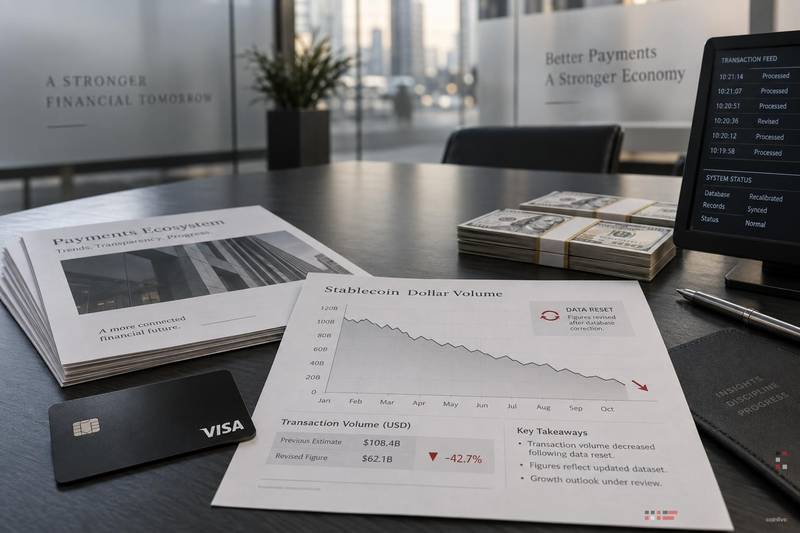
Visa's adjusted stablecoin dollar volume declined following a data reset on its on-chain analytics tracker, while the network's stablecoin transfer count held relatively steady, slipping less
Visa's adjusted stablecoin dollar volume declined following a data reset on its on-chain analytics tracker, while the network's stablecoin transfer count held relatively steady, slipping less than 2% over the same period.
Dollar volume drops as the data reset reshapes the baseline
The adjusted dollar volume figure that Visa publishes as part of its stablecoin activity monitoring was revised downward after the reset recalibrated the underlying measurement methodology, per CryptoSlate. Adjusted volume strips out certain transaction types, such as smart-contract interactions and protocol-internal transfers, to focus on economically meaningful activity.
A reset of that kind can sharply reduce the reported figure without necessarily reflecting a drop in real-world stablecoin usage. Direct before-and-after comparisons of the headline dollar number should be treated with caution, since the reset changes what gets counted, not just how much, making the post-reset figure structurally incomparable to the pre-reset baseline. For related coverage, see Hong Kong Enforces New Stablecoin Licensing Law.
Transfer counts barely moved, signaling a narrower usage change
Where dollar volume took a sharper hit, the raw count of stablecoin transfers on the Visa-tracked networks fell less than 2% over the comparable window. That divergence matters: transfer counts are less sensitive to the average size of each transaction, so a sub-2% count decline alongside a larger volume drop suggests that average transfer size, not transaction frequency, drove most of the headline move. For related coverage, see Hong Kong's RMB Stablecoin Regulations Prompt Moves by Ant, JD.com.
Count stability can coexist with lower average value per transfer. If a reset excludes a subset of high-value institutional or protocol-layer transfers while leaving retail-sized transactions in scope, the count metric may be nearly unchanged even as aggregate dollar volume registers a meaningful fall. The stablecoin infrastructure Visa, BlackRock, and Coinbase are building around relies on both metrics to gauge adoption, and the divergence highlights why neither figure tells the full story on its own.
What to watch in subsequent reporting periods
The meaningful confirmation window is the first full comparable period reported after the reset, where both dollar volume and transfer counts are measured on the same post-reset basis from the start. That will be the first clean read on whether underlying stablecoin activity through Visa's tracked networks is growing, flat, or contracting.
Analysts tracking Visa and Mastercard's push into blockchain payments should also watch average transfer size as a derived metric: divide adjusted dollar volume by transfer count each period to assess whether the reset-driven compression in value is narrowing or holding. Readers monitoring regulatory shifts should note that Hong Kong's new stablecoin licensing regime reflects the growing scrutiny on how payment networks measure and report stablecoin flows.
Additional source references: source document 1.
Disclaimer: This article is for informational purposes only and does not constitute financial or investment advice. Cryptocurrency and digital asset markets carry significant risk. Always do your own research before making decisions.
Read original article on coinlive.me