Visa Stablecoin Platform: A New Payment Infrastructure One of the world's biggest payment networks just built its own on-ramp for stablecoins. The Visa Stablecoin Platform, or VSP, went live
One of the world's biggest payment networks just built its own on-ramp for stablecoins.
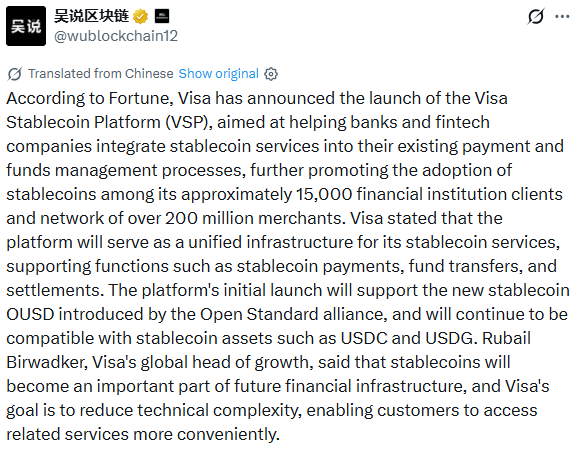
The Visa Stablecoin Platform, or VSP, went live in beta on July 16, 2026. It gives banks, fintechs, and crypto-native firms a single environment to mint, redeem, hold, and transfer stablecoins, built directly into Visa's existing network.
 Source: X(formerly Twitter)
The payment giant says the network reaches roughly 15,000 financial institution clients and more than 200 million merchants worldwide. This isn't a side experiment — it's infrastructure sitting on top of Visa's core payment rails.
At its core, the Visa Stablecoin Platform solves an operational problem, not an access problem. Institutions can already buy stablecoins elsewhere. What they've lacked is a way to plug stablecoins into treasury, settlement, and money-movement systems they already run.
VSP packages three things together:
Wallet-as-a-Service — onchain wallet infrastructure institutions don't have to build themselves
Mint and burn connectivity — direct issuance and redemption tools for supported stablecoins
Dual-approval controls — security workflows built for sensitive institutional transactions
Rubail Birwadker, Visa's global head of growth, told Fortune the network is less about accessing stablecoins and more about fitting them into existing treasury and banking workflows. That framing matters. The company isn't pitching VSP as a crypto product — it's pitching it as plumbing.
The platform builds on real prior work. The card issuer first settled transactions in USDC back in March 2020. It introduced a dedicated digital dollar settlement program in December 2025. VSP now serves as the umbrella covering all of it.
Visa Stablecoin Platform: Inside the OUSD Launch Partner
VSP launches supporting one stablecoin specifically: OUSD, or Open USD, introduced two weeks earlier by a new consortium called Open Standard.
Open Standard counts more than 140 founding partners, including Visa, Mastercard, American Express, Stripe, BlackRock, Coinbase, Google, and US Bank. OUSD is designed to share most of the earnings it collects from reserves back with the businesses using it — a structural difference from stablecoins that keep reserve yield internal.
The Visa Stablecoin Platform stays compatible with existing assets too. USDC, issued by Circle, and USDG, issued by Paxos, both remain supported alongside OUSD. The payements giant is treating OUSD as an addition to its lineup, not a replacement.
VSP is currently limited to a select group of beta clients. A full rollout timeline hasn't been announced.
Visa Stablecoin Platform: Why This Matters for Adoption
Visa isn't alone here. Mastercard and American Express have both partnered with Open Standard around OUSD as well. Mastercard separately rolled out its own payement token settlement option for banks last month, covering six regulated dollar-backed assets.
That competitive overlap says something important: the major card networks are converging on digital asset settlement as a real business line, not a marketing exercise. Visa's Chief Product and Strategy Officer, Jack Forestell, has said stablecoins are reshaping the back end of commerce the way AI is reshaping the front end.
Visa's pilot programs have reportedly reached a $7 billion annualized settlement run rate already, suggesting real institutional demand exists ahead of full deployment. Still, VSP remains in beta, and the jump from pilot to global scale is where similar infrastructure consortia have stalled before.
Conclusion
The Visa Stablecoin Platform turns fiat-backed token access into infrastructure Visa's existing bank and merchant network can plug into directly. OUSD launches first, with USDC and USDG supported alongside it. VSP is live in beta now — full-scale rollout is the next milestone worth tracking.
YMYL Disclaimer
This article is for informational and educational purposes only and does not constitute financial or investment advice. All infrastructure details, partnership figures, and dates are based on publicly available data as of July 17, 2026. Digital asset adoption trends and market impact discussed here are illustrative, not guarantees. Digital asset activity carries risk. Always conduct independent research before making financial decisions.