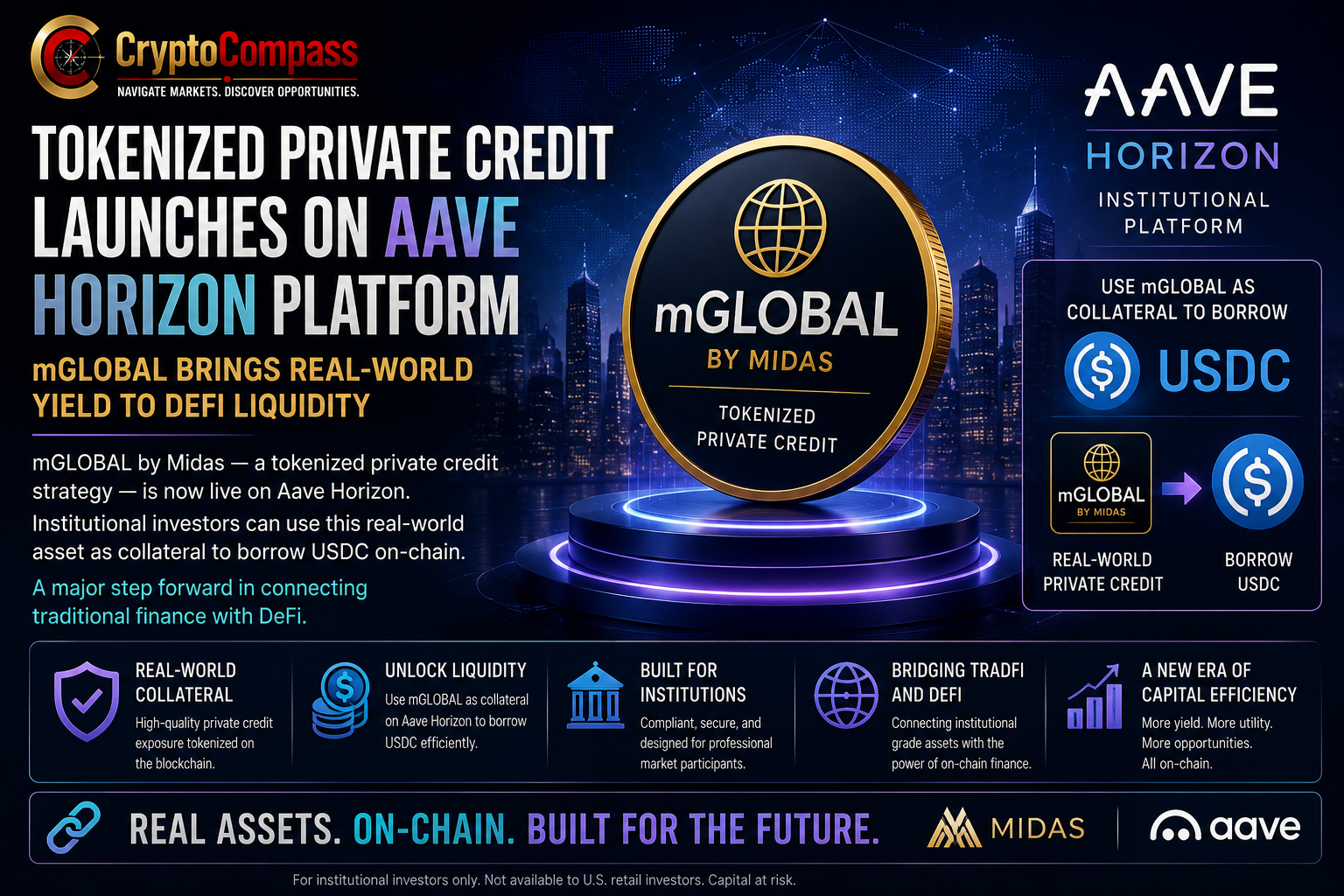
A tokenized private credit fund has been launched on Aave Horizon, allowing institutional investors to use real-world financial assets as collateral for on-chain borrowing. While the announcement may appear technical, it represents one of the clearest examples yet of how tokeniza
For years, decentralized finance promised to bring traditional financial assets on-chain.
The vision was simple.
Imagine a world where bonds, credit funds, Treasury bills, real estate, and private market investments could interact directly with blockchain-based liquidity.
Investors could borrow against them.
Trade them.
Use them as collateral.
Or integrate them into entirely new financial products.
The industry called this vision Real World Assets, or RWAs.
Now, another piece of that vision has become reality.
Midas has launched mGLOBAL, a tokenized private credit fund, on Aave Horizon, allowing institutional investors to use tokenized credit exposure as collateral to borrow USDC.
At first glance, the development may appear niche.
In reality, it could represent a major milestone in the convergence of Wall Street and DeFi.
What Is mGLOBAL?
mGLOBAL is a tokenized security designed to provide exposure to a private credit strategy.
Private credit has become one of the fastest-growing sectors in global finance.
Instead of lending through public bond markets, private credit funds provide financing directly to companies.
The asset class has attracted enormous interest from institutional investors because it often generates higher yields than traditional fixed-income products.
Historically, access to private credit has been restricted.
Large institutions.
Family offices.
Accredited investors.
The market has remained relatively inaccessible and illiquid.
Tokenization changes that dynamic.
Rather than holding exposure through traditional fund structures, investors can hold blockchain-based representations of those assets.
That creates flexibility that traditional finance has rarely been able to offer.
Why Aave Matters
The more important part of this announcement is not mGLOBAL itself.
It is where it was launched.
Aave is one of the largest lending protocols in decentralized finance.
Historically, DeFi collateral has largely consisted of crypto-native assets:
ETH.
Wrapped Bitcoin.
Stablecoins.
Liquid staking tokens.
Now, tokenized private credit is joining that list.
This changes the conversation.
For the first time, institutional investors can potentially bring a traditional financial asset into a DeFi environment and use it to access on-chain liquidity.
The asset remains productive.
The capital becomes liquid.
That is a powerful combination.
The Rise Of Productive Collateral
Financial markets are built around collateral.
Collateral determines how much liquidity can be created.
The better the collateral, the larger the financial system that can be built on top of it.
Crypto's early years relied heavily on volatile assets as collateral.
That created risk.
A borrower might pledge ETH.
ETH falls.
Liquidation follows.
The system remains functional, but volatile.
Real-world assets introduce a different type of collateral.
Treasuries.
Credit funds.
Institutional financial products.
Assets whose value derives from real economic activity rather than purely crypto market sentiment.
Many believe this is the next major phase of DeFi.
Why Private Credit Is Important
Private credit is not a random asset class.
It is one of the fastest-growing areas in traditional finance.
Global private credit assets now measure in the trillions of dollars.
Major firms including BlackRock, Apollo, KKR, Blackstone, and Ares continue expanding aggressively into the sector.
The reason is straightforward.
Investors want yield.
Private credit often provides it.
By bringing private credit exposure on-chain, tokenization potentially connects one of Wall Street's most attractive asset classes with one of crypto's most efficient liquidity systems.
That combination is difficult to ignore.
The Bigger Story: Capital Markets Are Becoming Programmable
The true significance of mGLOBAL is not the token.
It is what the token represents.
Traditional finance has historically operated within closed systems.
Assets sit inside custodians.
Collateral sits inside banks.
Liquidity sits inside financial institutions.
Blockchain changes that architecture.
Assets become programmable.
Ownership becomes transferable.
Collateral becomes interoperable.
Liquidity becomes global.
A tokenized credit fund on Aave is essentially a glimpse into what future capital markets may look like.
Why Institutions Care
Institutional investors are increasingly interested in blockchain technology for one reason:
Efficiency.
Settlement can be faster.
Collateral can move more freely.
Capital can be utilized more effectively.
The launch of mGLOBAL on Aave Horizon demonstrates how tokenization can create entirely new capital efficiency opportunities.
Instead of simply holding a private credit position, investors may now use that position as collateral to access additional liquidity.
That is standard practice in traditional finance.
The difference is that it is now happening on-chain.
CryptoCompass View
For much of the past cycle, tokenization was treated as a future narrative.
Something that would eventually happen.
Something that sounded promising but remained largely theoretical.
That phase is ending.
The launch of mGLOBAL on Aave Horizon is another example of tokenization moving from concept to implementation.
Importantly, this is not about bringing crypto to Wall Street.
It is increasingly about bringing Wall Street onto blockchain infrastructure.
The distinction matters.
For years, DeFi tried to create an alternative financial system.
Today, it is beginning to integrate with the existing one.
And that may prove to be a much larger opportunity.
Because the largest pool of capital in the world is not inside crypto.
It is outside of it.
Tokenization is ultimately a story about connecting those two worlds.
This week's launch suggests that connection is becoming increasingly real.
—
By Suttermill
CryptoCompass Editorial Desk