The Depository Trust & Clearing Corporation (DTCC)- The backbone of the U.S. securities market.
For years, tokenization has been promoted as one of blockchain's biggest promises. Yet despite billions of dollars flowing into digital assets, most tokenized securities remained confined to pilot programs, private experiments and limited institutional trials.
That may be beginning to change.
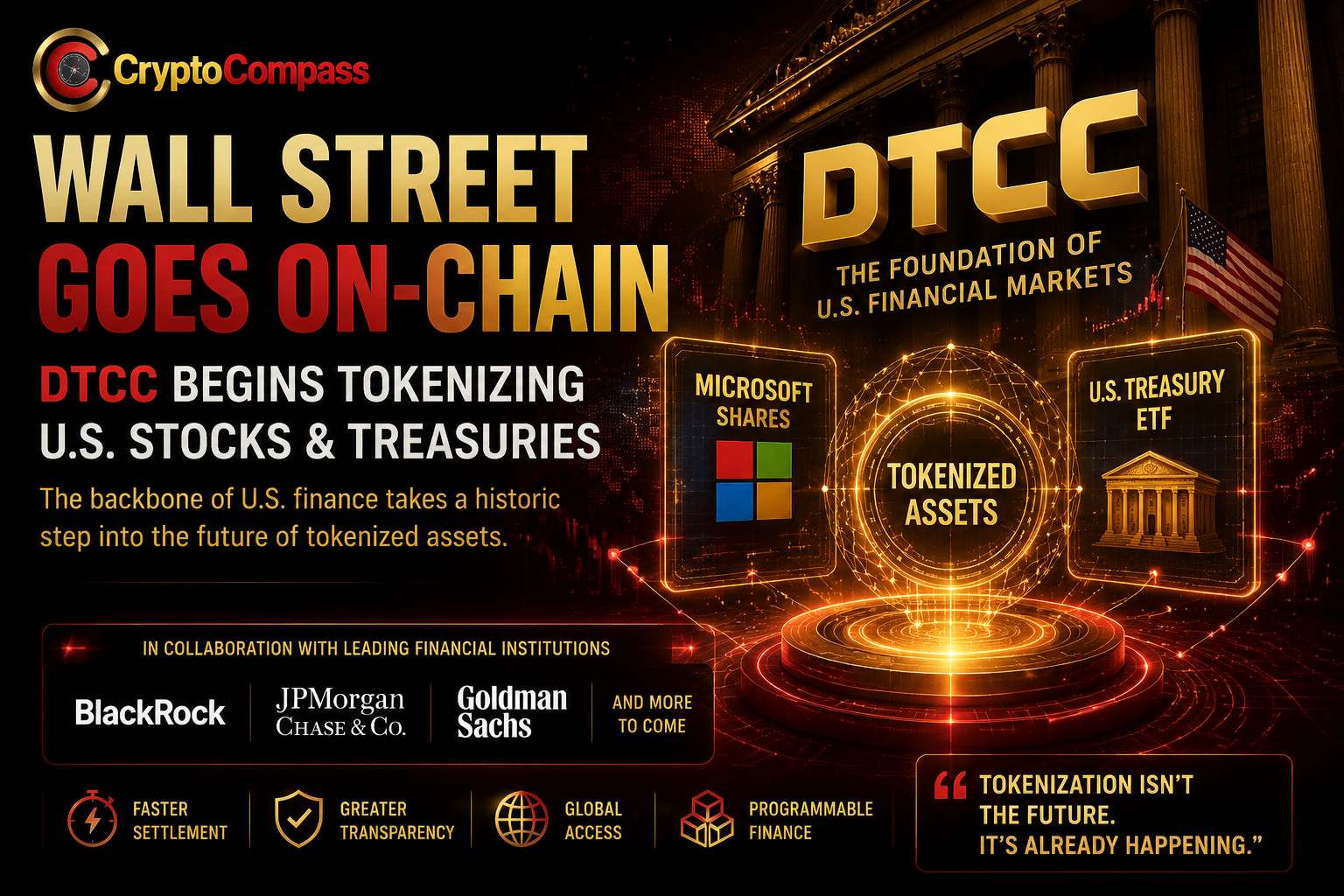
The Depository Trust & Clearing Corporation (DTCC)—the backbone of the U.S. securities market—has officially begun production transactions involving tokenized financial assets, working alongside some of the world's largest financial institutions, including JPMorgan, BlackRock and Goldman Sachs.
This is not another proof of concept.
It is one of the clearest signals yet that Wall Street is moving from experimentation to implementation.
What Is DTCC?
For many crypto investors, DTCC is relatively unknown.
Yet it is arguably one of the most important financial institutions in the world.
DTCC operates the core infrastructure responsible for clearing, settling and safeguarding the vast majority of securities traded in the United States. Every day, trillions of dollars in stocks, bonds, ETFs and other financial instruments pass through its systems.
In other words, while exchanges execute trades, DTCC ensures those trades actually settle and ownership is transferred correctly.
Without DTCC, the U.S. capital market simply would not function.
That makes this announcement far more significant than a new blockchain launch or another tokenization pilot.
From Pilot Projects to Production
Tokenization has existed for years.
Banks have issued tokenized bonds.
Asset managers have launched tokenized money market funds.
Crypto companies have wrapped traditional assets onto blockchains.
However, these initiatives largely operated outside the core financial infrastructure.
DTCC's latest move changes that narrative.
Rather than treating tokenized assets as experimental products, the organization has begun processing production transactions involving tokenized securities, integrating blockchain technology into the infrastructure that supports America's financial markets.
The distinction matters.
Testing demonstrates technological feasibility.
Production demonstrates operational confidence.
Why Stocks and Treasuries?
The initial assets involved include highly liquid financial instruments such as:
These are not speculative crypto assets.
They represent some of the safest and most actively traded financial products in the world.
Starting with highly liquid securities minimizes operational risk while demonstrating how blockchain infrastructure can improve settlement efficiency, ownership tracking and asset mobility.
Why Tokenization Matters
Traditional financial markets still rely on infrastructure designed decades ago.
Even in 2026, investors continue operating within constraints such as:
Tokenization offers a fundamentally different model.
Instead of relying on multiple centralized ledgers maintained by separate institutions, ownership can be represented digitally on blockchain infrastructure.
Potential benefits include:
Faster settlement.
Reduced operational costs.
Near real-time transfers.
Greater transparency.
Programmable financial assets.
Improved collateral efficiency.
Easier cross-border transactions.
Rather than replacing existing financial markets overnight, tokenization aims to modernize the infrastructure beneath them.
Wall Street Is Moving Together
Perhaps the most important aspect of DTCC's announcement is not the technology itself.
It is the list of participants.
The initiative involves institutions including:
BlackRock
JPMorgan
Goldman Sachs
These firms manage or influence tens of trillions of dollars in global assets.
Their participation suggests tokenization is no longer viewed merely as a crypto innovation.
It is becoming a strategic priority for traditional finance.
This trend has accelerated dramatically over the past two years.
BlackRock has expanded tokenized investment products.
Franklin Templeton operates tokenized money market funds.
JPMorgan continues developing blockchain-based settlement infrastructure.
Robinhood recently launched Robinhood Chain with a focus on tokenized financial assets.
Rather than competing against blockchain, Wall Street increasingly appears determined to adopt it.
Why This Is Bullish for RWA
Real World Assets (RWA) have become one of crypto's fastest-growing sectors.
Unlike speculative digital tokens, RWAs represent claims on tangible financial assets such as:
Government bonds
Stocks
Treasury funds
Money market products
Real estate
Private credit
The sector has attracted billions of dollars because it generates real economic value instead of relying solely on token appreciation.
DTCC's move strengthens the long-term investment thesis for RWAs by validating tokenization at the highest level of financial infrastructure.
Instead of asking whether tokenization will happen, markets are increasingly asking how quickly it can scale.
What It Means for Crypto
This development extends beyond traditional finance.
If tokenized securities become mainstream, blockchain networks stand to benefit from increased institutional activity.
Ethereum remains the dominant platform for tokenized assets today.
Layer 2 ecosystems—including Base, Arbitrum and Robinhood Chain—are also positioning themselves as infrastructure for tokenized finance.
Stablecoins will likely become an essential settlement layer.
Oracles, compliance providers and custody solutions could experience significant growth alongside tokenized assets.
The opportunity extends well beyond Bitcoin.
It encompasses the infrastructure supporting the next generation of financial markets.
Challenges Remain
Despite growing momentum, several obstacles remain.
Regulation remains fragmented across jurisdictions.
Interoperability between financial institutions and blockchain networks continues to evolve.
Legal recognition of tokenized ownership varies depending on asset class and geography.
Cybersecurity, custody and compliance requirements remain critical.
Tokenization is no longer a question of technology.
It is increasingly a question of regulation, adoption and market structure.
Outlook
For years, blockchain advocates argued that tokenization would transform capital markets.
Today, the conversation is no longer theoretical.
When the organization responsible for settling the majority of U.S. securities begins processing tokenized assets in production, it signals a structural shift in how global finance may operate over the coming decade.
Bitcoin introduced the idea of digital money.
Ethereum introduced programmable assets.
Tokenization may become the bridge that finally connects traditional finance with blockchain infrastructure.
The transition will not happen overnight.
But Wall Street has clearly begun laying the tracks
Key Takeaways
DTCC has begun processing production transactions involving tokenized financial assets.
Major institutions including BlackRock, JPMorgan and Goldman Sachs are participating.
Tokenization is moving beyond pilot programs into core financial infrastructure.
The development significantly strengthens the long-term investment case for the RWA sector.
Blockchain is increasingly becoming infrastructure for traditional finance rather than an alternative to it.
Disclaimer: This article is for informational purposes only and does not constitute investment advice.