Key Highlights A settlement between Paramount Skydance, Warner Bros. Discovery, and 12 states has resolved antitrust concerns surrounding their $110 billion merger agreement. Shares of Warner
Key Highlights
- A settlement between Paramount Skydance, Warner Bros. Discovery, and 12 states has resolved antitrust concerns surrounding their $110 billion merger agreement.
- Shares of Warner Bros. (WBD) jumped 11% to reach $30.87, completely eliminating year-to-date declines.
- Paramount (PSKY) shares dropped 2.94% to $10.06 following disclosure of settlement obligations.
- Under settlement terms, Paramount commits to $300 million in extra annual domestic production spending over five years, alongside $14.5 million yearly for community programs.
- The agreement imposes $30 million fines per missed film and could force divestiture of Paramount’s 49% Miramax ownership stake for serious violations.
California’s Attorney General Rob Bonta revealed on Monday that a settlement has been reached between Paramount Skydance and twelve states, eliminating the final significant obstacle to completing its $110 billion combination with Warner Bros. Discovery.
Paramount (PSKY) shares declined 2.94% to close at $10.06, erasing an early trading surge of almost 9% after investors digested the complete settlement requirements. Meanwhile, Warner Bros. Discovery (WBD) experienced a dramatically different trading session, climbing 11% to $30.87 and eliminating its entire year-to-date deficit.
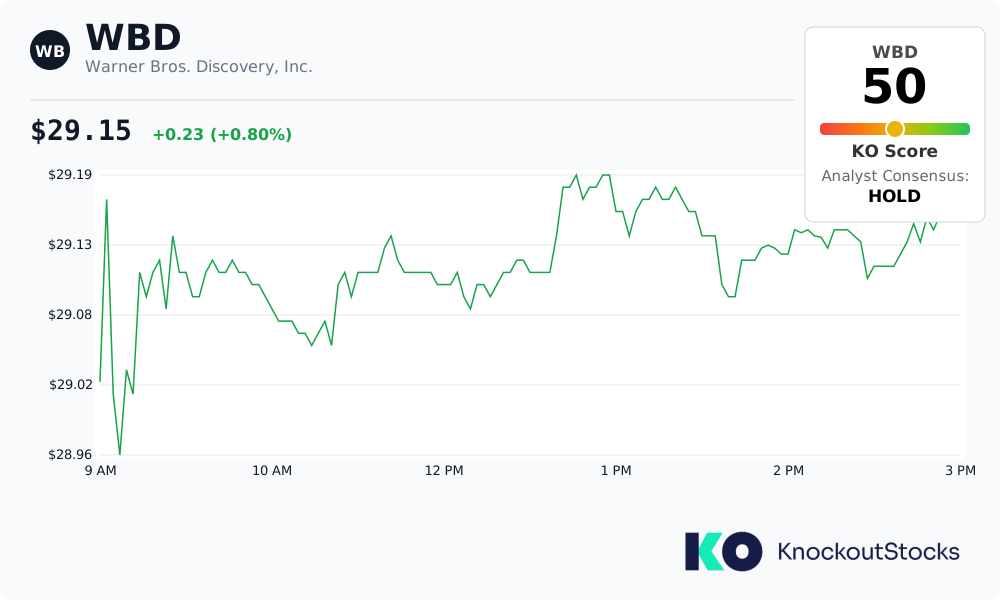 Warner Bros. Discovery, Inc., WBD
The contrasting market reactions clearly illustrate which company shoulders the settlement burden. Paramount bears the primary financial obligations.
Under the agreement, Paramount commits to investing an extra $300 million annually in domestic film and television production throughout the next five years, using 2025 expenditure as the baseline. Additionally, the company pledged $14.5 million each year toward community programs and an independent film development fund.
The total film production commitment has increased from the originally agreed 150 films to 156 over the five-year timeline.
A minimum of 20% of these productions must feature combined marketing and production budgets exceeding $50 million and secure wide theatrical distribution across no fewer than 3,000 domestic theaters. The settlement includes explicit restrictions preventing artificial intelligence-generated material from satisfying production requirements.
Financial Consequences for Non-Compliance
Should Paramount fall short of its yearly production commitments, the company will incur $30 million penalties for each missing film. According to Bonta, 90% of these penalty payments would be distributed directly to entertainment industry workers via health insurance and pension programs.
Complete failure to satisfy production quotas could trigger a mandatory sale of Paramount’s 49% ownership interest in Miramax.
The settlement also requires Paramount to contribute $17.5 million to the Writers Guild of America health plan and reimburse the WGA’s legal expenses. A five-year prohibition on writer layoffs at CBS News Broadcast operations is also mandated.
Journalism Independence Protections
A significant element of the settlement establishes a news editorial independence board with oversight authority for CBS News and CNN. This board must be operational within 180 days following merger completion and include five current or former journalists possessing a minimum of ten years professional experience.
The board will adjudicate conflicts between editorial staff and management regarding alleged reporting bias concerns. Both CNN and CBS have encountered scrutiny after CNN’s exclusion from White House access by President Trump earlier this year.
Paramount’s CEO David Ellison expressed satisfaction with the resolution, stating the company has secured “complete clearance for this merger.” He acknowledged both Attorney General Bonta and California Governor Gavin Newsom for their roles in reaching the final agreement.
Bonta emphasized the settlement does not constitute “a vote of support for this merger,” but maintained it transforms a potentially damaging reduction in domestic production into a substantial expansion of film creation, employment opportunities, and economic benefits.
The WGA indicated it accepted the settlement terms because, as a nonprofit organization, it lacked financial resources to continue challenging the merger without governmental backing. The guild maintains its position that the transaction “will cause damage to writers and the industry at large.”
An independent compliance monitor will be designated to ensure adherence to all settlement provisions.
The post Warner Bros. Discovery (WBD) Jumps 11% as Paramount (PSKY) Sinks 3% Following Merger Settlement appeared first on Blockonomi.