Crypto markets spent the past week moving lower as investors reacted to Federal Reserve uncertainty, a stronger U.S. dollar, and continued ETF outflows. Yet beneath the surface, something very different is happening. Stablecoin infrastructure is expanding, institutional adoption
A
AnonymousCryptoCompass newsroom
June 23, 2026
8 min read
ANALYSIS
CryptoCompass editorial visual for markets coverage.
The Market Is Weaker. Liquidity Isn't.
For most investors, the past week looked straightforward.
Prices fell.
Sentiment weakened.
Risk appetite declined.
Bitcoin slipped toward $64,000. Ethereum underperformed. Most major altcoins moved lower.
The market appeared fragile.
Yet when we move beyond price and examine capital flows, infrastructure development, and institutional activity, a different picture emerges.
The correction is real.
The exit is not.
Bitcoin Remains Trapped By Macro Forces
Bitcoin's weakness continues to reflect the same challenge facing most risk assets.
The Federal Reserve remains cautious.
The U.S. dollar remains strong.
Bond yields remain elevated.
Investors are still waiting for confirmation that monetary conditions will eventually loosen.
As a result, capital has become selective.
Risk-taking has slowed.
Market participants are demanding clearer macro signals before committing aggressively.
This is not unique to crypto.
It is the dominant theme across global markets.
ETF Selling Pressure Is Finally Easing
One of the most important developments of the week received less attention than it deserved.
Spot Bitcoin ETF outflows are slowing.
For weeks, ETF-related selling represented one of the largest sources of pressure on the market.
That pressure has not disappeared.
But it has weakened.
Recent daily flow data shows significantly smaller outflows than previous weeks, while some sessions have already returned to positive territory.
This matters because ETF flows have become one of the primary transmission channels between institutional capital and digital assets.
A slowdown in selling does not automatically create a rally.
But it removes a major obstacle.
Ethereum Faces Internal Questions
Ethereum's decline was amplified by concerns surrounding its long-term economic structure.
Discussions around Ethereum Foundation budget reductions, validator incentives, and future issuance models created additional uncertainty at a time when investors were already cautious.
Markets dislike uncertainty.
Especially during periods of macro stress.
The result was continued underperformance relative to Bitcoin.
At the same time, large leveraged positions on derivatives platforms remain under pressure, highlighting the fragility of sentiment across the broader market.
The Infrastructure Story Continues To Improve
While traders focused on red candles, builders continued building.
Chainlink's Project Pangea may prove to be one of the most important developments of the week.
The initiative connects dozens of European and South Korean banking institutions in an effort to enable near-instant foreign exchange settlement using stablecoins.
This is not another crypto experiment.
It is an attempt to improve real-world financial infrastructure.
The significance becomes even larger when considering that the project works alongside existing banking standards such as SWIFT and ISO 20022.
The future of blockchain adoption may not come from replacing traditional finance.
It may come from upgrading it.
Stablecoins Continue Their Quiet Expansion
Another major theme emerged from Brazil.
Oobit integrated directly with PIX, the country's dominant real-time payment network.
For users, the experience is simple.
Convert local currency into USDT.
Spend through familiar payment rails.
Access dollar liquidity without needing a traditional dollar bank account.
This trend continues to appear across emerging markets.
Stablecoins are evolving from speculative assets into financial utilities.
That distinction may ultimately be more important than short-term price movements.
Regulation Is Becoming Reality
Europe's MiCA framework continues to reshape the competitive landscape.
The message from regulators is becoming increasingly clear.
The next phase of crypto will be more regulated, more institutional, and more difficult for smaller operators.
Many firms may disappear.
The survivors will likely emerge stronger.
Historically, institutional capital prefers clarity over ambiguity.
MiCA may ultimately accelerate adoption by reducing uncertainty.
Institutions Continue To Move Forward
Despite the correction, institutional interest shows little sign of retreat.
BlackRock continues to position Bitcoin as a diversification asset.
Not a portfolio replacement.
Not a speculative bet.
A complementary allocation.
Meanwhile, Japan's pension system is preparing to begin limited crypto exposure starting in fiscal year 2026.
These allocations remain modest.
But the direction matters more than the size.
Institutional adoption rarely happens all at once.
It happens gradually.
Then suddenly.
Capital Is Rotating, Not Leaving
The most important takeaway from the week comes from liquidity data.
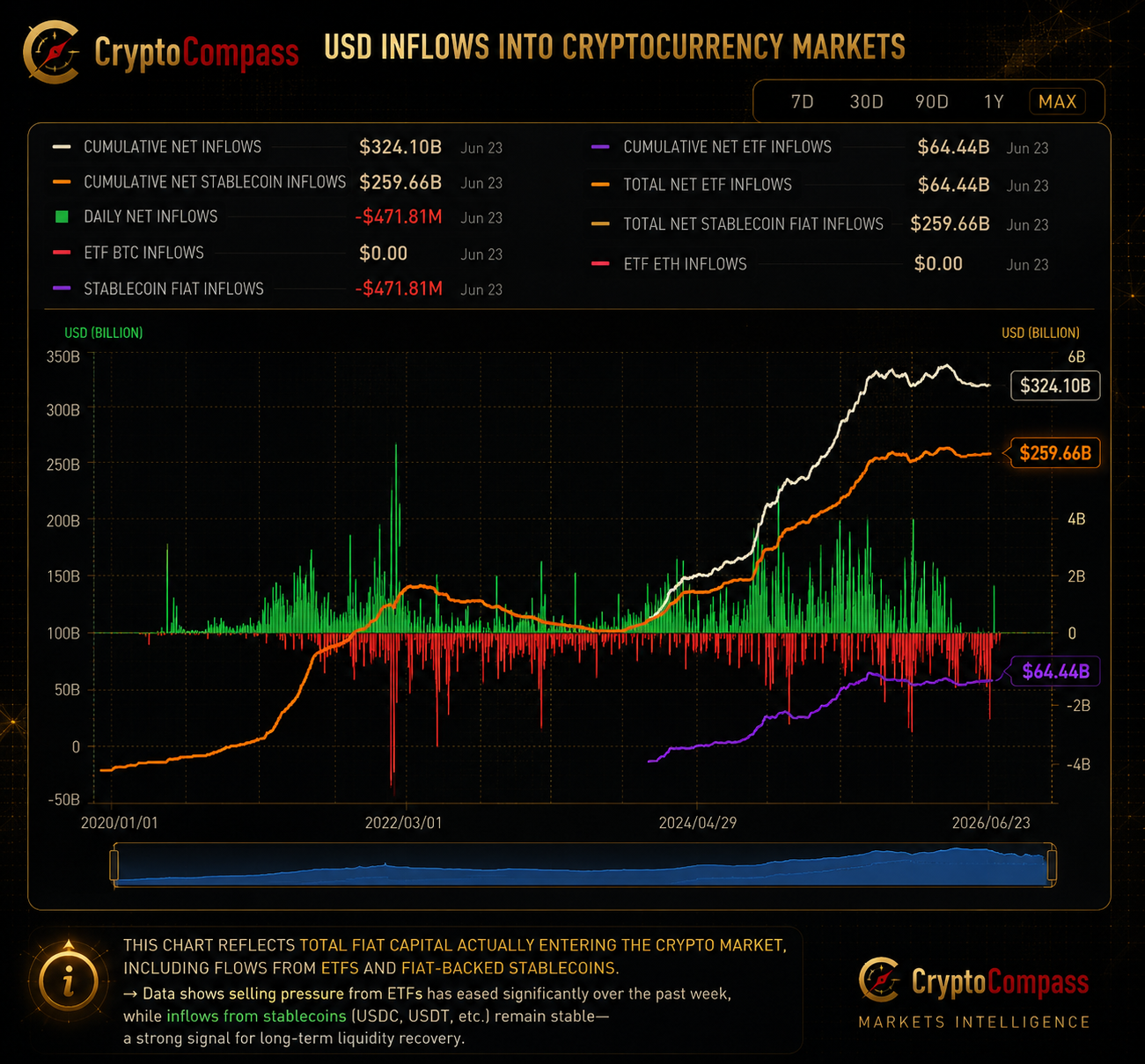
ETF selling pressure has eased significantly while stablecoin liquidity remains stable, suggesting capital is rotating rather than exiting the market. Total cumulative capital inside the crypto ecosystem remains remarkably strong.
ETF flows remain positive over the long term.
Stablecoin liquidity remains substantial.
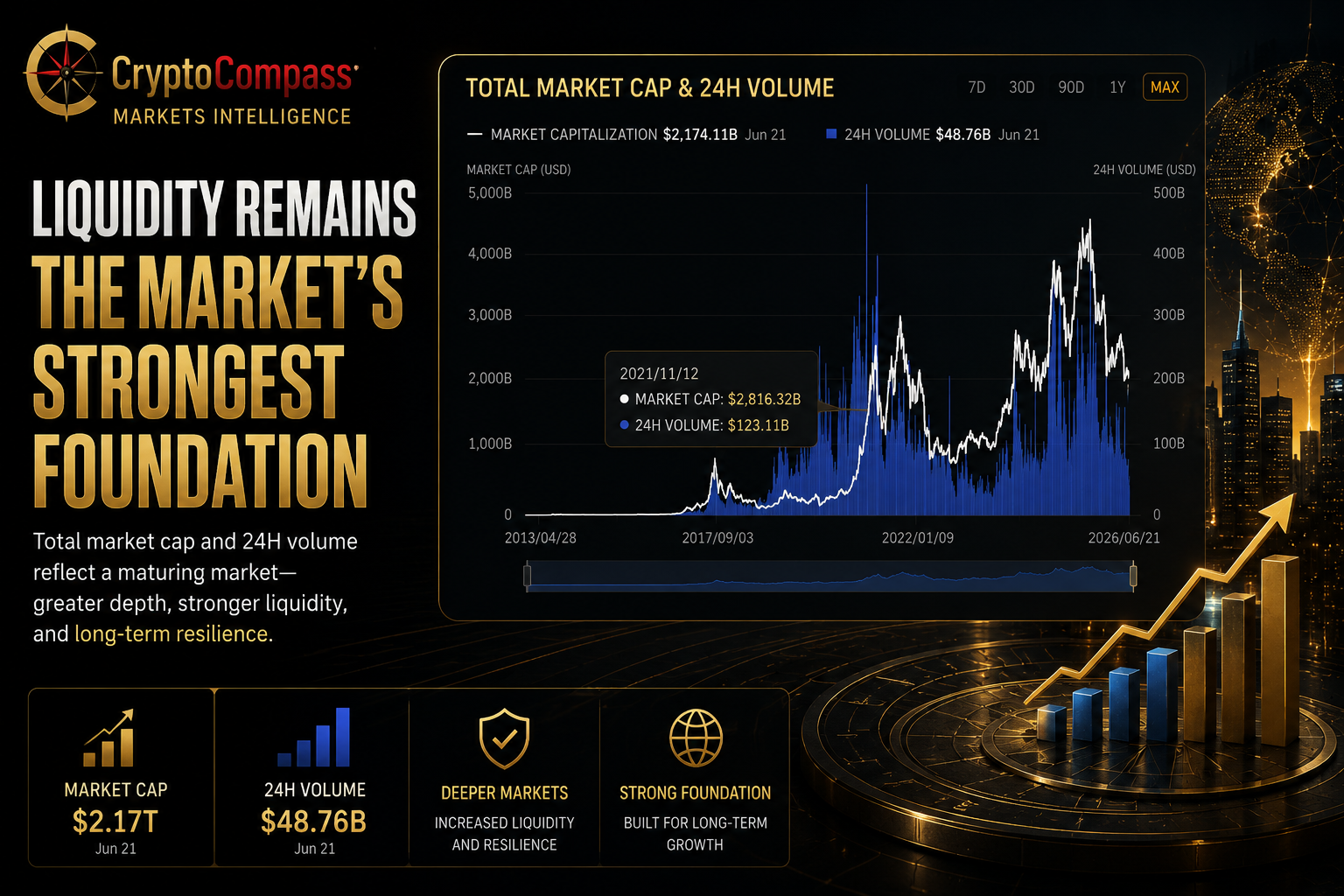
Market depth remains significantly healthier than during previous correction cycles.
Despite declining prices, overall market capitalization and trading activity remain elevated relative to previous correction cycles. This is why the current pullback feels different from historical capitulation events.
Prices are weaker.
Liquidity is not.
Capital appears to be repositioning rather than exiting the system entirely.
That distinction may define the next phase of the market.
CryptoCompass View
The market currently sits between two competing forces.
Short-term macro pressure continues to suppress risk appetite.
Long-term structural adoption continues to strengthen the ecosystem.
Investors are focusing on the first story.
History may ultimately remember the second.
The coming PCE inflation report and future Federal Reserve decisions will determine the next short-term move.
LINK faces downside risk as descending trendlines remain intact, with traders watching $11.80 support and lower price zones. Two possible corrective paths place November 5 on the calendar as
Analyst Ali Martinez has laid out bearish chart setups for the AI altcoins Venice Token (VVV), OriginTrail (TRAC), and AI Rig Complex (ARC) in an X thread, calling the sector “in big trouble.
Brazil’s stock market is getting hammered, and the reason has plenty to do with politics. Investors rushed to sell Brazilian assets on Monday after President Luiz Inácio Lula da Silva secured