Strategy (NASDAQ: MSTR) is no longer the main buyer of BTC, but accumulation continues for other whale wallets. Key stakeholders with over 10K BTC have increased their holdings in the past mo
Strategy (NASDAQ: MSTR) is no longer the main buyer of BTC, but accumulation continues for other whale wallets. Key stakeholders with over 10K BTC have increased their holdings in the past month.
Strategy is no longer a main driver of weekly BTC price moves, as the past five weeks have gone without big purchases.
Strategy split its spending between BTC and rebuilding some of its cash reserves. The company’s latest 8-K filing included the sale of $22M worth of MSTR common stock, with a relatively small 267 BTC purchase and $193M in STRC preferred share buybacks.
Between September 14 and October 18, Strategy added 3,466 BTC in total, valued at $290M. At the same time, the company spent $890M of its cash reserves on its preferred stock buyback program.
Strategy also expanded its buyback program to help STRC preferred shares trade at their target range. The company increased its spending cap for this goal from $2B to $3B, once again posing a challenge for raising cash.
As of October 18, Strategy holds $447.3M in cash, potentially requiring more raises for its buyback program.
Whales pass Strategy with active BTC accumulation
Accumulation addresses for shark and whale wallets offset Strategy’s slow buying in the past weeks. In the past month, wallets holding 10 BTC to 10K BTC added 88,987 BTC. Strategy bought only around 3% of the total, and is no longer key to the survival of BTC.
Strategy also calmed the market after avoiding a spiral of selling, retaining a treasury of 848,517 BTC. Yet the recent BTC price moves showed the coin could recover even without demand from treasuries.
Whale purchases, however, are still key to spot BTC demand. A strong spot demand recovery is closely watched as a sign of a more confident bull market.
Recent data on BTC wallet activity showed an increase in the raw number of shrimp wallets holding at least some BTC. Larger holders also increased their reserves, and the raw number of wallets rose in the past month. Another 45 whales built up a wallet of 1,000 to 10,000 BTC in the past 30 days.
New whales gain more influence
In 2026, the balance of BTC holders shifted, as well as their influence on the market. The realized market cap metric shows new buyers have a stronger potential influence on the market.
In early 2026, newer whales held 18% of the BTC realized market cap, rising to about 33% in October. New whales still lag in terms of total idle BTC holdings, but may be more influential in short-term trading. In the past month, whale wallets were also more likely to accumulate BTC, while retail wallets showed signs of distribution.
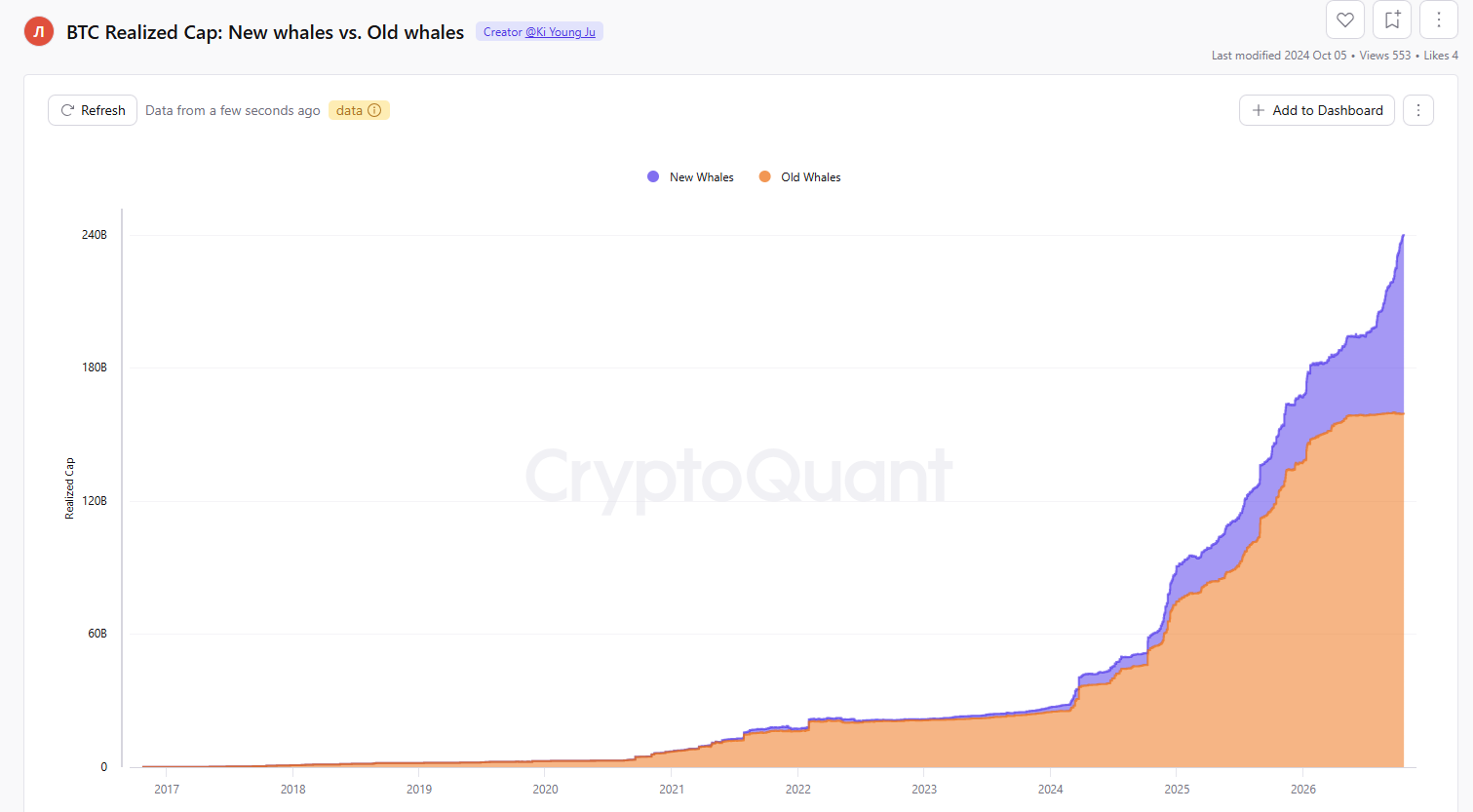
New BTC whales are more influential on the market, as they hold 33% of the BTC realized cap, with an average cost basis at $77K per BTC. | Source:
Cryptoquant
The newest cohort of whales moved into the market while BTC traded between $110K and its lows of $59K. During that time, the new whale cohort bought the local lows and kept accumulating. As a result, the cost basis of new whales is on average around $77K per BTC.
The new whale cohort is yet to show its intentions. With BTC trading as low as $81,000 in the past few days, the average realized gains are only slightly above the average cost. At this point, it remains unknown if the new whales would be ready to hold their BTC even at an unrealized loss.
The recent involvement and accumulation of new whales showed signs of growing momentum. Since July, the realized market cap metric turned exponential. At the same time, the new on-chain whales are not necessarily signs of new liquidity and may be due to legacy players repositioning.
If you're reading this, you’re already ahead. Stay there with our newsletter.