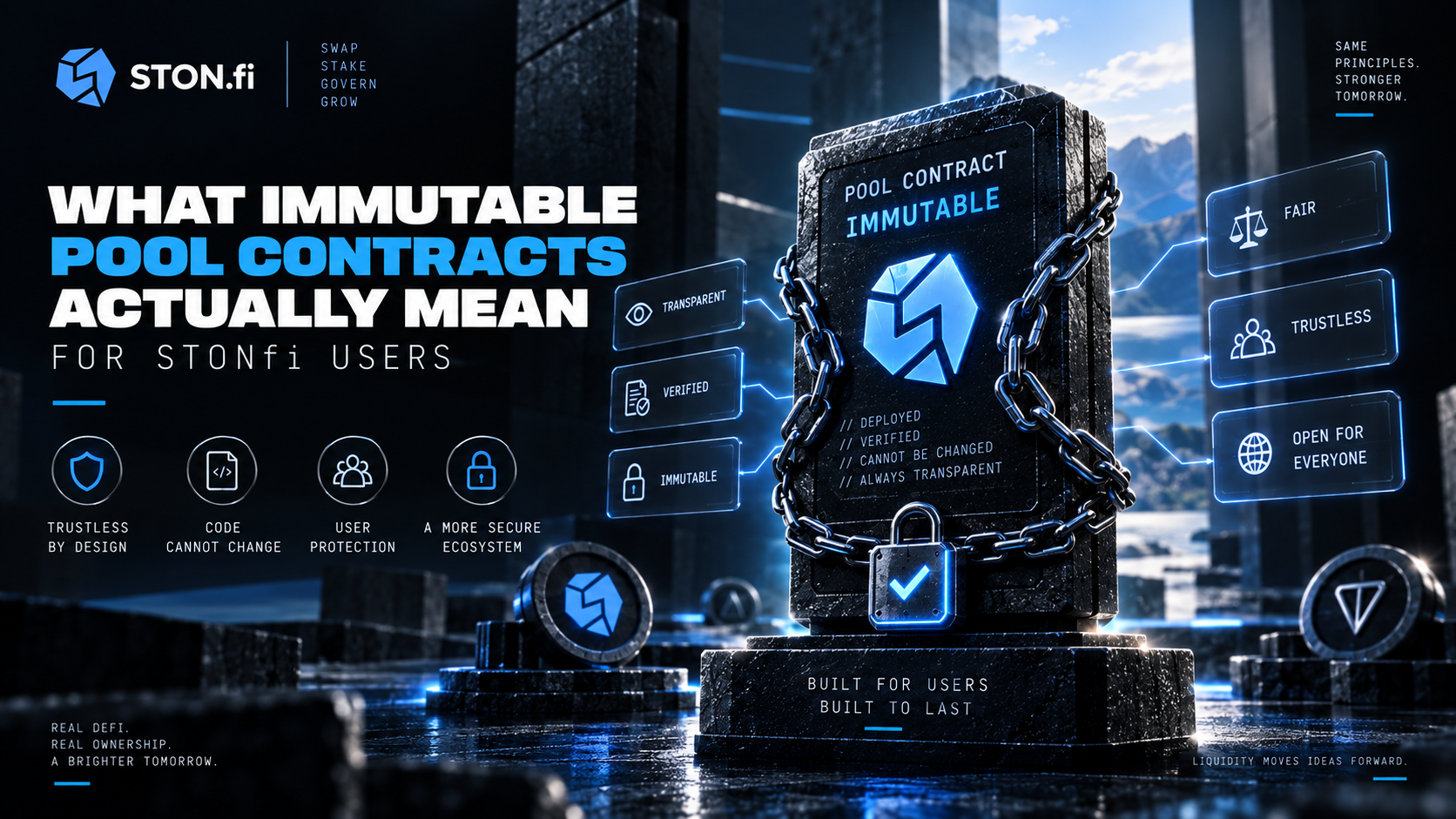
What Immutable Pool Contracts Actually Mean for STONfi Users "Immutable" is one of those words DeFi borrowed and then quietly stripped of precision. People use it as shorthand for "nothing ca
What Immutable Pool Contracts Actually Mean for STONfi Users
"Immutable" is one of those words DeFi borrowed and then quietly stripped of precision. People use it as shorthand for "nothing can ever change here," which sounds reassuring and is almost never what it actually means in practice. The real meaning is narrower, more specific, and honestly more useful once you understand it — but only if you're willing to sit with the distinction instead of treating the word as a security badge. 🔒
STONfi describes its liquidity pool contracts as immutable. That claim is accurate, and it removes a genuinely important class of risk. It also does not mean a pool exists outside of governance, configuration changes, or protocol-level evolution — because STONfi's architecture deliberately allows certain parameters and operating states to change through predefined mechanisms, and because the Router sitting in front of those pools is upgradeable even when the pools themselves aren't.
Understanding exactly where that line falls is the difference between an accurate mental model of your risk and a comfortable but wrong one.
STONfi splits responsibilities across several distinct smart contracts rather than concentrating everything into one monolithic piece of code, and that separation is what makes the immutability question interesting rather than binary.
The Router is the main entry point — it receives operations and routes them to the appropriate liquidity pool. The Pool stores the AMM data for a specific token pair, processes swaps and liquidity operations, performs the pricing calculations, and acts as the minter for LP tokens representing your share of that pool.

The architectural distinction that matters most: according to STONfi's documentation, the Router is the only DEX contract that can be upgraded. Pool contracts, once deployed, keep their code permanently.
That gives you two genuinely different security surfaces to think about, and conflating them is where most confusion starts. The pool offers strong code persistence — its core implementation cannot suddenly be replaced with different logic by anyone, under any circumstance. The Router offers protocol flexibility — it can coordinate pools, adjust supported parameters, and receive future upgrades as the protocol evolves.
This is a deliberate design trade-off, not an accident or an inconsistency. You get predictability exactly where predictability matters most — the code holding and calculating against your funds — while keeping enough flexibility at the coordination layer for the protocol to actually improve over time rather than being frozen at whatever its first version happened to get right.
This is probably the single most important thing to internalize, and it's where the casual definition of "immutable" does the most damage to people's understanding.
A pool contract can have permanently fixed code while the data stored inside that contract changes continuously, transaction after transaction, forever. These are completely separate concepts that happen to both live inside the same contract.
Every swap changes the pool's reserves. Adding or removing liquidity changes both reserves and total LP token supply. Fee accumulation changes balances over time. Pool status can change. Certain pool parameters can be updated through operations the existing contract code explicitly permits.

STONfi v2's pool state includes variables like reserves, total LP supply, LP fees, protocol fees, and pool status — all of which are designed to change, because a pool that couldn't update its own reserves would be a pool that couldn't process a single swap. The Router documentation separately defines administrative operations for changing fees and pool status, and specialized pool implementations may support additional parameter updates on top of that.
Here's how the pieces actually break down:
Existing pool contract code — cannot change. The core implementation is not replaceable.
Token reserves — change constantly, through every swap and every liquidity operation.
LP token supply — changes whenever liquidity is added or removed.
Trading fees — can be adjusted through documented protocol controls.
Pool status — trading or liquidity operations can be restricted.
Router code — can be upgraded.
The rules permitting all of the above — fixed for any existing pool, defined by that pool's deployed code.
That last line is the one that ties it all together. The rules governing what can change were themselves set permanently at deployment. Nothing can be added to that list afterward.
The cleanest way I've found to think about it: the rulebook is fixed, while the game continues to play out according to those rules. Immutability constrains what kinds of changes are possible, not whether anything changes at all.
The most direct benefit is protection against arbitrary pool-code replacement, and it's worth being specific about why that matters rather than accepting it as self-evidently good.
On an upgradeable smart contract, whoever controls the upgrade mechanism can potentially replace existing logic with entirely new code. Legitimate upgrade mechanisms genuinely are useful — they let developers fix bugs and add features without abandoning an address and migrating everyone. But they also create an additional security dependency that never goes away: users have to trust that the upgrade authority and its keys are never abused, never compromised, never mishandled by whoever holds them, indefinitely, for as long as their funds sit there.

TON's own smart-contract documentation is explicit about this, noting that upgrades can affect contract behavior, funds, and state, and that unauthorized upgrades can result in loss of control or loss of funds outright.
An immutable STONfi pool removes that particular attack path from the pool itself entirely. If you inspect or audit the code behind an existing pool today, an administrator cannot later silently replace that same pool's code with something different. What you reviewed is what stays there.
For liquidity providers specifically, this means the fundamental contract implementation holding your pool state isn't designed around an unrestricted "upgrade this pool later" mechanism sitting in the background as a permanent, open-ended trust requirement. That's a meaningful reduction in what you have to keep trusting over time.
Immutable code can still contain bugs. That sentence is worth reading twice, because it's the part people skip when "immutable" gets treated as a security credential.
In fact, immutability creates a real trade-off rather than being a pure win. If an error exists inside immutable code, developers cannot simply patch the deployed pool in place. The bug stays there, in that contract, permanently. Upgradeable contracts make fixing defects straightforward but introduce upgrade-authority risk. Immutable contracts eliminate upgrade-authority risk at the pool level but make deployed bugs much harder to correct.

Neither approach is universally superior. They're different risk profiles, and reasonable protocols make different choices depending on what they're optimizing for.
The honest framing is that immutability tells you something very specific about how a contract's code can change. It tells you nothing at all about whether every outcome that code produces will be favorable to you, which is a completely separate question.
Immutability also does nothing about market risk, impermanent loss, token risk, liquidity risk, or economic problems arising from unexpected market conditions. A perfectly immutable pool holding a token that collapses is still a pool holding a token that collapsed. The contract behaved exactly as deployed the entire time.
You can't understand STONfi's immutable pools properly without also understanding the Router, because looking at pool immutability in isolation gives a genuinely incomplete picture of the protocol's actual trust model.
STONfi describes the Router as the main entry point for DEX operations and the contract holding protocol-level administrative capabilities. It can lock or unlock operations, change fees for a particular pool, and upgrade its own contract. So while the mathematical and operational logic already deployed inside a pool cannot be rewritten, the environment through which you actually interact with that pool does have configurable elements and is itself upgradeable.

STONfi addresses Router upgrade risk through a seven-day timelock. The protocol documentation states that Router contract upgrades are delayed for seven days, giving users advance notice and a genuine opportunity to withdraw provided liquidity if they disagree with the proposed change.
That's a fundamentally different security model from instant administrative upgrades. Instead of the pattern where an admin proposes new code and that new code immediately controls the protocol, it becomes: upgrade initiated, waiting period begins, users can evaluate the change, and only then can the upgrade be finalized.
To be clear about what the delay does and doesn't accomplish — it doesn't make a bad upgrade impossible. Nothing about a timelock prevents someone from eventually finalizing a change users dislike. What it does is guarantee you have time to observe and react before new Router code becomes active, which converts a class of risk from "you find out afterward" to "you have a week to decide what to do about it." That's not nothing, and it's substantially better than the alternative, but it's not the same as the change being impossible.
Trading fees demonstrate exactly why "immutable contract" and "unchangeable pool" aren't synonyms, and it's the example I'd point to first if someone was struggling with the concept.
STONfi's current documentation says fees are configurable on a per-pool basis. The default total fee is 0.3% — 0.2% going to liquidity providers, 0.1% to the protocol — and the fee configuration can be adjusted within a documented 0%–1% range.
Mechanically, the Router exposes a set_fees operation that sends the new fee configuration to the target pool, and the v2 Pool contract already contains logic for receiving that authorized fee update.

Nothing about this contradicts pool immutability, even slightly. The code did not change. The original immutable code was written from the beginning to accept certain authorized parameter updates — that capability was baked in at deployment, not added afterward. Someone using the mechanism is using the contract exactly as it was permanently built.
This generalizes into a genuinely useful lesson for reading any smart contract: immutability refers to code replacement, not necessarily to every value stored by that code. A contract can be permanently fixed and still have been designed with configurable parameters from day one.
For an LP, immutable pool contracts make one specific part of the risk model substantially easier to reason about. You don't have to assume the exact pool contract you deposited into might later receive completely different bytecode through some pool-level upgrade mechanism. The implementation governing swaps, liquidity accounting, and LP-token behavior remains the implementation you can inspect today.

But that guarantee is narrow, and LPs should still actively monitor what sits outside it:
Current fees directly affect your fee yield, and they're adjustable within the documented range
Pool status affects whether the pool is usable at all for trading or liquidity operations
Router upgrades can affect how transactions move through the protocol, subject to that seven-day notice window
New protocol versions can introduce new pool architectures entirely, rather than rewriting old pools
That last point deserves emphasis because it's easy to miss. Protocol evolution on STONfi happens around immutable pools, not by changing them. A new version means new contracts, not modified old ones.
The practical takeaway: LP risk analysis should separate pool-code risk from protocol-control risk, rather than lumping both into one vague bucket labeled "smart contract risk." Those are genuinely different exposures with different mitigations, and immutability only addresses one of them.
For traders, pool immutability primarily buys predictability. A known pool cannot suddenly execute entirely different core logic because someone swapped out its contract code. The pricing calculations implemented inside that pool stay tied to its deployed implementation, permanently.
What it doesn't buy is any assurance that trading conditions themselves are permanent. Fees may change within the allowed range. A pool or the Router can be locked under supported protocol controls. Liquidity changes continuously, which directly affects your price impact on any given trade. Different STONfi versions and pool types may behave differently from each other.
So knowing a pool is immutable is genuinely useful context, but it doesn't replace checking the current pool configuration, liquidity, fees, and Router version before making assumptions about how your specific execution will go. Immutability is a statement about the code's permanence, not a snapshot of present conditions.
TON supports upgradeable contracts specifically because upgrades are genuinely useful — they let developers fix defects and add functionality without abandoning an existing address and forcing everyone to migrate. STONfi deliberately chose a different path for its pools, and that choice has real consequences for how the protocol grows.
Instead of relying on the ability to continually rewrite every deployed pool, evolution happens around immutable pools: through Router upgrades, through new contract implementations, and through new protocol versions. STONfi's documentation already separates its original v1 contracts from the newer v2 architecture, which adds features including improved liquidity management and a vault-based system.
This makes contract versioning considerably more important than it would be under an upgrade-everything model. An immutable contract tells you its implementation will remain what it was at deployment. It does not tell you that STONfi as a protocol will never introduce newer architectures — and in fact, immutability essentially guarantees that new architectures are how improvement has to happen.
When evaluating any DeFi protocol, asking simply "are the contracts immutable?" isn't sufficient, because the answer is almost always more nuanced than yes or no, and the nuance is where the actual risk lives.
A better question, and one you can actually answer with documentation:
Which contracts are immutable, which can be upgraded, which parameters can change, who is authorized to change them, and how much time do users have to react?
For STONfi, that question has a reasonably structured answer. Pool contracts are immutable. Their state changes according to predetermined logic already present in the deployed code. Certain pool parameters remain configurable within documented ranges. The Router holds broader administrative responsibilities and is upgradeable, with upgrades subject to a seven-day delay.
That's a far more accurate picture than either convenient extreme — "everything is controlled by admins" on one side, "nothing can ever change" on the other. Both of those are wrong, and both lead to badly calibrated decisions.
Immutable pool contracts give STONfi users a specific and genuinely valuable form of predictability: the core code of an already deployed liquidity pool cannot simply be swapped for a different implementation. That removes the risk associated with direct pool-code upgrades and makes an existing contract's behavior far easier to reason about over long time horizons.
But the guarantee has clear boundaries, and knowing where they fall is the whole point. Pool reserves keep moving. LP supply changes with every deposit and withdrawal. Fees can be adjusted within documented limits. Pools have configurable parameters and status controls. And the Router remains an upgradeable component of the broader architecture, protected by a seven-day delay rather than by absolute immutability.
The practical takeaway isn't that STONfi pools can never change. It's that their code cannot change, while their state and the protocol around them can evolve only through mechanisms the architecture already defines.
That distinction is what makes immutable contracts genuinely useful — and it's exactly what users need to understand before treating immutability as a complete security guarantee rather than the specific, bounded protection it actually is.
If a pool contract is immutable, why can its fees change? Because the original deployed code was written to accept certain authorized parameter updates. The code itself hasn't been replaced — a capability it always had is being used.
Can STONfi replace a pool I've already provided liquidity to? Not the pool's code. New protocol versions introduce new pool contracts rather than rewriting existing ones, so the implementation you deposited into stays as deployed.
What happens if a bug is found in an immutable pool contract? It can't be patched in place, which is the genuine trade-off of immutability. Fixes have to come through new contract deployments rather than upgrading the existing pool.
What does the seven-day Router timelock actually protect me from? It doesn't prevent an upgrade from eventually happening. It guarantees advance notice, giving you time to evaluate the change and withdraw liquidity before new Router code becomes active.