What Is Kaia? A Plain-English Answer for New Readers What is Kaia, and why are so many people searching for it right now? Kaia is a Layer 1 blockchain, which means it runs its own network ins
What Is Kaia? A Plain-English Answer for New Readers
What is Kaia, and why are so many people searching for it right now? Kaia is a Layer 1 blockchain, which means it runs its own network instead of borrowing another chain's. KAIA is the coin that powers it.
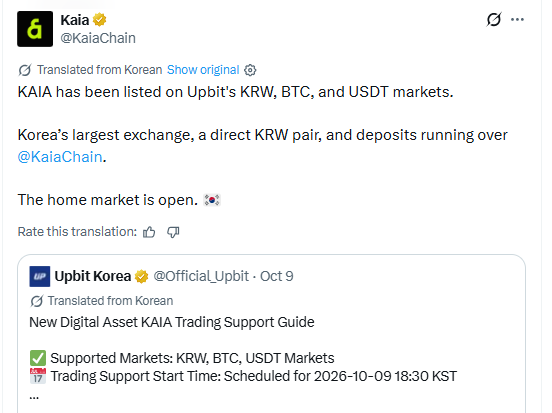
The spark was Upbit, a major South Korean exchange. On 9 October, it opened KAIA markets against the Korean won, Bitcoin and Tether. Listings like that make newcomers ask basic questions.
This guide covers where Kaia came from, how the coin works, and what the supply numbers say. You'll also see what to check before you act. Market figures below come from 12 October 2026.
Is Kaia the Same as Klaytn? How the Merger Worked
Mostly, yes. Kaia grew out of two older blockchains, Klaytn and Finschia. Klaytn came from the Kakao side, and Finschia came from the LINE side.
Both communities voted to combine them. The Klaytn Finschia merger took effect in 2024 and produced the Kaia name.
So what is Kaia today? It's Klaytn's network, upgraded, with Finschia's token holders brought in.
Kaia's docs call it a hard fork of Klaytn, and the chain ID didn't change. A hard fork is a major software upgrade that older versions can't follow.
The coins followed. KLAY balances were renamed KAIA automatically, while Finschia holders swapped FNSA for KAIA through an official portal. So KAIA is a rebrand of KLAY, not a brand-new token.
Supply moved with the merger. The docs show circulating supply rising from about 3.804 billion to 5.805 billion KAIA. Total supply fell from roughly 6.005 billion to 5.805 billion.
What Is Kaia Crypto in Simple Terms? How KAIA Works
Think of Kaia as a fast payment network that also runs apps. The project says its main chain handles at least 4,000 transactions per second, with one-second blocks and instant finality. Finality means a confirmed transfer can't be reversed.
The Kaia blockchain is also EVM-compatible. The EVM is the Ethereum Virtual Machine, the engine that runs smart contracts. So apps built for Ethereum can move over with few changes.
KAIA is the fuel. You pay network fees with it, and it rewards the nodes that keep the chain running. Apps can also pay fees for their users, which the docs call fee delegation.
Staking means locking coins to help secure a network in return for rewards. Core operators, called Governance Council members, must stake at least 5 million KAIA.
KAIA Tokenomics: Supply, Rewards and Funds Explained
What is Kaia worth on paper? Here's the latest snapshot, and it will move.
Metric
Figure
What it means
Price
About $0.0490 (down 9.3% in 24h)
Falling after the listing spike
Circulating supply
6.442 billion KAIA
Coins currently in the market
Total supply
6.442 billion KAIA
Same as circulating right now
Max supply
None
New coins keep being issued
Market cap
About $315.9 million
Price times circulating supply
FDV
About $315.9 million
Matches market cap here
Kaia has no hard cap. Each block mints 9.6 new KAIA, or about 300 million coins a year, according to the docs.
The docs put that near 5.2% inflation against the supply at the time. Against today's 6.442 billion, the same 300 million works out to about 4.7%. That second figure is our own arithmetic, not an official number.
What is Kaia paying out? Every block reward is split by a fixed formula:
50% goes to validators and the community. That's 40% as staking rewards and 10% as contribution rewards.
25% goes to a fund for developers and apps (KEF).
25% goes to a foundation-run fund for core development and operations (KIF).
Half of each reward goes to funds, not stakers. Those funds pay for grants, marketing and liquidity. The docs say the Governance Council reviews developer-fund spending in public forums.
Market cap is price times circulating coins. FDV, or fully diluted valuation, is price times all coins that could exist. The two match here because total supply equals circulating supply.
What Is Kaia Building With LINE, Kakao and Stablecoins?
What is Kaia's real pitch? Put blockchain inside apps people already use.
The docs cite Kakao, with 50 million users in Korea. They also cite LINE, with 200 million across Japan, Taiwan, Indonesia and Thailand. Those are the project's user counts, not on-chain activity.
Mini dapps are the bridge. A mini dapp is a small app that runs inside a messenger. Kaia's docs include build guides for LINE mini dapps, including game tools.
The project also says LINE NEXT is building Unifi, an Asia super-app for payments and remittances.
Stablecoins now sit at the center. A stablecoin is a token pegged to a currency, such as the US dollar. Stablecoins on Kaia include native USDT, which the project says is live in several Asian markets.
The site also lists JPYC for the yen. It describes a won-pegged stablecoin framework built through a pilot with KB Kookmin Bank.
These are project claims. Treat them as early pilots and plans, not proof of mass use.
What Does the Upbit Listing Mean for KAIA Holders?
Upbit's KAIA markets opened at 18:30 KST, with pairs against KRW, BTC and USDT. KRW means the Korean won. South Korea has long been a busy market for retail crypto trading.
Our listing-day report logged a 47.5% jump to $0.05714 within 24 hours. Since then, the price has slipped to about $0.049.
A listing adds buyers and visibility. It doesn't guarantee lasting demand, and it isn't an audit or an endorsement.
The Kaia Upbit listing meaning is mostly about access. Easier access can improve liquidity, which is how easily you can trade without moving the price. But it's one exchange event.
So what is Kaia without the listing pop? A network with big partners and unproven usage. Watch trading volume over the coming weeks, not one green candle.
How to Use Kaia: Simple Steps, Checks and Key Risks
What is Kaia asking from you as a user? A wallet, a few checks and some patience. How to use Kaia depends on your goal, and official links come first.
Hold or trade KAIA: Buy on an exchange that lists it. Confirm the exact deposit network before you send anything.
Try apps: Connect a compatible wallet, such as MetaMask, to Kaia. Copy the network settings from theofficial docs.
Move stablecoins: Use theKaia Portal bridge. Test with a small amount first.
What is Kaia's biggest risk? Supply is uncapped, and prices swing hard. The stablecoin and super-app plans are still early.
Scam links also spike after any listing. Double-check every URL, and never share your seed phrase.
The Bottom Line: What Is Kaia and What Stays Unclear?
So, what is Kaia? It's the merged Klaytn and Finschia network, built to bring stablecoins and apps to LINE and Kakao users. Its tech is fast and Ethereum-friendly, and its token plan sends half of each reward to funds.
What's unclear is real usage. User counts are project claims, and the Upbit bounce has already cooled. Next, track stablecoin supply, app activity and trading volume on Kaia's official explorer and portal.
Disclaimer:This article is for information only and is not financial, investment or legal advice. Crypto assets are volatile and can lose value quickly. Market data was checked on 12 October 2026 and may have changed. Do your own research and speak to a licensed adviser before you act.