What Makes OUSD Different From Other Stablecoins? Open Standard's OUSD went live on September 30, 2026, and crypto news feeds haven't gone quiet since. Why the noise? Visa, Stripe, Mastercard
What Makes OUSD Different From Other Stablecoins?
Open Standard's OUSD went live on September 30, 2026, and crypto news feeds haven't gone quiet since. Why the noise? Visa, Stripe, Mastercard and Coinbase are among its founding backers.
OUSD is a stablecoin built to hold $1. Open Standard says it will share reserve earnings with the businesses that grow it. Add a Chainlink data deal and a Pi Network partnership, and the latest OUSD update gets busy fast.
This guide covers how the token works, what's live now and which risks deserve attention. Every figure comes from Open Standard's official pages, checked on October 2, 2026.
How Does Open Standard’s OUSD Work Differently?
OUSD stands for Open USD. A stablecoin is a crypto token designed to keep a steady price, and here the target is $1.
Open Standard governs and operates the coin. It announced Open USD on June 30, 2026, and the OUSD live post followed on September 30. Bridge, a Stripe company, issues the token.
That's the plain part. The twist is who earns from it. Most issuers keep the reserve income. Open Standard's OUSD sends nearly all of it to partners after a small management fee, and gives them a voice through a board drawn from its founding partners.
The $1 Peg Starts With OUSD's Mint-and-Burn System
A peg is the price a stablecoin tries to hold. Open Standard's OUSD does it through minting and burning. Minting creates new tokens when USD comes in. Burning removes tokens when USD goes out.
Open Standard says businesses can mint and redeem at 1:1, with no fee and no artificial volume cap. One OUSD in, one USD back. For companies moving large sums, Open Standard's OUSD removes a cost that adds up.
Access runs through four partner routes: Stripe, Mastercard, Coinbase and Visa. The official integration paths page says Coinbase access was due to start on October 1.
Where Does the Value Behind OUSD Actually Come From?
Reserves are the assets that back every token. Open Standard's OUSD reserves sit with BlackRock, Lead Bank and BNY, and the company says they follow US regulatory requirements. Earnings on those reserves feed the partner rewards.
Attestations are periodic reports confirming what the reserves hold. The stated plan is monthly publication. An attestation isn't a full audit, and neither one guarantees safety.
The official pages list no circulating supply or market cap figure yet. That makes the monthly reports worth watching.
OUSD Turns Stablecoin Activity Into a Partner Economy
A partner that brings OUSD supply and activity to its platform earns rewards in proportion. To collect, a business must sign up as an Open Standard partner.
Equity adds a second layer. The five founding partners are Coinbase, Mastercard, Shopify, Stripe and Visa. Each invests in the company and helps seed $1B+ in launch liquidity, per the founding partners and equity post.
Here partners aren't just distributors, they're owners. The open question is whether that beats habit, since many of these firms also work with rival coins.
Four Blockchains Give OUSD a Wider Starting Point
Open Standard's OUSD is supported natively on Base, Ethereum, Solana and Tempo. Each blockchain runs its own version of the token with its own smart contract, which is the code that controls how the token moves.
Why spread out? Different businesses prefer different networks. Multichain access gives Open Standard's OUSD more places to circulate from day one.
The official site lists one contract address per chain. Copy addresses only from there.
Chainlink Gives OUSD a Route Into DeFi
An oracle feeds outside data, like prices, into smart contracts. Open Standard has standardized on Chainlink as an official data oracle for Open Standard's OUSD, according to Chainlink's announcement.
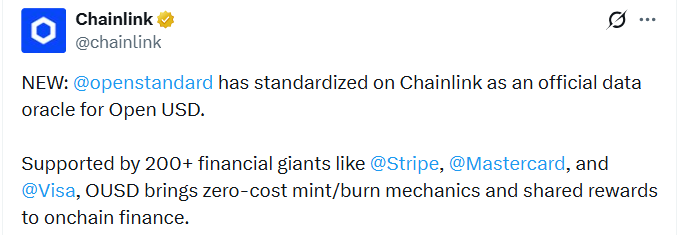
Why does it matter? DeFi apps need trusted price data before they can support a token. The stated use cases include lending, trading, margin products and yield-related apps.
Still, an oracle isn't a listing. Each lending market or exchange decides on its own whether to add OUSD. Treat Chainlink as groundwork, not proof of adoption.
Why Is Pi Network Connected to OUSD?
Pi Network announced a partnership with Open Standard on September 30. Pi says it will explore rewards programs for Pioneers, its name for users, and broader utility across its ecosystem. The OUSD deal for Pioneers update covers the Pi side.
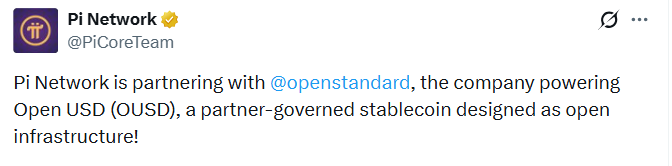
Source: Pi Network Post on X
Now separate live from planned. Live: the announcement, and Pi's place on the official partner list. Unconfirmed: Pioneer rewards, in-app use, eligibility and timing. Pi says more details are coming, and Pi joining the partner list shows how that step unfolded.
Where Can You Buy or Trade Open Standard's OUSD?
Open Standard names Coinbase, Kraken and Uniswap as the first trading venues, with more planned. Access runs through partners, so availability can differ by country.
Now the trap. Origin Dollar is an unrelated stablecoin that also uses the OUSD ticker and has existed since 2020. Copycat tokens using the Open USD name may exist too.
Tickers aren't identifiers. Contract addresses are. Match the address on your screen with Open Standard's official page before any swap.
Where Could OUSD See Its First Real-World Use?
Open Standard points to banking, cross-border payments, settlement and institutional trading. Stripe has said Open Standard's OUSD will be the default stablecoin for businesses running on Stripe.
Business payments and treasury use look like the first tests. Cross-border settlement comes next, since cheaper transfers are where stablecoins already show value. DeFi integrations would stretch the reach.
Pi is a different test. Its Pi Network real world use is still taking shape, and any Pioneer rewards plan would need to fit around it.
What Risks Should Users Know Before Using OUSD?
None of this makes Open Standard's OUSD unsafe. A new stablecoin simply deserves a careful start.
Issuer risk: users depend on Bridge's operations and compliance.
Reserve risk: assets at banks and asset managers still carry counterparty risk.
Smart-contract risk: code on four chains can contain bugs.
Liquidity risk: thin trading on newer venues can push the price off $1.
Adoption risk: USDT and USDC lead the market, and partner promises don't guarantee usage.
Ticker risk: copycat tokens and the Origin Dollar mix-up can cost real money.
What Comes Next for Open Standard’s OUSD?
Open Standard's OUSD is a $1 stablecoin issued by Bridge, backed by reserves at BlackRock, Lead Bank and BNY, and live on four chains. Its 1:1 mint-and-burn model costs businesses nothing, and partner rewards are the real differentiator.
Chainlink supplies price data for Open Standard's OUSD. Pi Network will explore rewards and utility, though nothing is confirmed. Adoption and supply transparency remain uncertain. Before using it, verify contract addresses and follow the latest OUSD news.
Disclaimer: This article is for information only and isn't financial advice. Crypto is volatile, and stablecoins can lose their peg. Do your own research before making any decision.