Stablecoins have become a central part of crypto. They support trading, lending, payments, savings products, and many other on-chain activities. For every stablecoin, one question matters fro
Stablecoins have become a central part of crypto. They support trading, lending, payments, savings products, and many other on-chain activities.
For every stablecoin, one question matters from the beginning: what helps its market price stay close to $1?
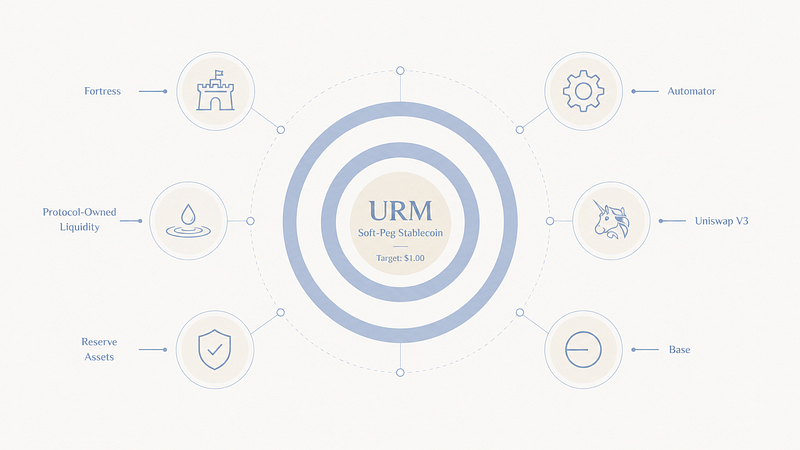
URM approaches this challenge through a soft peg, protocol-owned liquidity, active reserve management, and a protocol-managed treasury called the Fortress. These components work together through transparent smart contracts on Base to support the $1 target across different market conditions.
What is URM?
URM is a soft-pegged stablecoin on Base targeting a market price of $1.00.
A soft peg allows regular market activity around the target. Price movement can occur as users buy, sell, borrow, and use URM across the ecosystem. The protocol supports the target through liquidity management and predefined reserve actions.
The Fortress sits at the center of this structure. It coordinates the assets and smart-contract functions used to support URM’s market liquidity and peg.
What is the Fortress?
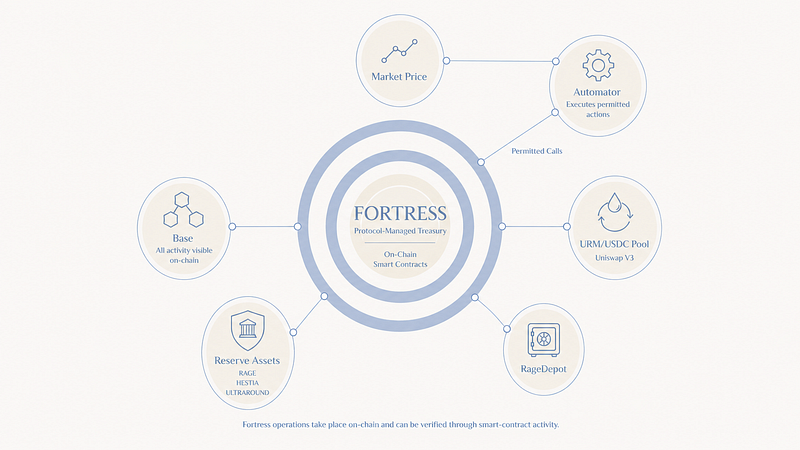
The Fortress is the protocol-managed treasury and smart-contract system responsible for peg support and liquidity management.
It holds defined reserve assets and follows predetermined contract logic. An execution keeper called the Automator calls the permitted Fortress functions when the required price conditions are present.
The smart contracts define every permitted action. The Automator handles execution according to those rules. Fortress operations take place on-chain, allowing users to review contract activity and verify each transaction.
URM’s two-layer peg defense
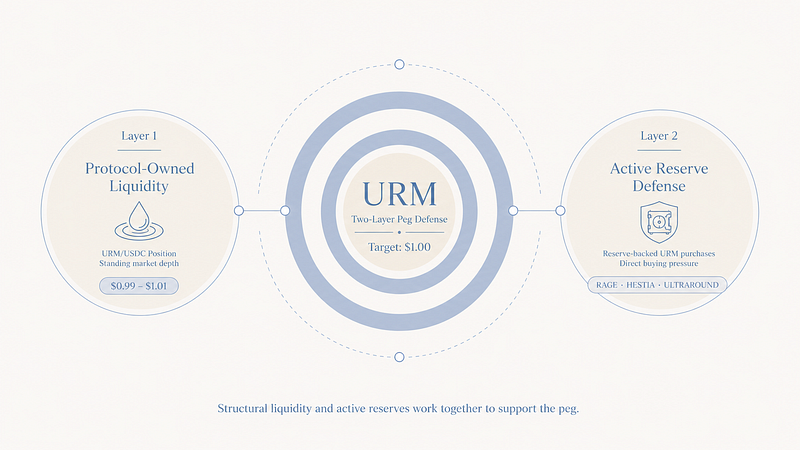
The Fortress uses two complementary layers of peg support.
The first layer is protocol-owned liquidity. The protocol owns a concentrated URM/USDC position on Uniswap V3. This position provides standing market depth around the $1 target and helps process buying and selling activity near the peg.
The second layer is active reserve-backed intervention. When configured price conditions are reached, the Fortress can deploy eligible reserve assets to purchase URM from the market. These purchases create direct buying pressure and work alongside the protocol-owned liquidity position.
Protocol-owned liquidity provides the structural layer. Active reserve management provides an additional response when market conditions call for it.
What happens when URM trades above $1?
Strong demand can push URM above its target price.
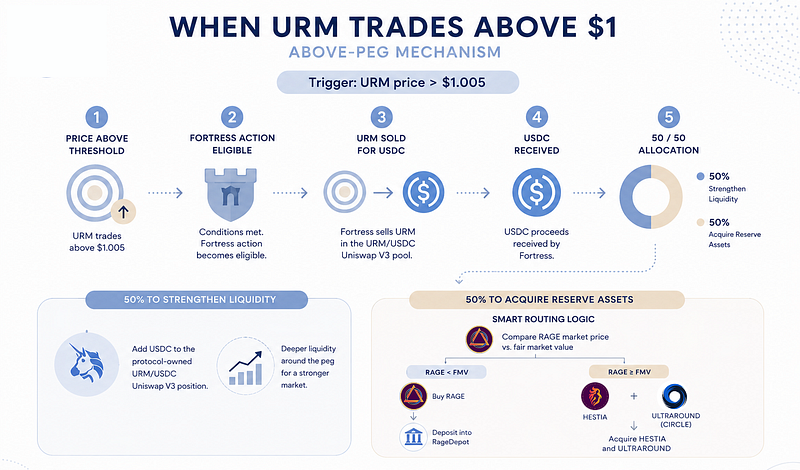
Under the stated default configuration, an above-peg action becomes eligible when URM trades above $1.005. The Fortress sells URM for USDC through the URM/USDC Uniswap V3 pool.
The USDC proceeds follow a default 50/50 allocation:
- 50% strengthens the protocol-owned liquidity position.
- 50% acquires assets for future reserve-based defense.
The asset purchase follows smart-routing logic. When RAGE trades below its fair market value, the Fortress buys RAGE and deposits it into the RageDepot. When RAGE trades at or above its fair market value, the Fortress acquires HESTIA and ULTRAROUND, also referenced as CIRCLE in the contracts.
Each above-peg action can deepen protocol-owned liquidity while expanding the assets available for future peg support.
What happens when URM trades below $1?
The Fortress also includes configured responses for below-peg conditions.
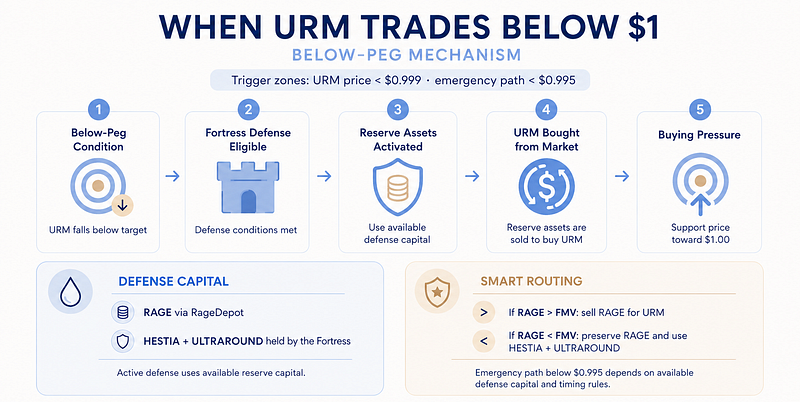
The standard active-defense path becomes eligible below $0.999 when sufficient defense-counter credit is available. An emergency path becomes eligible below $0.995, subject to available defense capital and the configured action interval.
During a valid action, the Fortress sells eligible reserve assets for URM. This purchases URM directly from the market and creates buying pressure around the target.
Defense capital can come from two sources:
- RAGE held through the RageDepot
- HESTIA and ULTRAROUND held directly by the Fortress
Under default smart routing, the Fortress compares RAGE’s market price with its fair market value. When RAGE trades above fair market value, the Fortress can sell RAGE for URM. When RAGE trades below fair market value, the system can preserve RAGE and use HESTIA together with ULTRAROUND as the alternative reserve path.
Why protocol-owned liquidity matters
The URM/USDC liquidity position is fully owned by the protocol and concentrated within the $0.99 to $1.01 range.
Its Uniswap V3 position NFT remains locked inside the Fortress contract. This gives the protocol a persistent layer of market depth around the target range.
Above-peg activity can add more liquidity to this position. A deeper position can process more trading activity near the peg. Trading fees generated by the position are periodically collected, converted into URM, and distributed to the protocol’s yield products.
Conclusion
URM supports its $1 target through a coordinated system built around liquidity, reserves, and transparent smart-contract execution.
Protocol-owned liquidity provides continuous market depth. The Fortress manages reserve assets and responds to configured market conditions. The Automator executes the permitted functions, while every action remains visible on-chain.
Together, these components create a clear framework for supporting URM across both above-peg and below-peg market conditions.
Learn more | Whitepaper | X | Telegram