Venice AI Review: Why Did the VVV Price Fall So Hard? Venice AI (VVV) had a great run in 2026. It was one of the AI crypto coins everyone kept talking about. Then the market flipped. On Nov 1
Venice AI Review: Why Did the VVV Price Fall So Hard?
Venice AI (VVV) had a great run in 2026. It was one of the AI crypto coins everyone kept talking about. Then the market flipped.
On Nov 13, 2026, the token traded near $17.93 on Base, about 48% below its Sept 21 peak of $34.37.
How does a private AI cryptocurrency lose almost half its price in under two months? This Venice AI VVV review walks through the chart, the privacy design, and the tokenomics step by step.
Venice AI (VVV) Quick Facts
Item
Detail
Project
Venice AI, a private AI app and API
Token
VVV, an ERC-20 token
Network
Base, an Ethereum layer-2 network
Launch date
Jan 27, 2025
Initial supply
100 million VVV
Main utility
Staking for AI access and emission yield
Second token
DIEM, a tokenized compute credit
Main edge
Privacy-focused AI infrastructure
Prices here follow one market data tracker, checked on Nov 13, 2026. Other trackers show slightly different peak values, so exact figures can vary.
Readers can check the live market data page and thehistorical price data themselves.
What Is Venice AI (VVV)?
Venice AI (VVV) is a private AI app with its own token. The app says it has over 4 million users and doesn’t filter what people can ask.
But that number has no stated definition. It could mean registered accounts or active users, so it’s best read as a company claim.
The token is an ERC-20 coin on Base, a cheaper network that runs on top of Ethereum. Venice published theoriginal token launch announcement with the first distribution plan.
Main features, in points:
Chats are private by default, with history kept on the user’s device
Open-source models for text, images, video, and audio
A developer API that works like the OpenAI one
A Pro plan at $18 a month, plus credits for premium models
Venice says it doesn’t store chats like big AI firms do. But a claim isn’t an audit, so privacy settings deserve a test.
How Does Venice AI Work?
A prompt travels over an encrypted connection to Venice’s proxy. The proxy passes it to an independent computing provider that runs the AI model.
The answer comes back the same way. Basically, privacy is the main product, and the AI models come second.
Is Venice AI Really Private?
Venice’sprivacy documentation shows that privacy isn't a one-on-one switch. Each model uses one of four modes.
Mode
What it means
Anonymous
Venice hides the user’s identity from the provider, but the provider may still see the prompt.
Private
Zero data retention, enforced by contract
TEE
Hardware-isolated processing with remote attestation
E2EE
Prompt encrypted on the device, decrypted only inside a verified secure enclave
So the level of protection depends on the model picked. That matters for anyone pasting work files into a chat.
E2EE also switches off features that need plain text, such as web search and memory. And all of this comes from Venice itself, since no independent test was found.
What Is the VVV Token Used For?
VVV is the main coin of the platform. Stakers earn yield from new token emissions and get a share of the platform’s AI computing power. Venice explains the steps in itsstaking guide.
Staked VVV is tracked as sVVV, a staked position. Venice has said staking 100 VVV unlocks Venice Pro, but that threshold can change, so the current staking page is the place to confirm it.
What Is DIEM, and How Does It Work?
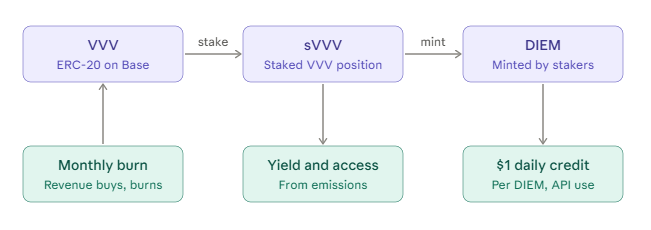
DIEM is a second token. Only VVV stakers can mint it, and each DIEM gives $1 of Venice API credit every day, subject to protocol terms. Venice describes it in itsDIEM launch post.
Revenue plays a part too. Since November 2025, Venice has spent some monthly revenue on buying VVV, and it has burned those tokens every month since December 2025.
The diagram below shows how VVV, sVVV, DIEM, and burns connect.
Venice AI Tokenomics: Supply, Distribution, and Staking
Official pages say VVV launched on Jan 27, 2025, with 100 million tokens. Venice’stokenomics page and help center explainer cover the split.
Allocation
Share
Purpose
25M VVV
25%
Airdrop to Venice users
25M VVV
25%
Airdrop to AI community protocol accounts on Base
35M VVV
35%
Grant to the Venice.ai company, including 10M for the team.
10M VVV
10%
Incentive fund
5M VVV
5%
Liquidity development
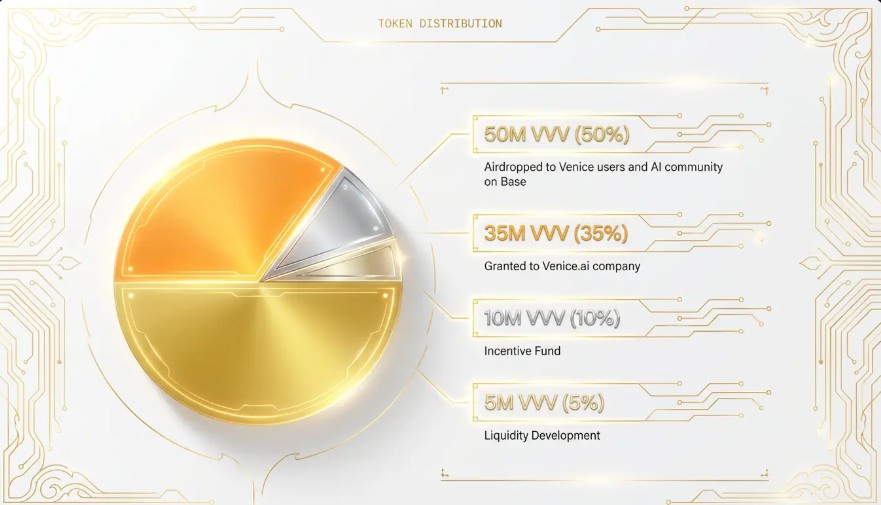
The two airdrop shares add up to 50%, which many summaries show as one block. No presale shows up in that split.
The 35M company grant works like a crypto treasury. The launch post says the team’s 10M portion was partly unlocked up front, with the rest vesting over 24 months. That points to a finish near January 2027.
But vesting terms for the other 25M weren’t found in the public sources checked. They couldn’t be independently verified.
Supply numbers also change from one document to the next. An older white paper built on April 2025 data lists 69.17 million tokens as the fixed supply.
That figure is outdated. VVV has no fixed cap, since emissions add new tokens and burns remove them. Readers should check the block explorer for live supply, and circulating supply sits near 48.9 million.
Venice cut yearly emissions from 3 million to 2 million VVV by Oct 1, 2026. That’s about 167,000 tokens a month.
The Nov 9 burn removed 21,657 VVV, worth about $458,000, or roughly 0.04% of circulating supply. Venice tracks these in itsburn update.
Why Did VVV Price Fall in 2026?
Late September brought a 10% one-day drop as the fastest runners gave back gains. On Oct 9, AI tokens fell about 9% after a report said a big chatbot maker’s yearly revenue was near $50 billion, not the $68 billion people had talked about.
Venice AI (VVV) had no hack, delisting, or governance shock in its public record those days. The drop fits a jumpy token cooling off after a wild run.
No peer dataset was used here. So this article doesn’t rank VVV against other AI tokens.
Broader money news was in the background too. On Nov 4, 2026, the Treasury offered $125 billion in securities, enough to refund about $97 billion of maturing debt and raise about $28 billion in new cash, per itsrefunding statement.
Treasury buybacks added up to $70 billion for liquidity support and up to $25 billion for cash management.
These are market conditions, not proven causes. No data here shows they moved VVV, and correlation isn’t causation.
How Do VVV Buybacks and Token Burns Work?
Venice uses a share of platform revenue each month to buy VVV on the market. Those tokens are then burned, which removes them from supply.
And that’s only part of the picture. New tokens still enter through staking emissions, so net supply depends on burns versus emissions.
Venice AI vs Other Decentralized AI Projects
Rivals in decentralized AI crypto and big AI firms are chasing the same users. A high-level comparison shows where Venice sits.
Feature
Venice AI
ChatGPT
Bittensor
Model
Private AI app and API
Centralized AI product
Network of AI subnets
Token
VVV and DIEM
None
TAO
Main focus
Privacy and stake access
General-purpose assistant
Rewarding AI work across subnets
Privacy approach
Four model-level modes
Governed by company policy
Varies by subnet
This is a design comparison, not a quality ranking. Each project solves a different problem.
What Are the Biggest Risks for Venice AI?
Unverified privacy claims. The four modes come from Venice’s own documents, with no independent audit found.
Emissions vs. burns. New tokens still outpace burns.
Grant unlocks. The 35M company grant has partial vesting details, and the rest is unclear.
Competition. Other AI platforms, centralized and decentralized, target the same users.
Market conditions. Jumpy tokens often fall first on risk-off days.
Can Venice AI Recover After the Crypto Selloff?
Demand for private AI is real, and Venice AI (VVV) saw November’s burn come in about 10% above October’s $414,000.
But burns still trail new tokens. Is one record burn enough to cover all that?
Many AI-powered crypto projects ship a shiny site and little else. AI crypto scams often follow one script: a famous model name, a countdown clock, and a promise of returns.
When sorting a real product from an AI-scam crypto project, the test is simple. Can the product be used today?
India crypto news adds context for local holders. The 2026-27 budget kept the flat 30% tax and 1% TDS, and new reporting penalties started on April 1, 2026.
VVV faces several uncertainties, including token emissions, market demand, competition, and broader crypto liquidity. These factors may influence its performance, but they don’t establish a reliable price direction.
Conclusion: Is Venice AI More Than Just an AI Crypto Token?
Venice AI (VVV) pairs a working private AI product with a token tied to staking, credits, and burns. That mix is real, and few AI crypto coins can say the same.
But a good product and a good token price are different things. User growth, supply schedules, and the wider market all move VVV, and none of them guarantees a comeback.
Readers should check burn data, staking terms, and fresh Treasury news before reaching a view.
Disclaimer
This article is for information only and isn’t financial advice. Crypto assets are volatile, and prices can fall sharply. Readers should research independently and consult a licensed adviser before acting.