The project describes itself with a simple analogy: it aims to do for AI infrastructure what Airbnb and Uber do for idle rooms and cars. It aggregates the world's idle GPUs, disks, and domain
The project describes itself with a simple analogy: it aims to do for AI infrastructure what Airbnb and Uber do for idle rooms and cars. It aggregates the world's idle GPUs, disks, and domain-specific models into one open network anyone can call or join.
What Is YeBlock
AI compute, model hosting, and fine-tuning today mostly run through a handful of centralized platforms.
That setup concentrates pricing power, hosting risk, and monetization in a few hands. YeBlock is a project built to change that structure.
According to its whitepaper, YeBlock LIM combines decentralized compute, decentralized storage, and LoRA-granular decentralized AI into a single open protocol. Idle GPUs contribute compute; idle drives contribute storage, and LoRA creators earn on-chain revenue every time their work gets used.
YeBlock Latest Update: App is now live
According to an official announcement dated July 17, 2026, the YeBlock app is now live across iOS, Android, and web.
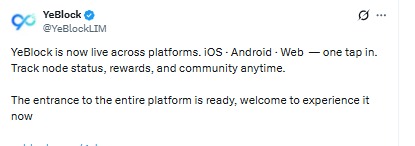
Source: @YeBlockLIM on X
The project says this gives users one-tap access to check node status, earnings, and community updates from any device, rather than being tied to a single platform.
The app is available through the official download page.
Vision of YeBlock Project
The project's stated core belief is that "DeFi made money liquid. YeBlock makes intelligence liquid."
The project frames its mission as giving AI compute, models, and economic incentives back to the people contributing them, rather than concentrating them inside centralized platforms.
The project's public commitments include releasing its core protocol and SDKs as open source under Apache 2.0 and handing governance to a DAO starting in 2027-Q2.
Why Was It Created
According to the whitepaper, the project was built to address three structural problems in the AI industry. Centralized clouds run at 60 percent plus gross margins, pricing out small AI startups.
Model hosting depends on centralized platforms like Hugging Face, which can remove models without warning. Long-tail LoRA fine-tuners create real value but have no path to monetize it.
The protocol aims to address all three by routing idle compute, storage, and specialized AI skills through one on-chain revenue-sharing protocol.
How Does YeBlock work
The protocol is organized around five parallel pillars. The first three form what the project calls the capability layer, deciding what the network can do.
The remaining two form the trust and time layers, deciding who it can serve and for how long.
Decentralized Compute: Idle GPUs worldwide pool into a rentable compute network for AI inference.
Decentralized Storage: Model weights and LoRA files are stored across the network so they cannot be removed by a single platform.
Decentralized AI: the protocol operates at LoRA granularity, so individual fine-tuned skills, not just full models, carry an on-chain author and settle revenue per call.
Privacy Protocol: Encryption and, at a higher tier, Trusted Execution Environment (TEE) isolation keep inference data hidden from node operators.
Post-Quantum Protocol: Communication channels and signatures are migrated toward NIST-approved post-quantum algorithms to protect long-lived AI assets.
The project states that dropping any one pillar degrades the protocol into something that already exists elsewhere, such as a centralized model marketplace or a general-purpose compute cloud.
Core Architecture & Key Features
On top of the five pillars, the project defines what it calls the Liquid Economy layer, made up of three components.
YeBlock LIME (Liquid Idea Market and Execution): lets a creator mint an idea as an encrypted, chain-verified asset that the network's AI can execute directly.
YeBlock LEM (Liquid Energy Mesh): lets energy providers convert surplus or cheap electricity into on-site compute revenue rather than selling power directly.
YeBlock LIP (Liquid Intelligence Pay):a payment rail designed for machine-to-machine settlement, built for the high-volume, low-value transactions typical of AI inference calls.
Several features run through the whitepaper's description of the protocol.
LoRA-granular revenue splits, so individual fine-tuners are paid on-chain per call rather than earning nothing for public uploads.
IPFS-anchored persistence for model weights, intended to prevent unilateral deplatforming.
Multi-LoRA pooled inference nodes, letting one base model serve many specialized LoRAs at once.
A published NIST post-quantum roadmap, covering hybrid key exchange and post-quantum digital signatures.
Technology Behind YeBlock
The inference layer is built on vLLM and SGLang, which the project says now support serving multiple LoRAs concurrently on a shared base model.
Storage draws on IPFS-style content addressing with sharding and redundancy coding.
For privacy, the project lists TLS 1.3 with client-side encryption as the default tier, with Intel TDX, AMD SEV-SNP, and NVIDIA confidential computing available for an enterprise TEE channel.
For post-quantum protection, the project references the NIST-standardized ML-KEM, ML-DSA, and SLH-DSA algorithms, migrating in phases starting with TLS hybrid key exchange at MVP.
Utility of the YBT Token
YBT is the native token of the network. According to the whitepaper, it is used for network incentives, call-fee settlement, staking by node operators and LoRA creators, and future DAO governance rights.
The project states that 40 per cent of net protocol ecosystem revenue is used to buy YBT on the open market and permanently burn it, intended as a deflationary mechanism tied to network usage rather than inflation.
Note: At the same time, the protocol remains pre-mainnet, its token is unissued, and its founding team is undisclosed. Readers should treat early participation as high-risk and verify details directly on yeblock.com.
Tokenomics of YBT
YBT has a fixed total supply of 121,000,000 tokens. According to the whitepaper's published allocation and Official website
Allocation
Tokens
Share
Distributed Referral Mining
30,000,000
24.9%
TGE (Token Generation Event)
21,000,000
17.4%
VC (Venture Capital)
14,520,000
12.00%
YeBlock Foundation
15,730,000
13.00%
Node
14,000,000
11.6%
Staking Mining
12,000,000
9.9%
Contribution Mining
9,000,000
7.4%
Partnerships, Grants, Growth
4,750,000
3.9%
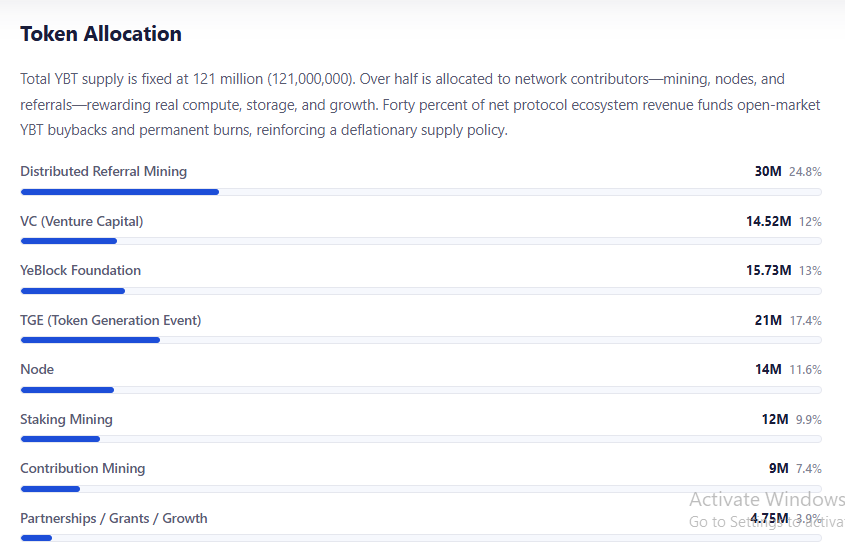
Source: Official YeBlock Website
The foundation allocation (13 per cent) and the VC allocation (12 per cent) both vest linearly over three years with a one-year cliff.
The whitepaper states that unlocked team tokens are expected to be re-staked and that a DAO vote can burn a portion of team YBT if they are not.
Note: As of this writing, the token has not yet been issued, and the project is not yet on mainnet.
Roadmap
The published roadmap runs in quarterly milestones. For 2026-Q3, the target is five seed nodes and a working single-LoRA inference loop, alongside open-sourcing the core protocol code under Apache 2.0.
For 2027-Q1, the project targets a public test of its privacy protocol's TEE channel. For 2027-Q2, targets include monthly calls above one million, at least five TEE nodes, and the first phase of DAO governance going live.
For 2027-Q4, the whitepaper sets a specific accountability metric: real USDC call fees must reach at least 50 percent of total node revenue within 18 months of launch.
Mainnet has not launched as of this writing. The web application at yeblock.com is live, and the project's whitepaper was published on July 15, 2026, with the app becoming available across iOS, Android, and web on July 17, 2026, according to official announcements.
Source: YeBlock Whitepaper
Note: All of this info was pulled directly from their official whitepaper and recent announcements. Since things can change fast in this space, definitely keep an eye on yeblock.com and their X account (@YeBlockLIM) to verify any future updates.
Ecosystem
YeBlock describes six ways to participate in the network, spanning non-technical users to professional developers: Compute Provider, Storage Provider, LoRA Creator, LoRA LP (Liquidity Provider), AI User or Developer, and Ecosystem Ambassador.
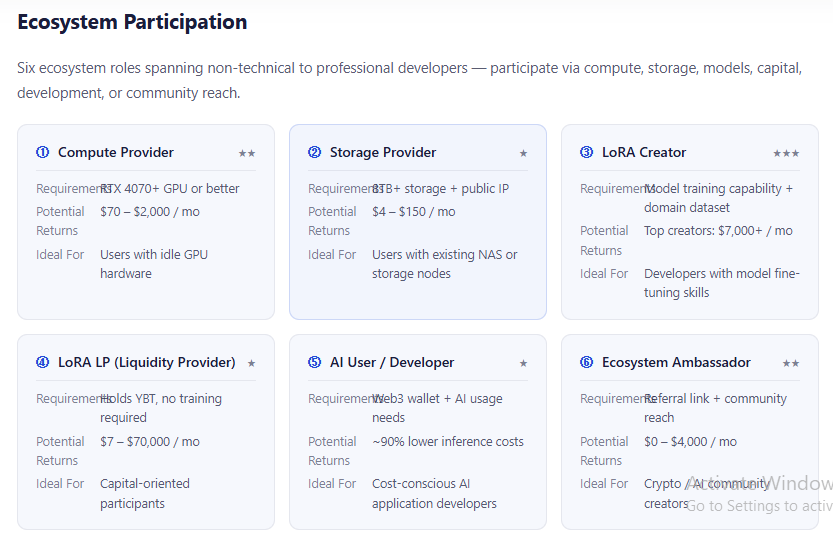
Source:Official YeBlock Website
The whitepaper is explicit that every revenue figure attached to these roles is a target design, not a guarantee, and that DAO governance will set final parameters. It also states that early real-world numbers are likely to run well below optimistic estimates in the first 6 to 12 months.
No third-party partnerships or design partners have been officially confirmed at this stage.
The whitepaper notes that a pre-seed funding round is planned based on the traction of yeblock.com and that current funding comes from the founding team and one unnamed top-tier Web3 venture fund.
Advantages
A five-pillar design that combines compute, storage, and AI with privacy and post-quantum protections in one protocol.
On-chain, per-call revenue splits for LoRA creators, addressing a monetization gap on platforms like Hugging Face.
A published, quarter-by-quarter roadmap with specific, checkable milestones.
An explicit 18-month accountability metric tying token emissions to real call-fee revenue.
Six defined participation roles covering a range of technical skill levels.
Major Issues and Risks
The whitepaper itself discloses several unresolved issues. Compute verification cannot be made fully collusion proof, since nodes could theoretically fake inference results.
The project relies on sampling, staking, and slashing to make cheating economically unattractive rather than impossible.
First token latency across distributed nodes runs 200 to 2,000 milliseconds, which the project says makes it unsuited to real-time chat or voice use cases for now.
The project also faces a cold-start problem common to two-sided marketplaces and multi-region regulatory risk from combining DePIN infrastructure, AI, and a token in one project.
The founding team's identity remains confidential and is scheduled for disclosure only 10 days before mainnet launch. No token has been issued yet, and mainnet has not launched.
Future Outlook
The project's next verifiable milestones are its 2027-Q1 testnet launch and its 2027-Q4 commitment that real call fee revenue must reach 50 percent of node income.
Whether the project reaches meaningful call volume, onboards enterprise customers through its TEE privacy channel, and ships its post-quantum migration on schedule will determine whether the five-pillar model performs as described.
Final Thoughts
YeBlock combines several DePIN and AI trends—decentralized compute, decentralized storage, LoRA-level monetization, tiered privacy, and post-quantum cryptography—into a single protocol rather than treating them separately.
The project has published detailed tokenomics, a quarterly roadmap, and a specific accountability metric for its first 18 months as per the official announcement.
Expert Opinion
Projects that publish a specific, checkable accountability metric, such as YeBlock's 18-month call-fee-to-revenue target, generally signal more disciplined planning than projects that only publish optimistic projections.
The project's whitepaper is also unusually direct in listing its own unresolved engineering challenges rather than omitting them.
At the same time, an undisclosed founding team and a pre-mainnet, pre-token status are common early-stage risk markers, not unique to this project.
The same combination of ambition and disclosure gaps appears across many early DePIN and AI infrastructure projects.
Disclaimer: This article is for educational and informational purposes only and should not be considered financial or investment advice. Always conduct your own research before.