In crypto, most investors focus on one question: "Will the price go up?" Yet some of the most successful participants in financial markets ask a completely different question: "Will the price
In crypto, most investors focus on one question:
"Will the price go up?"
Yet some of the most successful participants in financial markets ask a completely different question:
"Will the price move?"
This distinction lies at the heart of market making, one of the oldest and most important functions in financial markets.
A research paper examining market-making profitability offers a fascinating insight: market makers can generate profits not from correctly predicting market direction, but from continuously capturing value from price fluctuations and trading activity.
For communities such as Terra Classic (LUNC), this lesson is surprisingly relevant.
The Business of Volatility
Traditional investors often view volatility as a problem.
Sharp price swings create uncertainty, increase risk, and make forecasting difficult.
Market makers see the same volatility differently.
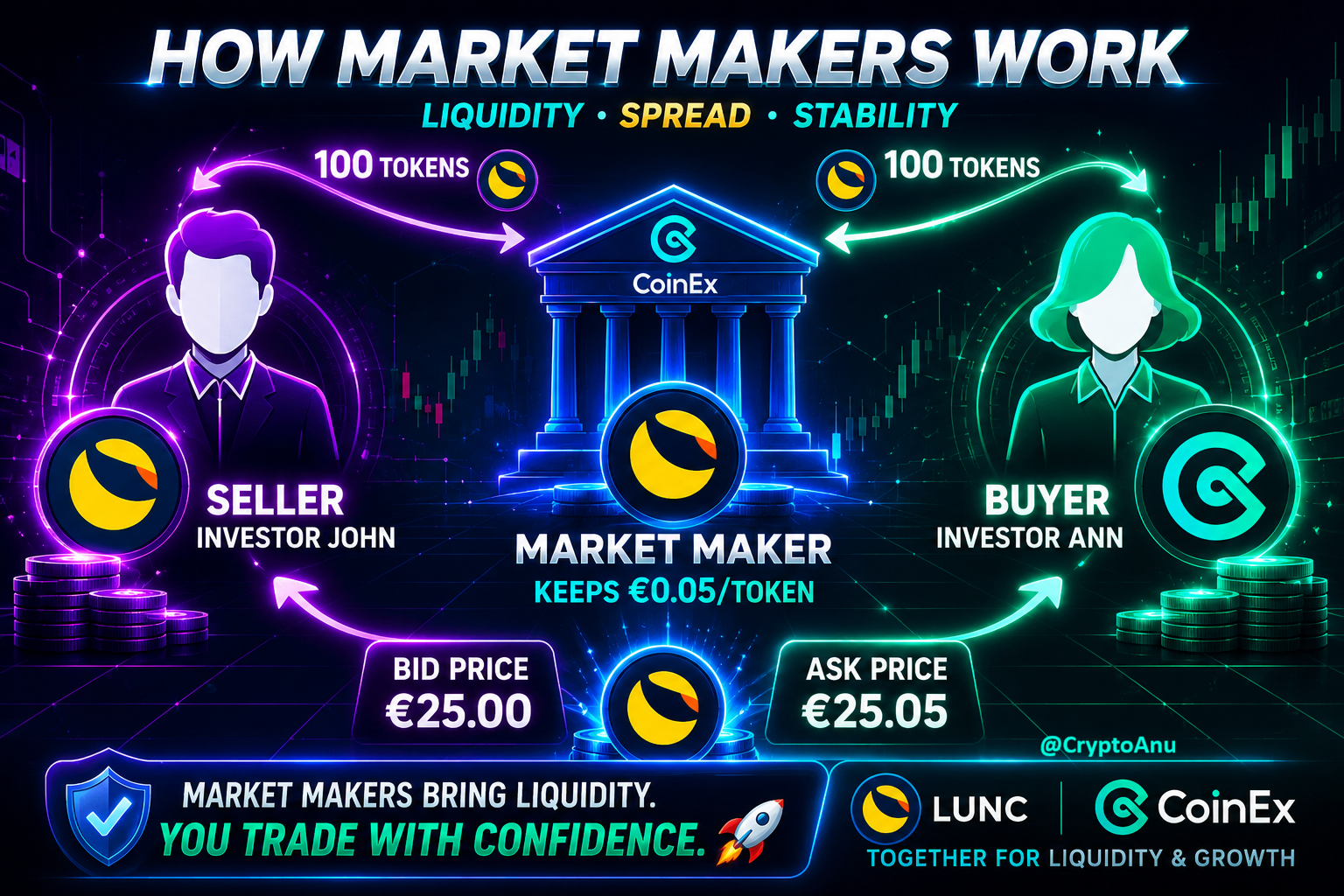
Their role is to provide liquidity by placing buy and sell orders near the current market price.
Instead of betting on whether an asset will rise or fall, they earn profits from facilitating trades and capturing the spread between buyers and sellers.
The research demonstrates that under mean-reverting market conditions, expected market-making profits can grow over time as price fluctuations accumulate.
In simple terms:
More movement creates more opportunity.
Why Movement Matters More Than Direction
Retail traders often become obsessed with directional predictions.
Will Bitcoin reach a new all-time high?
Will LUNC break a major resistance level?
Will the market crash?
Market makers think differently.
Whether the market rises or falls is often less important than whether participants continue trading.
Every trade generates activity.
Every activity generates liquidity demand.
And liquidity is the foundation of every healthy market.
Crypto: A Perfect Environment for Market Making
The cryptocurrency market is uniquely suited for market-making strategies.
Compared to traditional asset classes, crypto experiences:
- Higher volatility
- Faster sentiment shifts
- Greater retail participation
- More frequent narrative cycles
These characteristics create an environment where price movement is constant.
For market makers, this means opportunity.
For traders, it means uncertainty.
The same conditions can be viewed in completely opposite ways depending on perspective.
What the Research Says About Time Horizons
One particularly interesting finding is that profitability tends to improve over longer time horizons. The paper shows that expected profit grows with time while certain risks remain bounded under the studied models.
This has an important implication.
Short-term noise may dominate headlines, but long-term participation is often where sustainable opportunities emerge.
The study also finds that profitability remains surprisingly resilient even when trading frequency decreases significantly.
This suggests that success is not solely dependent on reacting to every market movement.
Instead, consistent participation in active markets may matter more.
Lessons for Terra Classic
Although Terra Classic is not a market-making strategy, several parallels exist.
LUNC has spent years generating:
- Strong community engagement
- Persistent trading activity
- Ongoing burn initiatives
- Cycles of optimism and pessimism
These characteristics create the very ingredient that market makers value most:
Activity.
Markets survive through participation.
Without participants, liquidity disappears.
Without liquidity, markets stagnate.
Volatility: Enemy or Opportunity?
One of the biggest psychological differences between professionals and retail investors is their interpretation of volatility.
Retail participants often associate volatility with danger.
Professionals often associate volatility with opportunity.
Neither perspective is completely wrong.
But understanding both perspectives can provide a more balanced view of market dynamics.
For LUNC holders, periods of volatility may not simply represent instability.
They may also indicate continued relevance, engagement, and market interest.
The Importance of Liquidity
Liquidity remains one of the most critical factors in determining the long-term viability of any asset.
Strong liquidity attracts:
- Traders
- Market makers
- Exchanges
- Institutional participants
Weak liquidity drives them away.
This is why community participation matters.
The more active an ecosystem becomes, the more attractive it becomes for broader market involvement.
Conclusion
The research on market making highlights a powerful idea:
Successful participation in markets is not always about predicting direction.
Often, it is about understanding structure.
Market makers thrive on volatility, liquidity, and activity.
For Terra Classic, the lesson is clear.
Long-term success may depend less on short-term price targets and more on maintaining the foundations of a healthy market:
- Participation
- Liquidity
- Utility
- Community engagement
Price may capture attention.
But activity sustains ecosystems.
And in the world of crypto, that distinction can make all the difference.