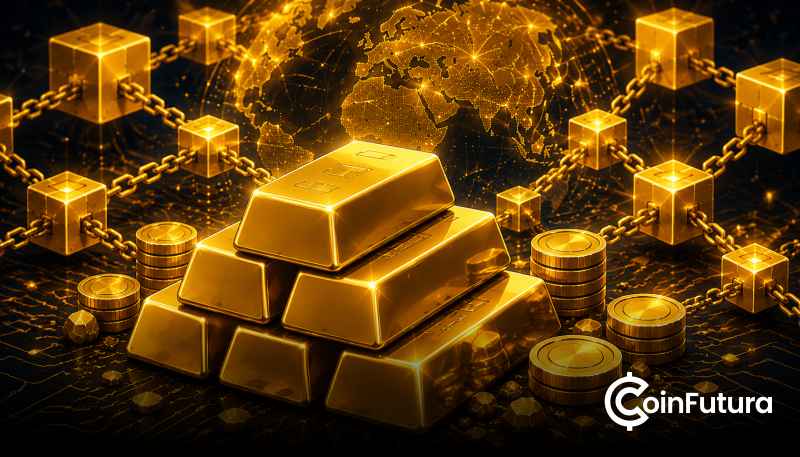
Tokenized commodities are bringing together the traditional asset market and the blockchain, opening up fresh avenues for crypto investors. Digital tokens enable assets like gold and silver t
Tokenized commodities are bringing together the traditional asset market and the blockchain, opening up fresh avenues for crypto investors. Digital tokens enable assets like gold and silver to be more accessible and tradeable. Their increasing use, however, also brings to the fore several pertinent questions relating to market stability, transparency, regulation and investment risk.
Bringing Real Assets Onto Blockchain Networks
Commodities are claims that represent ownership of a physical asset, such as gold, silver, and other raw materials, and are known as tokenized commodities. The digital tokens can flow over blockchain networks and the assets themselves can be influenced by real market forces. This, in turn, provides another meaningful link between the crypto markets and the existing commodity trading and investment systems around the world.
A well known example of a token is gold-backed tokens, but there are many other variations of token structures that exist between issuers and jurisdictions. Some are ownership claims which can be redeemed, others are contractual exposure without corresponding rights to metal. When comparing the available products offered at different trading platforms, investors should look at custody and redemption policies and legal safeguards already in place.
The blockchain settlement can enable access to trading around the world and ease transfers among authorized market participants. But quicker transfers won't mean quicker delivery of the metal or access to cash. Furthermore, the value of the tokens is still subject to the support of the reserves, the working of the exchanges and the trust of the emitter.
How Commodity Tokens Could Change Market Access
A traditional commodity investment might require the services of a broker, storage facilities, or a special market account. Some access barriers may be mitigated in tokenization by the use of smaller denominations and the constant transfers on the blockchain. This means that qualifying investors may achieve greater flexibility in investing without the cost of setting up costly personal storage units or making physical delivery arrangements.
However, the availability is subject to local rules, platform limitations and the actual design of the token. Also, trading 24 hours a day presents looming pricing issues in times when commodity markets are closed. In such time periods, the spreads can widen since market makers are not able to hedge their positions.
Collateral and lending opportunities are also potential ways for tokenized gold to engage with the decentralized finance (DeFi) market. However, with the advent of smart contracts, there are also technical risks in addition to the price volatility of commodities. Hence, investors are exposed to two types of digital infrastructure failures and to issues with the underlying asset.
Price Forecasting Remains a Difficult Task
Research into precious metals reveals that there are multiple forces in the economy that are changing and, in turn, affecting the price of precious metals. The market conditions are affected by currency changes, interest rates, geopolitical events and industrial demand. As such, there is no way that commodity tokens can avoid the price volatility that exists in the underlying asset that they represent, just because the ownership information is recorded on the blockchain.
Díaz, Hansen and Cabrera were among those who analyzed machine learning predictions based on 186 possible gold risk premium indicators. In the face of several advanced methods, their study revealed that there was limited improvement over the historical average. In addition, transaction costs mitigated many of the benefits in the apparent portfolios of those forecasts.
Alharbi applied the Gaussian mixture models to discover various groups of prices for four precious metals. This method explained historical price trends, but it wasn't enough to create a reliable projection of future returns. Likewise, token traders need to differentiate between what works as a useful market analysis and what proves their predictions will perform well in varying market conditions.
Managing Risk With Better Data And Controls
Machine learning can be used to assist in risk monitoring by analyzing the price dynamics and corresponding markets. For instance, models can evaluate unusual movements, changing correlations and potential times of market stress. During times of financial stress, regulatory shifts, and/or liquidity disruption, however, historical patterns can be weakened.
Velez Flores and associates conducted a study which compared different predictors of the gold market for decision-making. Ridge regression showed good performance on some accuracy measures, but failed to give an obvious added value for sales. For this reason, the economic test should be done on tokenized commodity strategies, not just based on accuracy statistics.
Audits of reserves, security of custody, smart contracts and the redemption process are an area where risk control is required. In addition, the market participant should consider the trading costs, the illiquidity, the counterparty's risk and the price difference. These protections are important because even when pricing the commodities accurately, there are certain operational failures that can occur resulting in costly losses, or broken redemption promises.
What Comes Next For Crypto Commodity Markets
Tokenized commodities could expand the crypto market beyond ones that are primarily asset-based. They can introduce exposures to existing industries, monetary conditions, and physical supply chains. However, asset quality and enforceable claims are important for their stability, not the blockchain records.
Platforms will be able to integrate commodity data with automatic monitoring and transparent reporting of reserves in the future. Disclosures, however, must be made in reserve, and until automated systems are developed it's impossible to depend on trustworthy inputs. As a result, the importance of market infrastructure is as significant as the innovations in the design of tokens.
Finally, selected physical markets might become more accessible and transferable as a result of tort shocks.mechanized commodities. Their long term role to play will rely on regulation, reliable custody, liquidity and real investor protection. The primary benefit for the crypto markets is choice of assets, rather than being immune from traditional financial risk or potential market shocks.
The post What Tokenized Commodities Mean for the Future of Crypto Markets appears on Coin Futura. Visit our website to read more interesting articles about cryptocurrency, blockchain technology, and digital assets.