Very Network's tokenomics puts more than half its supply directly in community hands, 5.1B of 10B VERY, but the more interesting question for the Very Network listing is not the size of that
Very Network's tokenomics puts more than half its supply directly in community hands, 5.1B of 10B VERY, but the more interesting question for the Very Network listing is not the size of that allocation; it is what happens once those tokens actually meet the market.
VERY Tokenomics Snapshot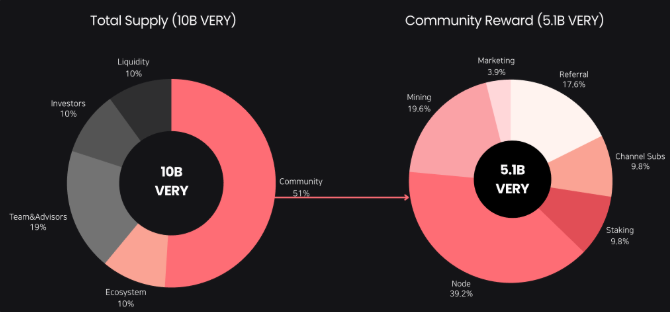
Source: Official Very Network tokenomics chart, captured August 21, 2026
Category
Share of Total Supply
Community
51% (5.1B VERY)
Team & Advisors
19%
Ecosystem
10%
Investors
10%
Liquidity
10%
Community Sub-Allocation
Share of 5.1B Pool
Node
39.2%
Mining
19.6%
Referral
17.6%
Channel Subs
9.8%
Staking
9.8%
Marketing
3.9%
Node and Mining Dominate the Community-Pool
Node and Mining together account for nearly 59% of the entire community-allocation, roughly 3B of the 5.1B pool.
That matters because both categories reward active participation rather than passive holding, meaning a meaningful share of eventual circulating supply is earned progressively through usage, VeryChat activity, node operation, and mining, rather than unlocked all at once for a small group of early buyers.
What Happens When Migrated VERY Meets the Market?
This is the real test behind any Very Network Launch narrative. As mined and node-earned tokens VERY migrate on-chain ahead of exchange-listing, the key variable is pace: a steady trickle of migrated tokens supports smoother price discovery once trading opens, while a large backlog clearing all at once ahead of the listing could create real supply pressure right as demand is still forming.
Nothing in the tokenomics chart itself discloses how much of the 5.1B community pool has already been earned versus how much remains for future distribution, a genuine gap for assessing near-term listing-risk.
Does This Structure Favor Smoother or Rockier Trading?
It cuts both ways. A 51% community-first supply structure limits the concentrated-insider-dump risk that smaller presale allocations often carry.
But it also means Very Network Listing sentiment depends heavily on whether VeryChat and node adoption keep growing fast enough to justify the token reaching a broad, engaged holder base rather than a speculative one.
VERY Price Prediction: Listing-Scenarios
Scenario
Estimated Outlook
Key Driver
Invalidation
Bear Case
Weak, volatile price discovery
A large backlog of migrated Node/Mining VERY clears before listing-demand builds
Sustained selling pressure in listing week
Base Case
Gradual, orderly price discovery
Migration paces closely with genuine VeryChat and node adoption
Price stabilizing without sharp early swings
Bull Case
Stronger post-listing demand
Broad community allocation translates into active, engaged holders rather than sellers
Sustained volume growth beyond listing week
VERY Price Prediction: What Migration Pace Could Change
Scenario
Estimated Outlook
Key Driver
Invalidation
Slow, Metered Migration
Limited listing-day float, supports base-to-bull path
Most of the 5.1B pool remains unearned or unmigrated at listing
Would require disclosed migration data to confirm
Rapid Migration Before Listing
Elevated early sell pressure
A large share of Node and Mining rewards has already migrated on-chain
Consistent with typical mining-token supply patterns
Ecosystem, Investor, Liquidity Allocations Stay Locked
Limited additional pressure beyond community supply
The remaining 49% of total supply follows separate, undisclosed vesting
Would require confirmed vesting details
Disclaimer
Informational purposes only, not financial advice. No confirmed Very Network launch date, listing date, or listing price has been disclosed. Tokenomics figures are project-disclosed. Scenarios above are pattern-based estimates, not confirmed outcomes. Cryptocurrency carries significant risk of loss.