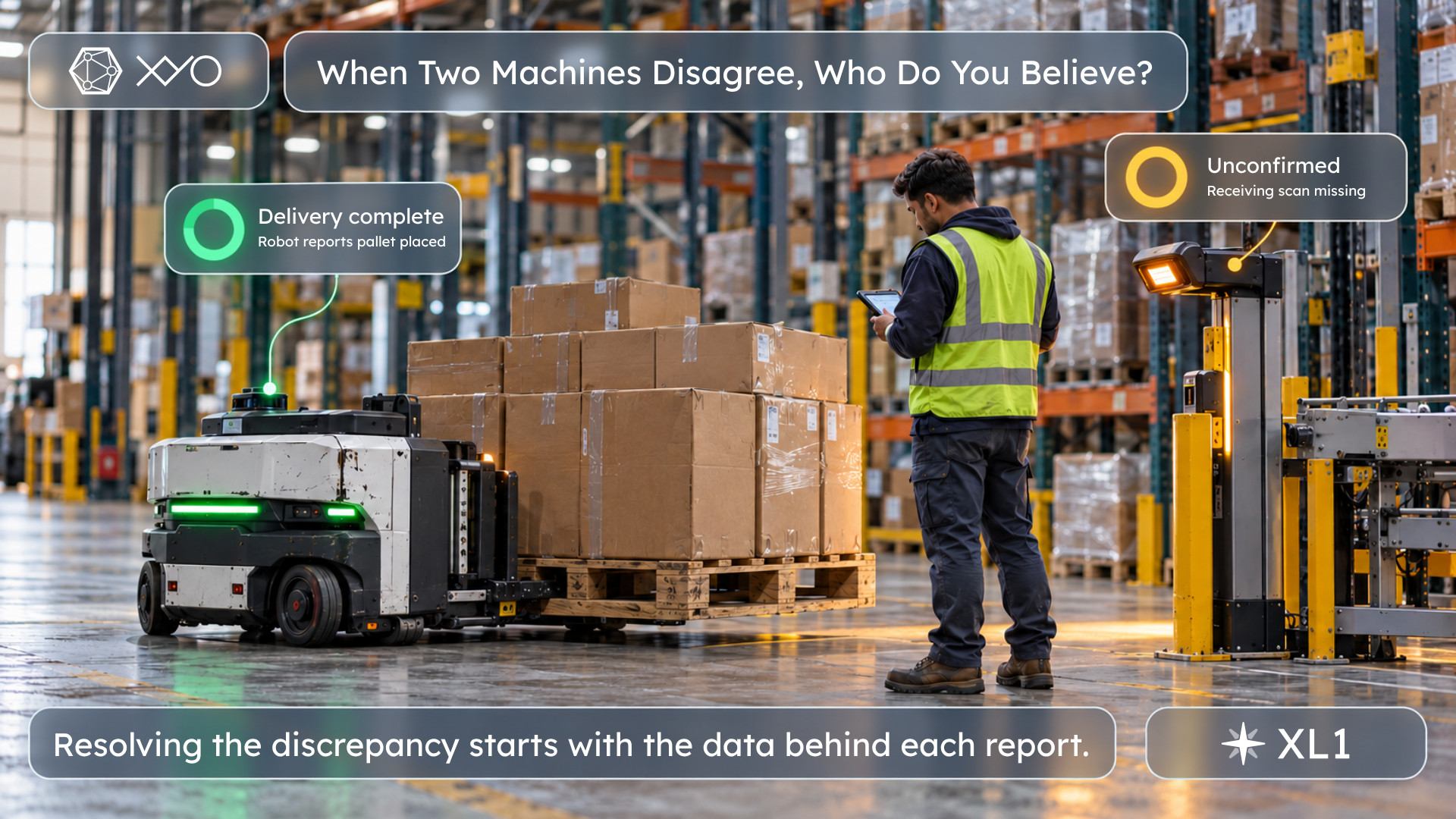
Imagine a warehouse robot carrying a pallet to a receiving bay. It reaches the assigned location, lowers its load, and marks the delivery complete. Across the building, the inventory system s
Imagine a warehouse robot carrying a pallet to a receiving bay. It reaches the assigned location, lowers its load, and marks the delivery complete. Across the building, the inventory system still lists the shipment as missing because the receiving scanner never registered it. Payment is held up while a warehouse manager investigates, with the robot’s operator pointing to its delivery record and the customer pointing to an empty inventory entry.
As businesses give machines more responsibility, these disagreements deserve attention. An automated system can finish its assigned task without giving another system enough information to recognize that completion. When the systems belong to different companies, resolving the discrepancy means reconstructing an event from records that were created for different purposes.
In this hypothetical delivery, the robot considers its work finished when it deposits the pallet within the designated receiving area. The inventory software recognizes delivery only after a scanner reads the pallet’s identifier. Those definitions usually produce the same outcome, which makes the difference easy to overlook until a scan fails.
Perhaps the robot placed the pallet with its label facing away from the scanner, or a worker moved it before the receiving process finished. The robot could also have stopped at the wrong bay. Each explanation requires a different response: a missed scan calls for an inventory correction, while a navigation error requires someone to find and move the shipment. Sending a replacement before establishing what happened could leave the customer with duplicate stock. The robot’s “complete” status offers too little detail to choose between those responses because it describes the system’s conclusion without explaining the observations behind it.
The investigation becomes more useful when the robot’s record identifies the pallet and connects it to a particular unloading event. An investigator can then compare that event with the receiving scanner’s history, accounting for differences in clocks or identifiers. A nearby device’s observation could help establish that the robot reached the bay, although arrival alone would leave open whether it unloaded the correct pallet.
That distinction matters when developers decide what their systems should report. A device that detects arrival should record arrival; accepting a shipment requires its own conditions. If software treats those events as interchangeable, a limited observation can become the basis for a decision it does not support. The same issue applies to the records’ origins. Investigators need to know which device supplied an observation and whether the record changed after the event, particularly when a dispute involves companies with separate systems and competing interests.
XYO’s focus on real-world data makes this coordination problem relevant to its technology. The network is designed to support verification of physical events, including asset movement and the presence of devices, with XYO Layer One providing infrastructure for permanent data validation.
Developers building a delivery application around that infrastructure could connect observations to the event under investigation and make the resulting records available for verification. They would still need to determine which devices contribute useful information and how much each observation establishes. Preserving a faulty sensor reading does not correct the sensor, and confirming a robot’s arrival does not establish that the customer accepted its load.
For the warehouse manager, the value would come from being able to narrow the investigation. Reconciling an unloading event with the receiving equipment’s history could reveal a missed scan and give the manager a basis for correcting the inventory entry.
An inventory system that treats the shipment as missing could place another order while payment software withholds the original invoice. By the time someone locates the pallet, a replacement might already be on its way. Developers can account for this by distinguishing a confirmed failure from an unresolved event, allowing a missing scan to trigger review before it triggers a reorder. That requires access to the relevant records and an agreed process for deciding when they are sufficient to proceed.
The appropriate response depends on the delivery. A business might automatically accept a low-value shipment once another receiving device corroborates its arrival, while requiring a person to review conflicting records for sensitive cargo.
In the warehouse example, resolving the dispute means locating the pallet and understanding why the receiving process missed it. Enough context attached to the delivery could let the manager correct the inventory and release payment without spending the afternoon asking two companies to export their logs.