Which EU Countries Are Crypto Firms Choosing for MiCA Licenses? — Source: CoinGape Germany leads Europe with over 50 MiCA licenses, making it the largest Crypto-Asset Service Provider (CASP)
Which EU Countries Are Crypto Firms Choosing for MiCA Licenses? — Source: CoinGape
- Germany leads Europe with over 50 MiCA licenses, making it the largest Crypto-Asset Service Provider (CASP) hub by volume.
- Luxembourg, Malta, and Ireland are attracting several global crypto giants, despite issuing fewer licenses than Germany.
- Block of Fame’s analysis of the ESMA register shows that crypto firms are prioritizing regulatory certainty and financial ecosystems over sheer license numbers.
MiCA Countries:- With the European Union’s Markets in Crypto-Assets (MiCA) regulation nearing its July 1 transition deadline, crypto firms are in a final race to secure licenses that will allow them to continue serving customers across Europe.
Under the European Union’s Markets in Crypto-Assets (MiCA) framework, crypto firms need just one authorization from an EU member state. This helps them passport their services across all 27 member nations.
But while the framework creates a single market for crypto, it also leaves firms with a crucial strategic decision: Which country’s regulator have most crypto firms choose?
The answer is far from straightforward.
Over the past year, several major crypto firms have adjusted their European licensing strategies as MiCA implementation gathered pace. Coinbase recently selected Luxembourg as the home of its European MiCA license. After withdrawing its MiCA application in Greece, Binance is seeking authorization in another EU member Spain.
There are other exchanges too that have explored or shifted between different jurisdictions before finalizing their applications. The varying approaches raise a broader question: Which EU countries are emerging as the preferred destinations for MiCA licenses?
To find out, Block of Fame team analyzed the European Securities and Markets Authority (ESMA) MiCA register. We complemented it alongside public announcements from leading crypto firms to map where the industry’s biggest players are obtaining their licenses.
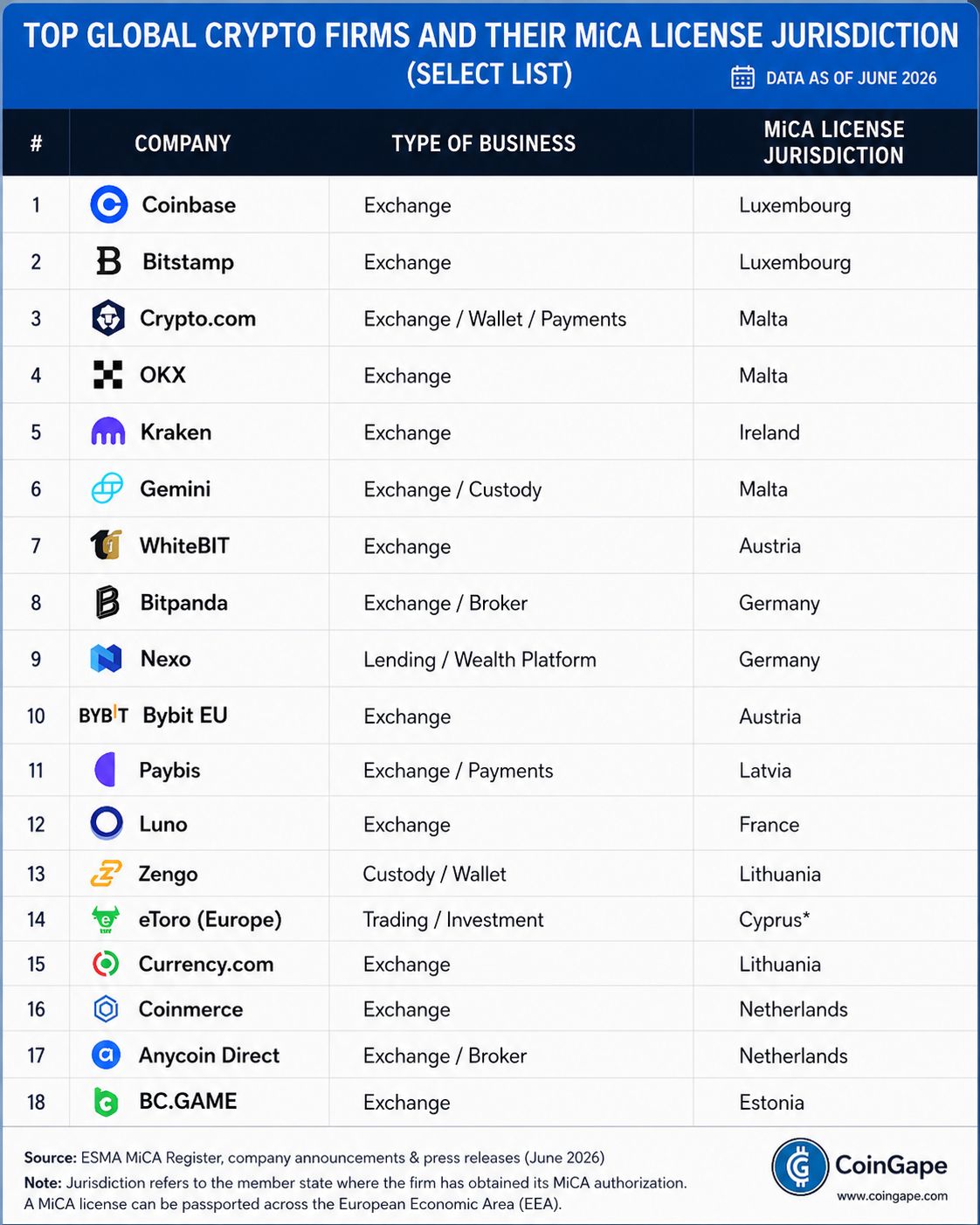
Source: ESMA Register
So, which countries are winning the MiCA race?
Germany Leads the Numbers
According to the latest European Securities and Markets Authority (ESMA) register, Germany has emerged as the largest MiCA licensing hub in Europe.
The country has issued approximately 53-54 MiCA authorizations, the highest among all EU member states. This makes it home to nearly one in every four licensed Crypto-Asset Service Providers (CASPs) across the bloc.
The Netherlands follows with around 25-26 licenses, while France and Malta have each issued roughly 12-13 authorizations.
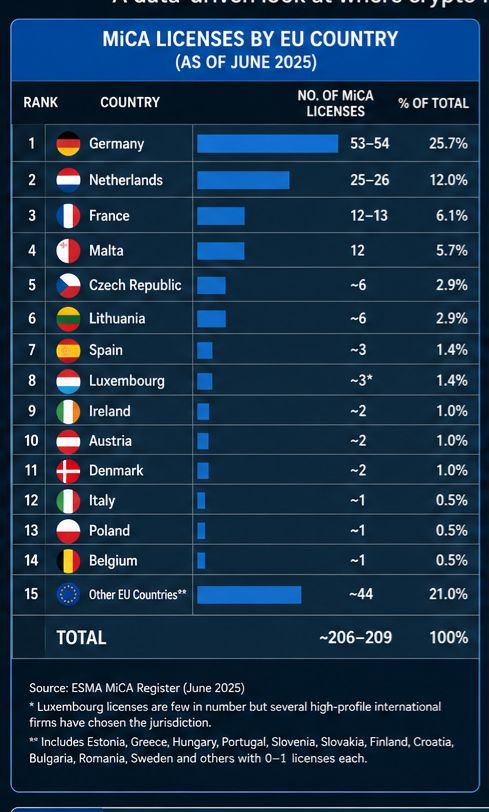
Overall, roughly 180-210 crypto firms have secured MiCA authorization across Europe. This is a surprisingly small number considering that more than 1,200 virtual asset service providers (VASPs) previously operated under national registration regimes before MiCA came into force. Infact, there are leading crypto firms left for MiCA license.
That means fewer than 20% of previously registered crypto businesses have transitioned to full MiCA authorization.
Why Germany Is Winning
Germany’s dominance is hardly accidental.
Its financial regulator, BaFin, has long supervised crypto custody businesses even before MiCA. As a result, many firms already operating under Germany’s regulatory framework found it easier to migrate into the new European regime.
Germany is also home to several established crypto infrastructure providers, institutional custody firms and fintech companies. That’s creating an ecosystem that naturally feeds MiCA applications.
But Numbers Don’t Tell the Whole Story.
While Germany leads by authorization count, some of Europe’s biggest crypto exchanges have opted for other jurisdictions.
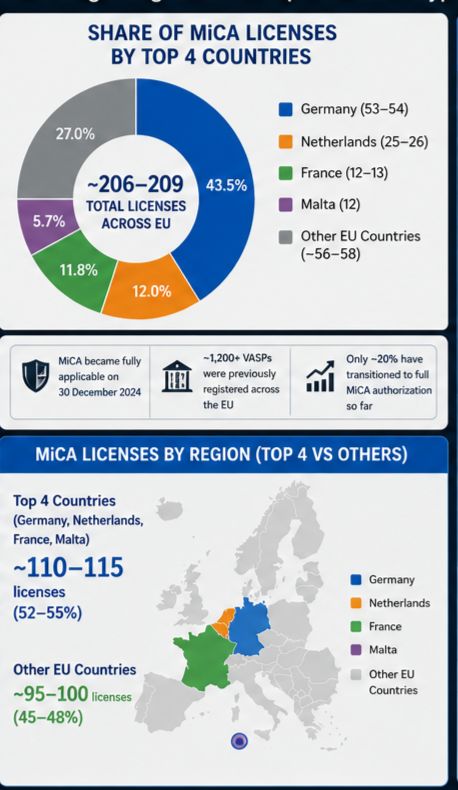
MiCA License countries
Luxembourg has emerged as an attractive destination for large international firms despite issuing far fewer total licenses. Its decades-long reputation as a cross-border financial hub, deep banking ecosystem and internationally respected regulator make it an appealing base for crypto firms.
Similarly, Malta continues to punch above its weight. Long regarded as one of Europe’s earliest crypto-friendly jurisdictions, it remains a preferred destination for several major exchanges despite issuing only about a dozen MiCA licenses so far. For example, Crypto.com, OKX have chosen Malta as their MiCA base. Ledger has chosen France. Similarly. Kraken has chosen Ireland.
Why MiCA is becoming a Highly Concentrated Market
Another striking trend is how concentrated MiCA licensing has become.
Germany, the Netherlands, France and Malta together account for well over half of all MiCA authorizations issued across Europe.
Meanwhile, several major EU economies, including Spain, Italy and Belgium, have issued comparatively few licenses despite having sizeable crypto markets.
Although a MiCA license grants access across the European Union, the choice of home regulator can significantly influence licensing timelines. It can decide supervisory expectations, banking relationships and long-term compliance costs.
Thus, chosing a MiCA license hub is as important as getting the license.
About the author
Which EU Countries Are Crypto Firms Choosing for MiCA Licenses? originally appeared on CoinGape