White House News: Why Is Washington Leaving AI Oversight to Industry? Forget a new federal watchdog agency, at least right now. The biggest White House News story this week is a flat rejectio
White House News: Why Is Washington Leaving AI Oversight to Industry?
Forget a new federal watchdog agency, at least right now. The biggest White House News story this week is a flat rejection of government-led oversight for artificial intelligence, straight from President Trump's top economic adviser, landing right as some of the loudest voices in tech are begging for guardrails.
What Hassett Actually Said
National Economic Council Director Kevin Hassett told CNBC's "Squawk Box" that the private sector, not federal regulators, is where risk from the technology should get solved.
His exact framing: these are "completely solvable problems", with industry itself capable of handling them without new government intervention.
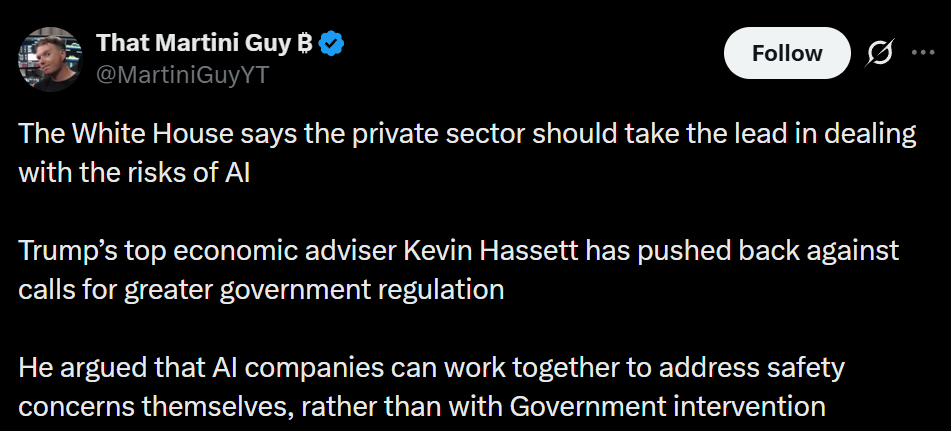
Source:MartiniGuyYT on X
Hassett didn't frame this as Washington stepping back entirely, either. He was careful to note the government still plays a watchdog role through existing law enforcement, just not through new rulemaking built specifically around the sector.
Private companies, not new agencies, should lead on safety
Existing law enforcement authority stays in place
No new federal bureaucracy is planned to approve these systems
The stance lines up directly with the president's public position
Trump Sets The Tone Himself
None of this is Hassett freelancing. Just days before the interview, President Trump used his social media platform to go after industry leaders and outside voices sounding alarms about their technology, framing those warnings as overblown rather than credible risk signals.
That timing matters for the White House News cycle unfolding right now. When the president publicly dismisses safety warnings, then his top economic adviser goes on national television days later reinforcing a hands-off regulatory stance, it reads less like coincidence and more like coordinated messaging.
Not Everyone Is On Board
Pushback arrived fast. Senate Intelligence Committee Vice Chairman Mark Warner directly challenged the administration's framing, arguing that reasonable guardrails and innovation aren't mutually exclusive and that treating any oversight as automatically anti-innovation doesn't hold up.
Warner's timing wasn't random either. He'd reportedly spoken over the weekend with Anthropic CEO Dario Amodei and OpenAI's Sam Altman, two industry leaders who've been among those pushing hardest for stronger safety frameworks, the same voices Hassett's private-sector argument is effectively betting on self-regulation.
Congress Isn't Rushing Either
Where Key Players Stand
Position
Kevin Hassett (NEC Director)
The private sector should lead; no new agency is needed.
President Trump
Publicly dismissive of safety warnings
Sen. Mark Warner (D-VA)
Guardrails and innovation can coexist.
House Speaker Mike Johnson
Backs White House; warns against "red tape"
Senate Leadership
Discussing a "path forward" on legislation, no fast timeline
Congress isn't moving fast either, and that hesitation is part of this White House News puzzle.
House Speaker Mike Johnson has publicly sided with the administration, cautioning that lawmakers instinctively reach for heavy regulation instead of letting industry move.
Senate leadership has floated conversations about a possible legislative path forward, but Congress adjourns for the year ahead of the November elections, making fast-moving legislation look unrealistic right now.
What This Means Going Forward
This doesn't happen in a vacuum. Internal deliberation sits behind it, weighing but so far holding back from a formal review process for advanced models, floated earlier in the year as something resembling FDA-style testing before public release. Right now, that idea remains just an idea, not policy.
The bigger picture here: Washington is betting the industry can grade its homework, at least through the rest of the year.
Whether that holds once Congress reconvenes after elections, or whether pressure from lawmakers like Warner grows into something more concrete, will define this White House News story going forward.
Disclaimer
This article is for educational and informational purposes only and should not be considered financial or investment advice. Always conduct your own research before making investment decisions.